

On this page
When you boil drinking water to prepare tea, mix infant formula, or purify water during a monsoon advisory in India, the cooled water often tastes dull or completely lifeless. Chemically pure water (H₂O) has no flavour, but fresh water drawn from a stream, well, or municipal tap tastes crisp and refreshing.
That difference comes from invisible solutes. Natural drinking water is a dilute solution carrying dissolved atmospheric gases and mineral electrolytes. Heating water to a rolling boil drives those dissolved gases out of solution. Understanding why this happens connects everyday kitchen science to gas solubility, thermodynamics, and solution equilibria.
Why does boiled water taste flat?
Water gets its clean, lively taste primarily from dissolved oxygen (O₂) and carbon dioxide (CO₂). Dissolved oxygen gives water a light mouthfeel, while carbon dioxide reacts with water to form trace carbonic acid:
CO₂(aq) + H₂O(l) ⇌ H₂CO₃(aq) ⇌ H⁺(aq) + HCO₃⁻(aq)
This mild acidity gives fresh tap water a faint, crisp tartness. Under the Bureau of Indian Standards IS 10500:2012 specifications, acceptable drinking water maintains a pH between 6.5 and 8.5 with an agreeable taste.
When water boils, both gases escape. Once cooled, the water contains almost no dissolved oxygen and virtually zero carbonic acid, leaving it tasting flat and lifeless.
What happens to dissolved oxygen and carbon dioxide when water boils?
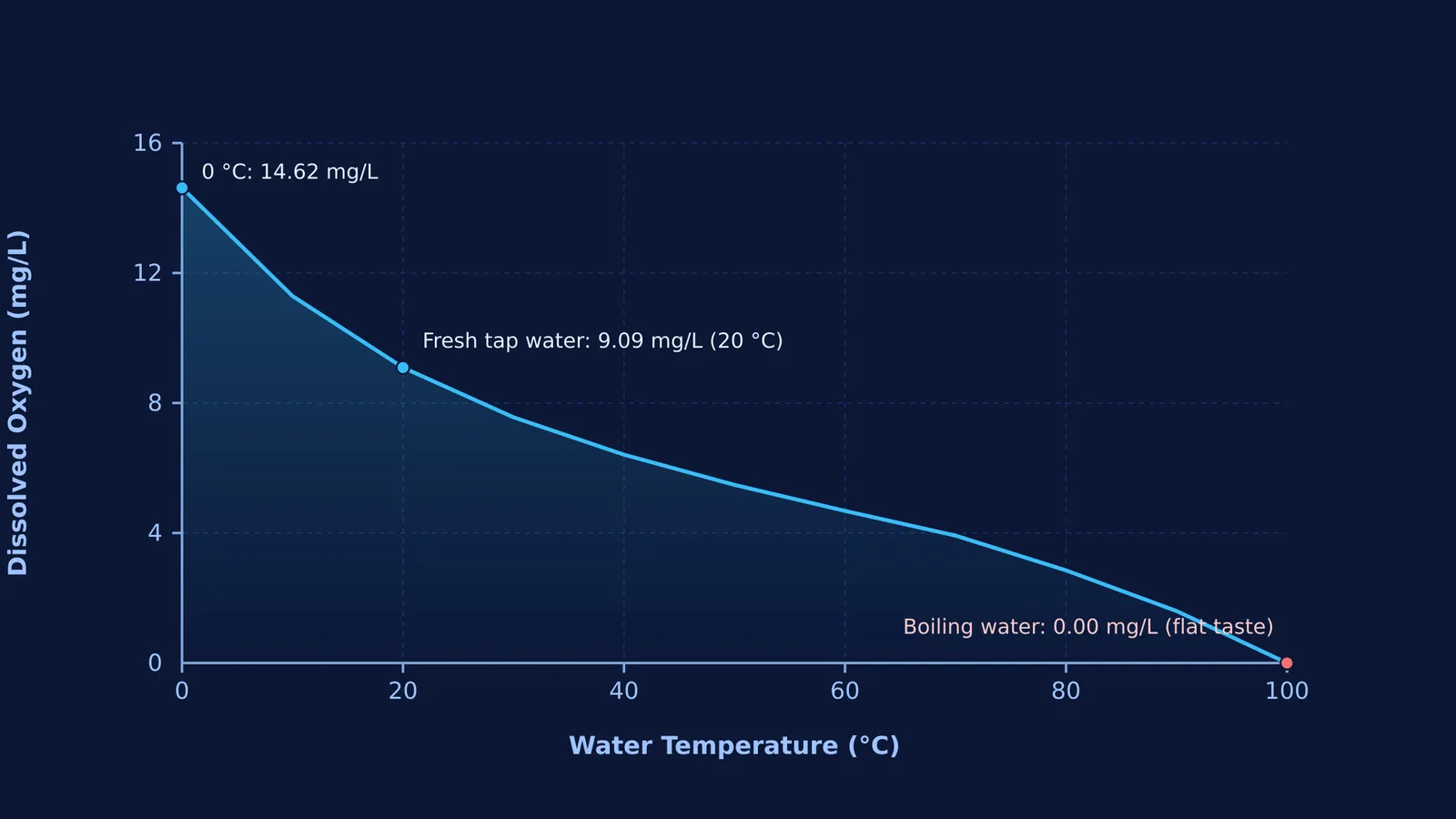
The loss of dissolved gases is dramatic and measurable. According to the U.S. Geological Survey Water Science School data on dissolved oxygen, fresh water at 0 °C holds 14.62 mg/L of dissolved oxygen at standard pressure (1 atm). At 20 °C, solubility drops to 9.09 mg/L, and at 25 °C it falls to 8.26 mg/L.
These saturation values, established by Bruce Benson and Daniel Krause in *Limnology and Oceanography* and implemented in the USGS DOTABLES program, follow a steep downward curve. At 40 °C, solubility drops to 6.41 mg/L, falling further to roughly 4.7 mg/L at 60 °C. At 100 °C, oxygen solubility reaches zero.
At the boiling point, steam bubbles nucleate throughout the liquid, sweeping dissolved O₂ and CO₂ out of solution. The steam plume above the surface displaces ambient air, driving the partial pressure of atmospheric gases at the liquid surface to near zero. Within 60 seconds of a rolling boil, dissolved oxygen and carbon dioxide are completely expelled.
Why does gas solubility decrease as water gets hotter?
Why do solids dissolve better in hot water while gases escape? Sugar dissolves faster in hot tea, yet heating expels gases. The answer lies in the thermodynamics of Henry's law and gas solubility.
In 1803, William Henry published his findings in the *Philosophical Transactions of the Royal Society*, showing that a dissolved gas's concentration C is proportional to its partial pressure P above the liquid (C = k × P). Crucially, dissolving a gas in water is exothermic (ΔH_sol < 0):
Gas(g) + H₂O(l) ⇌ Gas(aq) + Heat
Gas molecules lose translational freedom when solvated by water, causing an entropy drop (ΔS < 0). For dissolution to be spontaneous (ΔG = ΔH − TΔS < 0), enthalpy must be released.
By Le Chatelier's principle, supplying heat drives this exothermic equilibrium in reverse. Higher temperatures give dissolved gas molecules sufficient kinetic energy to break free and escape.
If you want to observe how kinetic energy disrupts weak solvent cages and drives dissolved gases into the vapor phase, the Fermi Simulation Lab offers interactive simulations for ideas that are easier to see than to read. For students practicing physical chemistry numericals on gas solubility and Henry's law constants, the Fermi Problem Library provides worked problems with a step-by-step solver that explains the reasoning rather than printing an answer.
Does mineral loss also change the mouthfeel of boiled water?
In hard-water areas, boiling also alters the solubility product and precipitation equilibria of dissolved minerals. According to the U.S. Geological Survey Water Science School data on water hardness, heating hard water decomposes dissolved bicarbonates into insoluble calcium carbonate scale:
Ca(HCO₃)₂(aq) → CaCO₃(s) + H₂O(l) + CO₂(g)
Because calcium carbonate has an extremely low solubility product (Ksp ≈ 3.3 × 10⁻⁹ at 25 °C), it precipitates as solid limescale on kettle walls. This strips calcium (Ca²⁺) and magnesium (Mg²⁺) ions that normally give water body and mouthfeel.
How can you restore the fresh taste of boiled water?
Boiling disinfects water, but drinking flat water is unappealing. The U.S. Centers for Disease Control and Prevention, the U.S. Environmental Protection Agency, and the World Health Organization all recommend aeration to restore taste.
Use this five-step checklist to revive boiled water:
Cool the water completely: Let the boiled water cool in a covered vessel to prevent contamination.
Aerate between two clean vessels: Pour the cooled water between two clean containers four to six times from a height of 20 to 30 cm. The cascading stream entrains air bubbles, creating a large surface area for atmospheric O₂ and CO₂ to redissolve.
Or shake in a clean bottle: Pour the cooled water into a clean bottle until half full, cap tightly, and shake vigorously for 15 seconds.
Add a tiny pinch of salt for mineral balance: If boiling precipitated heavy minerals, add a tiny pinch of salt (under 0.05 g per litre). As the EPA notes, this restores electrolyte mouthfeel without tasting salty.
Chill before drinking: Cold water holds more dissolved gas (11.29 mg/L at 10 °C versus 8.26 mg/L at 25 °C according to the USGS DOTABLES data) and delivers a crisp finish.


