

On this page
When you look at a mature banyan tree (*Ficus benghalensis*), you see thick, cable-like structures hanging from its branches. These are not vines draped over the tree, nor are they separate plants; they are a living, growing part of the banyan itself.
Why does a banyan tree have hanging roots?
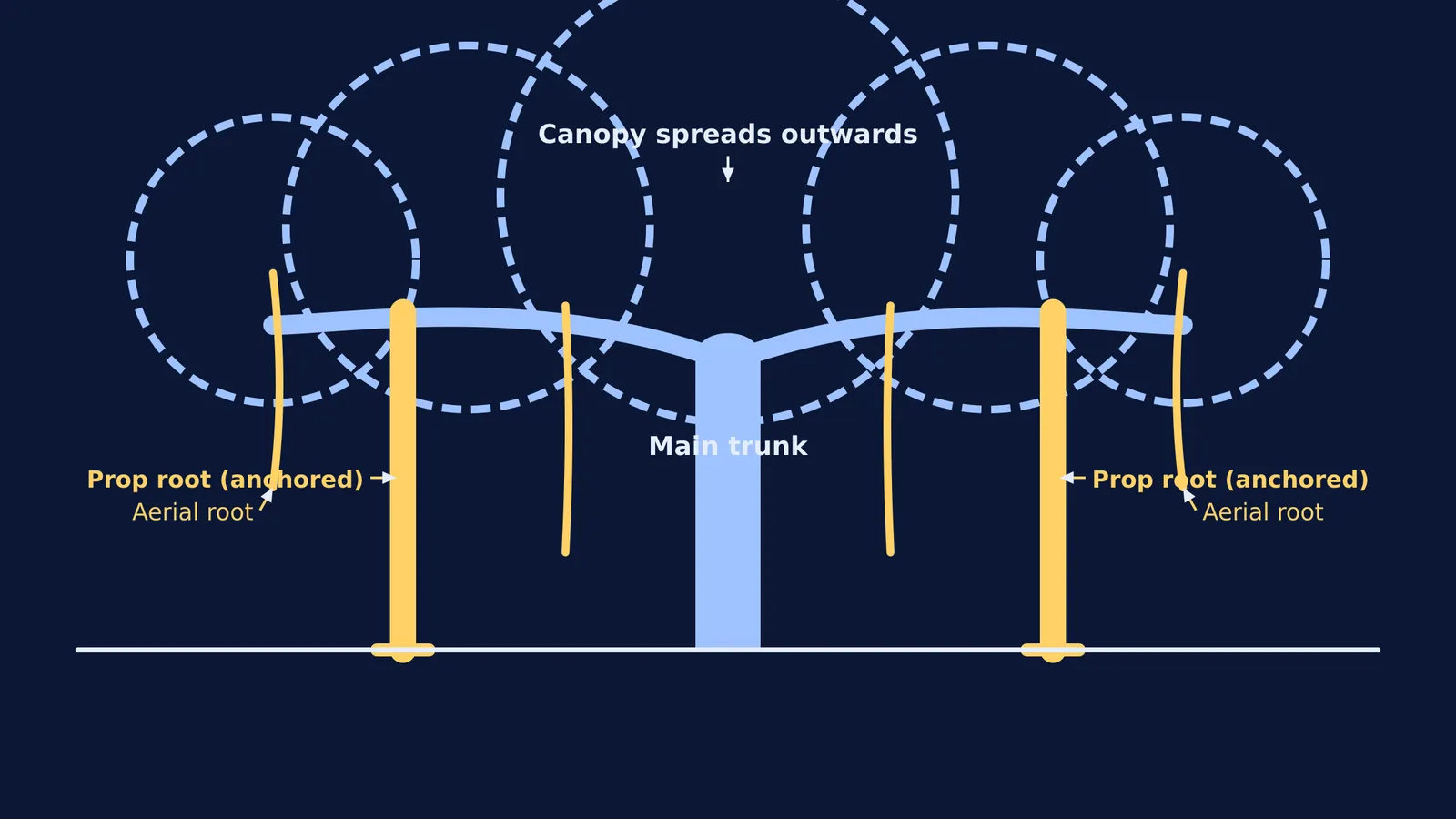
As a banyan tree grows, its horizontal branches spread far outward to capture maximum sunlight. This creates a severe structural problem: wood has its mechanical limits, and these massive, heavy branches would eventually snap under their own weight if left unsupported.
To solve this, the tree produces aerial roots directly from its branches. Normally, a plant's primary root system develops from the radicle of the seed. However, roots that arise from any other part of the plant—such as stems or leaves—are called adventitious roots. In the banyan tree, these adventitious roots emerge from the thick branches and hang in the air.
Driven by positive geotropism, which is the natural tendency of roots to grow downwards in response to gravity, they descend through the air towards the soil. You learn about this gravitational pull when studying geotropism and other tropic movements in Class 10.
What happens when aerial roots reach the ground?
While they are hanging in the air, these roots are relatively thin and flexible. However, when a hanging root finally touches the ground, a dramatic biological shift occurs. It penetrates the soil, anchors itself, and begins to absorb water and minerals just like a regular underground root.
More importantly, the root undergoes secondary growth. The cambium tissue inside the root becomes highly active, adding layers of vascular tissue that cause the root to thicken significantly. It turns into dense hardwood, covered in bark.
Botanists call these matured structures "prop roots" because they act exactly like architectural pillars propping up a heavy roof. With the immense weight of the branches now safely supported by these thick props, the banyan tree can continue spreading its canopy outward almost indefinitely.
If you are studying plant morphology, picturing how these structures grow and adapt can be difficult from a textbook alone. The Fermi Simulation Lab has interactive simulations for the ideas that are easier to see than to read, letting you observe how environmental factors like gravity and light shape plant development over time.
How big can a banyan tree grow?
Because prop roots allow the canopy to keep spreading without breaking, banyan trees can reach an enormous, woodland-like size. The most famous example is The Great Banyan, located in the Acharya Jagadish Chandra Bose Indian Botanic Garden in Shibpur, Howrah, near Kolkata.
This single specimen is estimated to be over 250 years old. It covers an astonishing area of 18,918 square metres (1.89 hectares), making it the widest tree in the world by canopy coverage.
In 1925, the Great Banyan's original main trunk became severely infected by a fungus after being damaged by cyclones, and botanists had to remove it to save the rest of the tree. Despite completely losing its primary trunk, the tree continues to thrive and expand today. It is kept alive and fully supported by its 3,772 prop roots. Walking underneath it feels like walking through a dense forest, even though every "trunk" you see is actually a modified root from a single individual plant.
Other types of root modifications
Roots do much more than simply grow underground to anchor the plant and absorb water; they frequently modify themselves to help the plant survive extreme environments. While banyans use prop roots to support heavy horizontal branches, other plant species have evolved different structural and functional strategies:
Stilt roots: Plants with tall, slender, jointed stems, such as maize and sugarcane, grow thin supporting roots obliquely downwards from their lower stem nodes. These act like guy-ropes on a tent to keep the tall plant from blowing over in the wind.
Pneumatophores: Trees growing in waterlogged, swampy soils, like mangroves (*Rhizophora*), face a unique problem: the mud lacks oxygen. To breathe, they send specialised roots vertically upwards into the air.
Storage roots: Plants like carrots, turnips and sweet potatoes have roots that swell up to store reserve food for the winter.
You can compare these specialized root strategies to stem modifications: tendrils, thorns, rhizomes and more, which serve similar survival purposes—such as climbing, defense, or storage—but originate from the shoot system rather than the root system.


