

On this page
Set up a simple circuit with a battery, a bulb, and a beaker of dilute hydrochloric acid, and the bulb will glow brightly. But try the same test with dry HCl gas, or even a solution of glucose, and the bulb stays dark.
If all three contain hydrogen, why does only one let the current flow? The answer comes down to one requirement for electrical conductivity in liquids: free-moving ions.
Why do acids conduct electricity in water?
To conduct an electric current, a liquid needs mobile charge carriers. In chemistry, these carriers are ions.
An acid is defined as a substance that increases the concentration of hydrogen ions (H⁺) when dissolved in water, according to CK-12's Arrhenius acid principles. When you mix hydrogen chloride gas with water, the polar nature of the water molecules becomes crucial. Water molecules have a slight negative charge on the oxygen atom and a slight positive charge on the hydrogen atoms. They surround the HCl molecule and pull it apart. The covalent bond breaks, releasing a hydrogen ion—which immediately joins a water molecule to form a hydronium ion, H₃O⁺—and a chloride ion (Cl⁻). The ions are now hydrated, meaning they are surrounded by a shell of water molecules that prevents them from recombining.
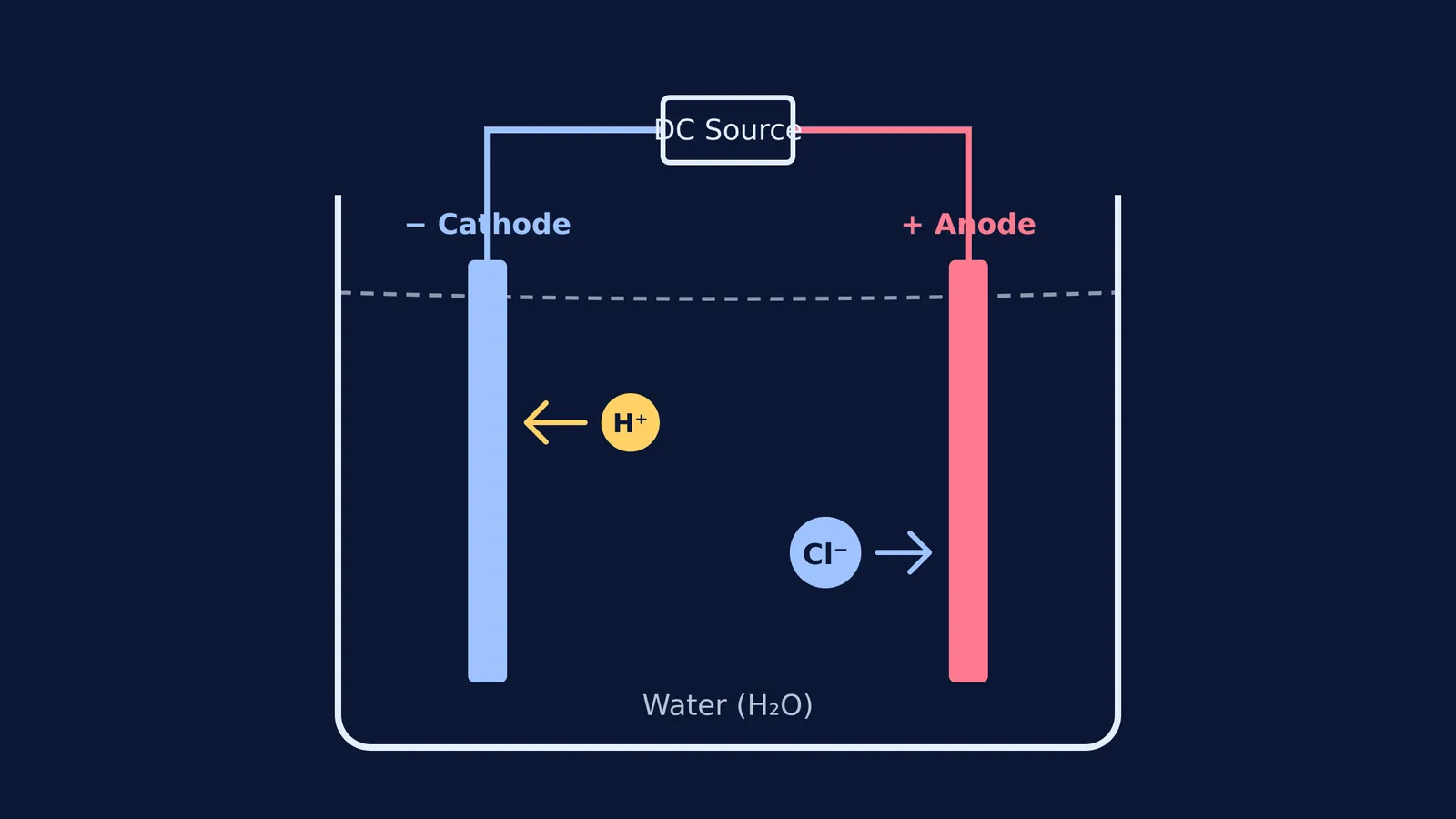
Because strong acids ionise completely, the water fills with mobile, charged particles. When a voltage is applied, these ions migrate toward the electrodes—cations to the negative cathode, anions to the positive anode—and the current flows.
If you find these definitions hard to keep straight while studying Arrhenius, Bronsted-Lowry and Lewis acids, the Fermi Concept Library covers every concept in physics, chemistry, biology, mathematics and computing.
Why does dry HCl gas not conduct electricity?
Dry HCl gas is made of covalent molecules. Although the bond between the hydrogen and chlorine atoms is polar, the electrons are shared, meaning there are no free ions or electrons to carry a current.
Without water to facilitate the ionisation process, dry HCl cannot dissociate into H⁺ and Cl⁻ ions, as explained in the NCERT Class 10 Science curriculum. Because there are no charged particles available to move, the dry gas acts as an insulator.
Why do glucose and alcohol not conduct electricity?
Glucose (C₆H₁₂O₆) and alcohol (such as ethanol, C₂H₅OH) both contain hydrogen atoms. However, they do not conduct electricity when dissolved in water.
These are covalent compounds. When they dissolve in water, they remain as intact, neutral molecules rather than breaking apart into positive and negative ions. The water molecules surround the glucose or alcohol molecules to dissolve them, but they are not strong enough to break the internal covalent bonds. As a result, the solution is filled with uncharged sugar or alcohol molecules suspended in water.
Because they do not release H⁺ ions or any other charge carriers into the solution, there is no pathway for the electric current to flow. This is why, in a standard conductivity experiment, dipping the electrodes into a glucose or alcohol solution leaves the bulb completely dark.
How do you solve conductivity questions?
When a homework or exam question asks whether a substance conducts electricity, use this three-step framework to find the answer:
Is it a metal or a solid conductor? Metals have a sea of free electrons that carry current.
Is it dissolved in water? If the substance is in a solid or dry gas state (like dry HCl or solid NaCl), its ions are locked in place or it remains molecular. It will not conduct.
Does it ionise? If it is in an aqueous solution, check if it breaks into ions (like strong acids, strong bases, and soluble acids, bases and salts in Class 10). Strong acids like sulfuric acid (H₂SO₄) and nitric acid (HNO₃) ionise completely, making them excellent conductors. Weak acids like acetic acid (CH₃COOH) ionise only partially, so their solutions conduct electricity poorly and make the test bulb glow dimly. If the substance stays as a neutral molecule (like glucose, alcohol, or distilled water), it will not conduct at all.
If you get stuck applying these rules to a specific reaction, Fermi's AI tutor can work out what you already know and build a plan for the session, so you sit down to a clear next step.


