

On this page
When a volleyball is hit with a perfect float serve, it doesn't spin. Instead of following a predictable parabolic arc, it dances, swerves and suddenly drops, leaving receivers scrambling.
This erratic movement is not magic; it is a direct result of the ball's aerodynamics. By hitting the ball without spin at a specific speed, the server forces the surrounding air into an unstable state known as the drag crisis.
This devastating technique is not new. The float serve was perfected on the world stage in the 1960s by the Japanese women's national team, famously dubbed the "Oriental Witches." Coached by Hirofumi Daimatsu, the team needed to overcome significantly taller opponents like the athletes from the Soviet Union. They developed an overhead serve hit with a rigid hand and an abruptly stopped follow-through to eliminate all spin. The resulting aerodynamic wobble baffled receivers who were used to powerful but predictable spin serves. This innovation helped Japan win the Olympic gold medal for women's volleyball at the 1964 Tokyo Olympics. Today, the fluid physics behind that gold-medal tactic is well understood by sports scientists.
What causes the drag crisis at critical speeds?
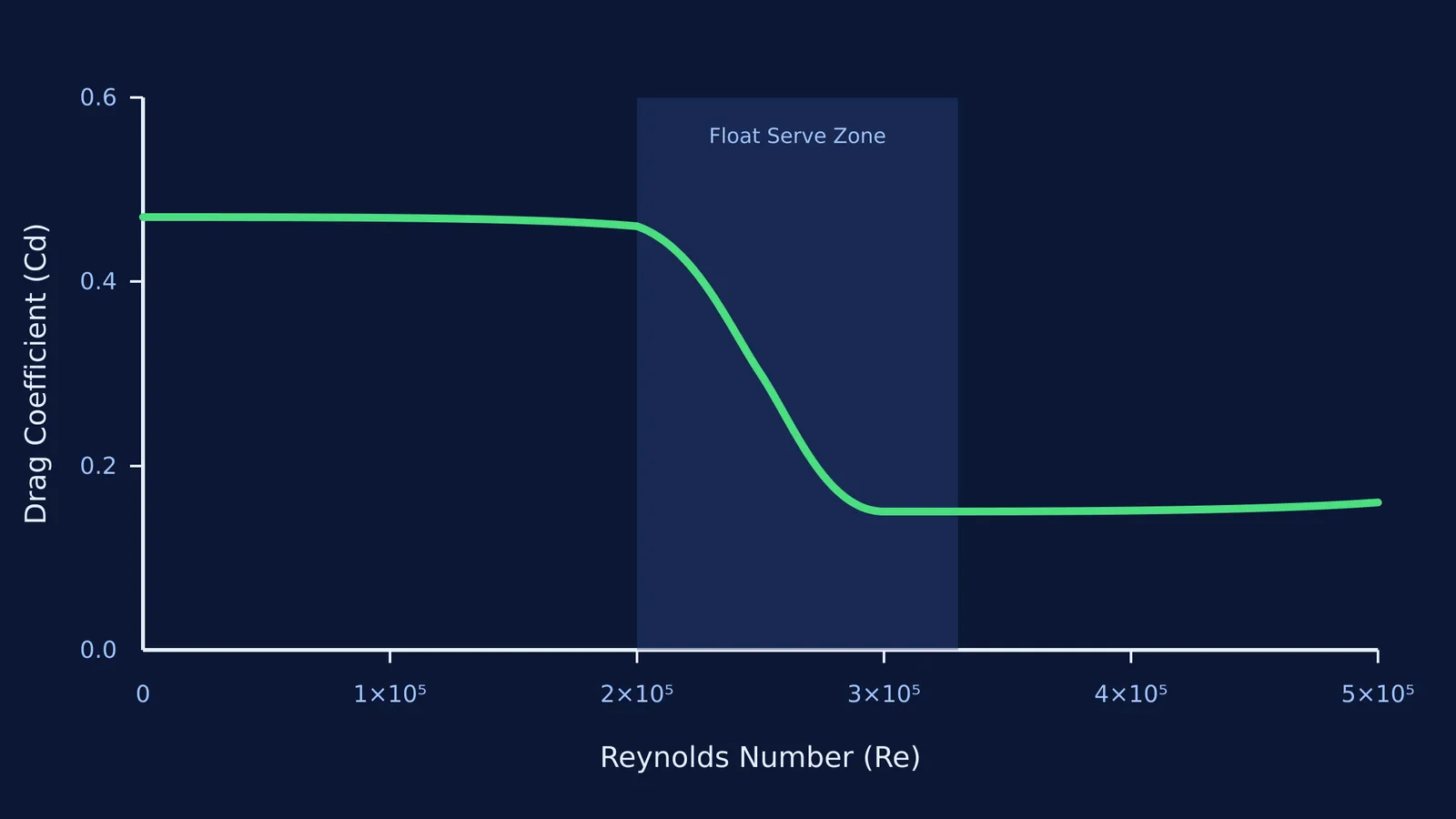
To understand how air moves around a ball, physicists use a dimensionless value called the Reynolds number, which compares inertial forces to fluid friction. At lower speeds, the air boundary layer around the volleyball is smooth and laminar. However, laminar flow is fragile. It lacks the energy to stay attached to the curving surface of the ball, so it separates early, near the ball's equator. This leaves a massive, low-pressure turbulent wake behind the ball, resulting in high aerodynamic drag that slows the ball down smoothly.
The critical Reynolds number where a standard volleyball experiences the drag crisis is between 2.0 × 10⁵ and 3.3 × 10⁵. At this threshold, the boundary layer of air becomes turbulent. Unlike laminar flow, a turbulent boundary layer mixes rapidly, drawing higher-energy air down to the surface. This extra kinetic energy allows the air to cling to the ball's curving shape much longer before finally detaching near the back. This drastically shrinks the size of the wake and causes the aerodynamic drag to plummet. For a standard volleyball, this aerodynamic shift typically occurs at a velocity of about 15 m/s, which perfectly matches the speed of a competitive float serve.
Why does a volleyball float serve wobble in the air?
The wobble happens because the transition from laminar to turbulent flow does not occur perfectly evenly across the ball's surface.
In a topspin or jump serve, the rapid rotation of the ball creates a consistent pressure difference that stabilizes its flight. In a float serve, the lack of spin means there is no such stabilization. As the ball moves through the air, its seams and panels act as tiny tripping points for the thin layer where fluid friction lives.
Because the ball is flying right at the edge of the drag crisis, the airflow might become turbulent on the left side but remain laminar on the right. This creates a highly asymmetric wake and sudden lateral pressure differences that push the ball sideways. Because the separation points of the air constantly shift across the panels, the direction of these forces fluctuates, resulting in the unpredictable wobble. This chaotic behavior is a classic example of turbulence in fluid flow. To see how airflow separates behind a sphere at different speeds and creates these forces, you can model it in the Fermi Simulation Lab.
Modern ball designs have attempted to tame this chaos slightly. Newer volleyballs, such as the Mikasa MVA200 used in recent Olympic games, feature dimpled surfaces or honeycomb patterns instead of purely smooth panels. These textures act as aerodynamic turbulators, much like the dimples on a golf ball. The dimples intentionally trip the boundary layer into turbulence at a slightly lower speed, shifting the critical Reynolds number down to roughly 2.2 × 10⁵. While this makes the drag drop more consistent and slightly stabilizes the overall flight path compared to older 18-panel balls, the highly asymmetric panel layout ensures the float serve still retains its signature, receiver-baffling dart.
How do you hit a float serve without spin?
To successfully trigger the drag crisis and make the ball wobble, the server must eliminate all rotational forces at contact.
Use a rigid hand: Strike the ball with the firm, flat heel of your palm rather than wrapping your fingers over the top.
Contact the centre: Hit the ball squarely through its dead centre. Any off-centre contact will impart spin, which stabilizes the wake and ruins the float effect.
Stop your follow-through: Unlike a spike where your arm swings all the way through, a float serve requires a sharp, "popping" motion. Stop your hand instantly upon contact to avoid rolling your wrist over the ball.
By mastering this technique and launching the ball near the 15 m/s threshold, you force the ball to do the aerodynamic work for you. If you want to explore the underlying flight equations further, you can start by learning projectile motion with a simulation.


