

On this page
A fast bowler running in with an old cricket ball can produce a famously difficult delivery: reverse swing. Instead of moving in the expected direction, the ball suddenly veers the "wrong" way late in its flight.
For decades, reverse swing was considered a dark art. Today, fluid dynamics gives us a precise mechanical explanation. It all comes down to the thin layer of air hugging the ball, known as the boundary layer, and how it behaves at high speeds on a worn surface.
If boundary layers and fluid pressure are hard to picture from text alone, the Fermi Simulation Lab lets you change flow speeds and watch how turbulence shifts the low-pressure zones on moving objects.
What makes a new ball swing?
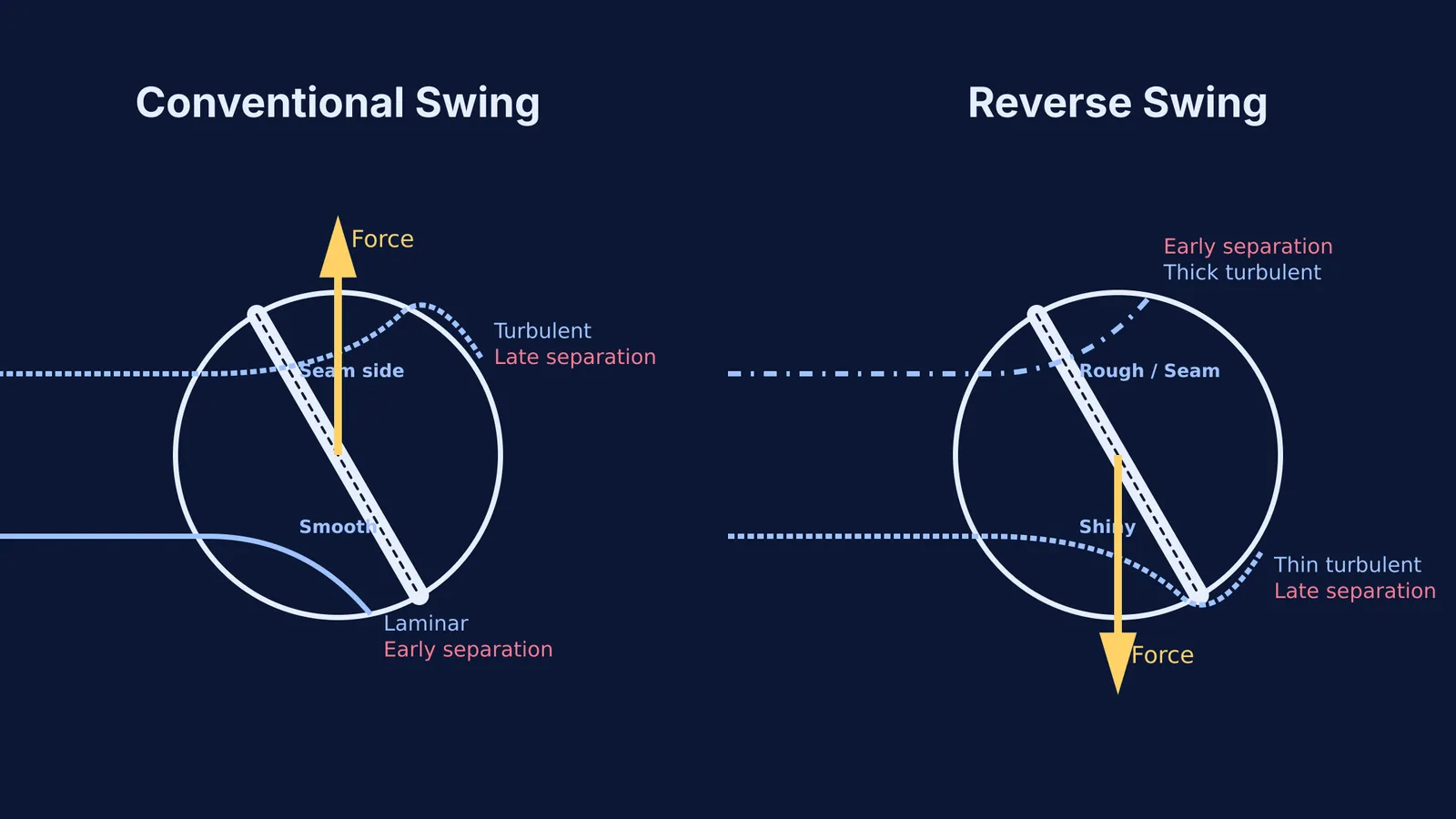
To understand reverse swing, you first need to know why a new ball swings conventionally. A cricket ball is mostly smooth but has a prominent raised seam. As wind tunnel experiments show, when a bowler delivers a new ball at around 105 to 110 km/h (65 to 70 mph) with the seam angled, the air splits into two paths.
On the smooth side, the air flows cleanly in smooth layers. This is called laminar flow. Because it lacks energy, laminar flow separates from the ball's surface relatively early.
On the seam side, the raised stitching acts like a tripwire. It disrupts the air, turning it into chaotic, swirling turbulent flow. This turbulent layer has more kinetic energy, allowing it to grip the curved surface of the ball for longer before separating.
Because the air stays attached longer on the seam side, it creates a lower-pressure zone there. The ball is pulled into this low-pressure zone, swinging toward the seam.
What is reverse swing and why does an old ball do it?
As a cricket match progresses, the ball gets battered. Fielding teams deliberately keep one side perfectly polished and shiny by rubbing it on their trousers, while letting the other side scuff up naturally.
According to research by NASA aerodynamicist Rabindra Mehta (Mehta, 2005), this roughness fundamentally changes the boundary layer. When the ball is old and rough, or when it is bowled at very high speeds, the air on *both* sides of the ball becomes turbulent before it even reaches the seam.
In this fully turbulent state, the seam no longer acts as a tripwire. Instead, it becomes an obstruction. As the turbulent air hits the seam, the boundary layer thickens significantly. A thick turbulent layer is unstable, causing the airflow on the seam side to separate *earlier* than it would on a smooth surface.
Meanwhile, the turbulent air on the smooth, shiny side remains thin and stays attached to the ball longer. The low-pressure zone is now on the shiny side, and the ball swings in that direction—away from the seam. This is reverse swing.
Just as Gustav Magnus and the physics of a spinning ball's curve explains how spin shifts air pressure, reverse swing shows how surface roughness shifts the separation points of the boundary layer.
How does speed affect reverse swing?
Speed is the critical ingredient. Mehta's wind tunnel tests (Mehta, 2005) showed that even a brand-new ball can reverse swing if it is bowled fast enough—typically upwards of 145 km/h (90 mph). At that extreme pace, the air becomes turbulent on both sides simply due to the velocity.
However, a rough surface lowers the speed threshold required to trigger this turbulence. By roughening one side of an old ball, a bowler can achieve reverse swing at around 110 to 115 km/h (70 mph). If you are looking at the Equation of trajectory of a projectile: finding u and θ from it, reverse swing adds a dynamic lateral force that changes continuously as the ball slows down in flight.
How do you set up a ball for reverse swing?
If you want to try this on the pitch, here is a practical checklist for preparing the ball:
Assign a dedicated shiner: A single player should polish the ball to keep the wear consistent.
Keep one side smooth: Polish one side vigorously on your trousers to keep it as shiny as possible.
Let the other side wear: Allow the opposite side to scuff up naturally on the pitch. Do not shine it.
Keep it dry: Keep sweat and moisture off the rough side so it remains abrasive.
Bowl fast: Deliver the ball at your maximum pace with the seam angled slightly toward the slips or fine leg.


