

On this page
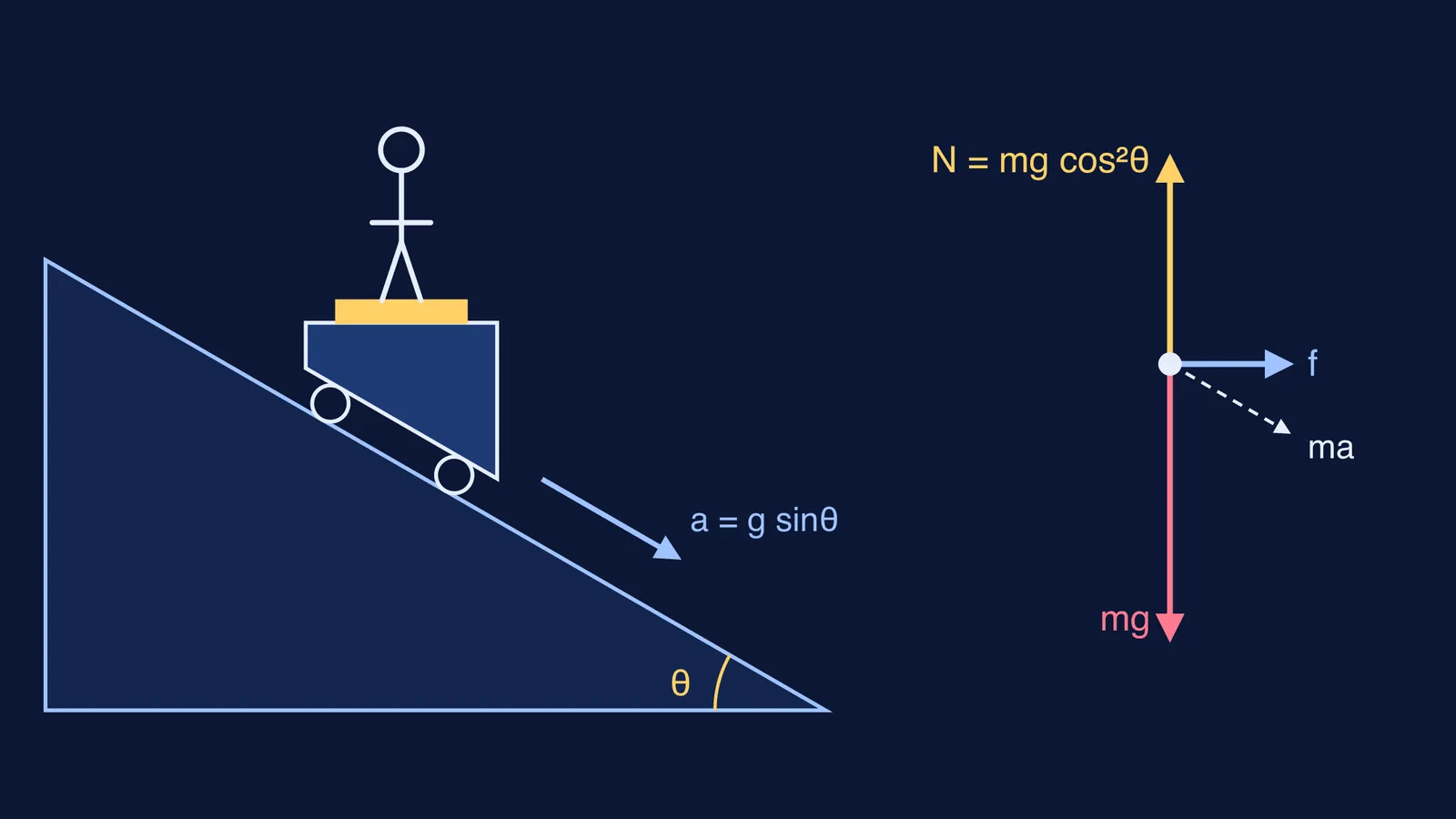
A common JEE-style question puts a person on a weighing machine fixed to a trolley sliding down a frictionless incline. Most students write mg cos θ, the normal force from the block-on-incline chapter. For a horizontal scale, the correct reading is mg cos²θ.
What does a weighing scale actually measure?
A scale does not measure gravity; it measures how hard it pushes up on you. In OpenStax's University Physics, section 6.1, a person on a scale in a lift reads more than their weight while the lift accelerates upward, and exactly their weight at constant velocity.
So the rule is: scale reading = normal force from the scale. A scale marked in kilograms shows that force divided by g. Our post on the weighing machine reading in a lift builds the same idea step by step.
Why does the scale read mg cos²θ on a sliding trolley?
On a frictionless incline, a body slides down with acceleration g sin θ, as HyperPhysics on the frictionless incline states. The person moves with the trolley, so they also accelerate at g sin θ along the slope. Now look only at the person on the flat top of the scale.
Forces on the person: weight mg down, normal force N up from the scale, and friction f horizontally from the scale's surface.
Split the acceleration g sin θ into vertical and horizontal parts. The vertical part is (g sin θ)(sin θ) = g sin²θ, pointing down. The horizontal part is g sin θ cos θ.
Vertical equation: mg − N = m g sin²θ. So N = mg(1 − sin²θ) = mg cos²θ.
Horizontal equation: f = mg sin θ cos θ. Without this friction, the person would slip on the scale.
Check it from the trolley's frame: add a pseudo force mg sin θ up the slope. Its vertical part, mg sin²θ, pushes up on the person, so the scale supplies the rest: mg − mg sin²θ = mg cos²θ. If pseudo forces feel shaky, read our explainer on pseudo forces in non-inertial frames.
Worked example: a 60 kg student on a 30° slope
The reading is the normal force (OpenStax section 6.1); take g = 9.8 m/s².
Weight: mg = 60 × 9.8 = 588 N.
cos 30° = 0.866, so cos²30° = 0.75.
Normal force: N = 0.75 × 588 = 441 N. A kilogram scale shows 441 ÷ 9.8 = 45 kg.
Friction needed on the feet: f = 588 × 0.5 × 0.866 ≈ 255 N, pointing horizontally toward the downhill side.
At other angles, the reading is 60 cos²θ kg:
θ = 0°: 60 kg (flat ground).
θ = 30°: 45 kg.
θ = 45°: 30 kg.
θ = 60°: 15 kg.
θ = 90°: 0 kg (free fall, the scale reads nothing).
The 90° case is a good sanity check: any correct formula must give zero in free fall.
Is the reading mg cos θ or mg cos²θ? A quick decision list
Before you write a formula, ask these questions.
Is the trolley accelerating? If it is held at rest or moving at constant velocity, the reading is mg. This matches the constant-velocity case in OpenStax.
Is the scale's top horizontal, on a smooth incline? The reading is mg cos²θ, and the scale's surface must supply friction mg sin θ cos θ.
Is the scale's top parallel to the incline, so you stand tilted? Then you are like a block on the slope. OpenStax section 5.6 gives N = mg cos θ for an object sliding on an inclined plane, so the reading is mg cos θ and no friction is needed.
Is the incline rough? Find the trolley's acceleration a first, then use N = m(g − a sin θ) for a horizontal scale.
Most wrong answers skip questions 2 and 3. Our guide to resolving forces on an incline shows when to split along the slope and when to split vertically and horizontally.
How do you avoid this mistake in JEE problems?
Treat every apparent-weight question the same way: write the system's acceleration, isolate the body on the scale, and apply Newton's second law along the normal force. The lift and the sliding trolley are the same problem with different accelerations.
If you keep landing on mg cos θ, the gap is usually in setting up axes, not algebra. The Fermi Problem Library has worked problems with a step-by-step solver that explains the reasoning rather than printing an answer, so you can see where your free-body diagram went off track. For the underlying ideas, the Fermi Concept Library covers every concept in physics, chemistry, biology, mathematics and computing, each with its own lesson.
Try it now: work out the reading for a 50 kg person at 37°, using cos 37° ≈ 0.8. You should get 32 kg.


