

On this page
When you turn on a garden hose attached to a rotary lawn sprinkler, the arms immediately begin to spin, scattering water across the grass. This simple device is a perfect demonstration of two fundamental concepts in mechanics: Newton's third law of motion and reaction torque.
If you are preparing for the JEE or a Class 11 physics exam, questions about rotating sprinklers or fluid momentum are common. Understanding the exact forces at work will help you solve them without memorising isolated formulas.
Why does a lawn sprinkler rotate?
The spinning motion of a sprinkler is driven by jet propulsion, exactly like a rocket.
According to the OpenStax *University Physics* textbook, Newton's third law of motion states that whenever one body exerts a force on a second body, the first body experiences a force that is equal in magnitude and opposite in direction to the force that it exerts.
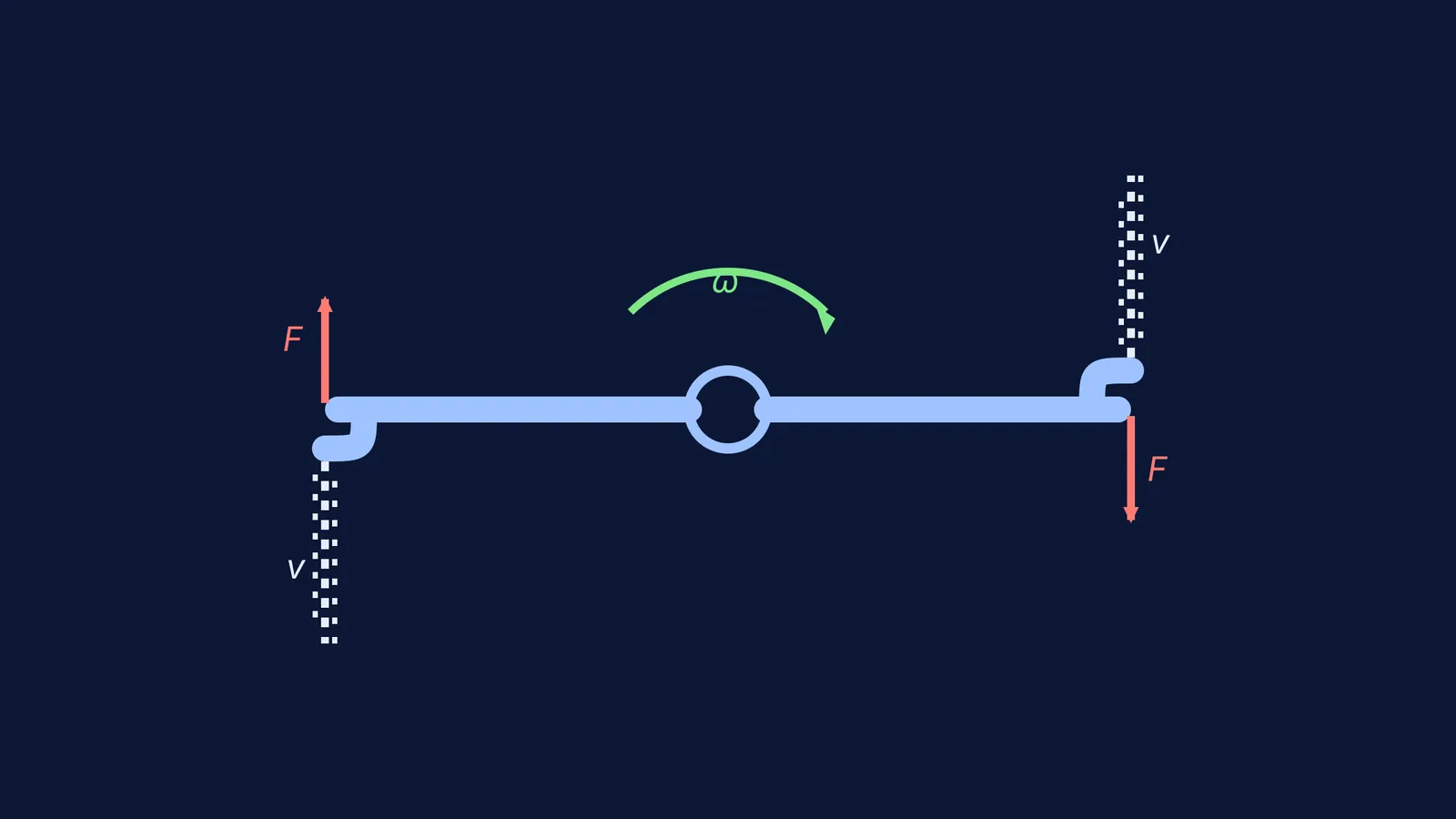
In a sprinkler, the water pressure forces a jet of water out of the nozzle at a high speed. As this water is accelerated out of the opening, it carries momentum away from the sprinkler. To conserve momentum, the water pushes back on the nozzle with an equal and opposite reaction force. Because the nozzle is located at the end of an arm, this backward push causes the entire arm to move away from the water jet.
If you struggle to break down these momentum problems into their vector components, the Fermi Problem Library has a step-by-step solver that explains the reasoning rather than just printing an answer.
How do you calculate the reaction force?
To find the force pushing back on the sprinkler, you need to look at the rate at which the water's momentum changes.
Imagine water flowing out of a nozzle with a cross-sectional area A at a relative velocity v.
The volume of water leaving the nozzle every second is A × v.
The mass of this water per second (mass flow rate) is ρ × A × v, where ρ is the density of the water.
Since force is the rate of change of momentum (dp/dt), you multiply the mass flow rate by the velocity of the water.
This gives the reaction force F on each nozzle: F = ρAv²
This force pushes directly against the nozzle, opposite to the direction of the water spray.
How does reaction force create torque?
A force alone only pushes an object in a straight line. For the sprinkler to spin, that force must create a turning effect about the central pivot.
OpenStax defines torque as the cross product of the position vector and the force applied. The magnitude of this torque is τ = rF, assuming the nozzle is bent at exactly 90 degrees to the arm.
If a sprinkler has two identical arms, each of length r, and they both eject water at the same speed v, the total reaction torque driving the sprinkler is: Total Torque = 2 × r × (ρAv²)
This torque accelerates the sprinkler, causing it to spin faster and faster. In a real garden, friction in the central bearing and air resistance eventually balance this torque, and the sprinkler reaches a steady, constant rotation speed.
If you are revising these concepts for an exam, you might find our guide on avoiding common rotational motion mistakes helpful for preventing standard errors in torque calculations.
What happens in a frictionless sprinkler?
A classic physics thought experiment asks: what is the maximum speed a sprinkler can reach if there is absolutely zero friction?
If there is no friction to hold it back, the reaction torque will keep accelerating the arms. However, as the arms spin faster, the nozzle itself is moving backwards relative to the ground. The absolute velocity of the water in the air is the speed of the jet *minus* the backward speed of the nozzle (ωr).
The sprinkler accelerates as long as the water carries forward momentum away.
When the backward speed of the nozzle exactly matches the forward speed of the water jet (v = ωr), the water's horizontal speed relative to the ground becomes zero.
At this exact speed, the water simply falls straight down.
Because the water no longer carries any horizontal momentum away, the reaction force drops to zero.
The sprinkler has reached its maximum angular velocity, ω = v / r.
Visualising how these relative velocities cancel out can be tricky. You can read our guide on the motion of a bead on a rotating rod to explore a similar rotating system, or build a mental model of how moving frames work.
By tracing the momentum from the water jet to the reaction force and finally to the torque, you can master not just the sprinkler problem, but any question involving fluid propulsion.


