

On this page
Many problems ask you to find a vector that points in the exact same direction as a given vector, but has a specific length—such as 5. This requires separating the vector's direction from its magnitude.
Why separate magnitude and direction?
In physics and advanced mathematics, you often know the direction of a force or velocity from geometry, but you need to set its magnitude independently based on physical laws. For instance, if an object slides down a ramp, the friction is parallel to the ramp. If you have a position vector pointing down the ramp, normalise it to get the pure direction. Then, if the friction force has a magnitude of 5 Newtons, scale that unit vector by 5 to find the complete force vector.
By separating the magnitude from the direction, you can solve complex multi-dimensional problems one piece at a time. This is why mastering normalisation is so crucial.
How do you find a vector of a given magnitude in a given direction?
Finding a vector of specific magnitude in a given direction is a two-step process: normalisation and scaling.
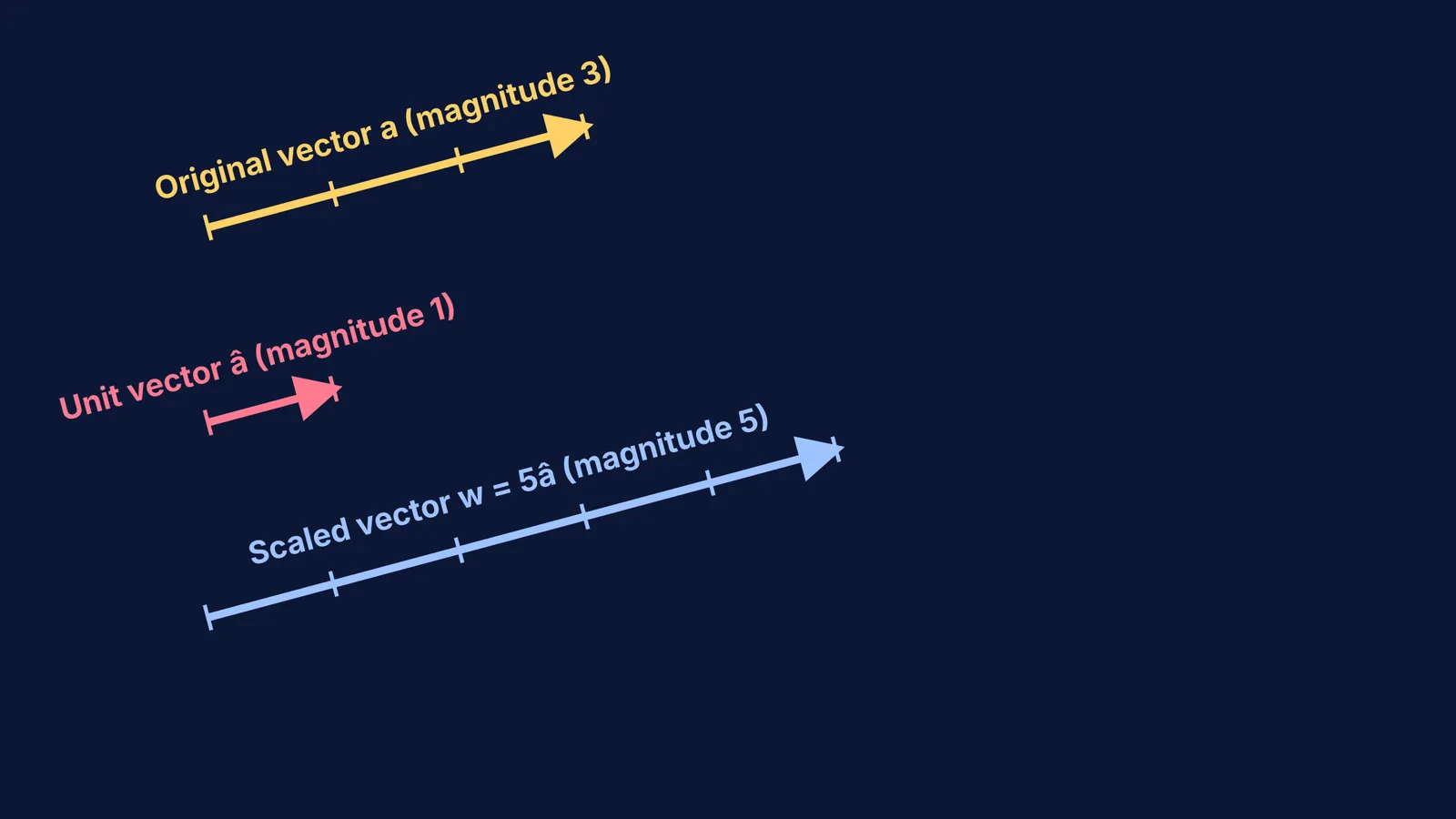
First, you must find the unit vector, often written as â (pronounced "a hat"). A unit vector is defined as a vector with a magnitude of 1 (OpenStax). A unit vector â in the same direction as a non-zero vector a can be found by multiplying a by the reciprocal of its magnitude: â = a / |a|. This process is called normalisation.
Second, you scale the unit vector to the desired magnitude. To create a vector w with a magnitude of 5 in the same direction, you simply multiply the unit vector by 5: w = 5â.
Worked Example 1: 3D vector of magnitude 5
Let's find a vector of magnitude 5 in the direction of the vector a = i + 2j - 2k.
Step 1: Find the magnitude of the original vector The magnitude |a| is the square root of the sum of the squares of its components. |a| = √(1² + 2² + (-2)²) |a| = √(1 + 4 + 4) |a| = √9 = 3
Step 2: Find the unit vector â Divide the original vector by its magnitude. â = (1/3)(i + 2j - 2k) â = (1/3)i + (2/3)j - (2/3)k
Step 3: Multiply by the desired magnitude To get a magnitude of 5, multiply the unit vector â by 5. w = 5 × â w = 5 × [(1/3)i + (2/3)j - (2/3)k] w = (5/3)i + (10/3)j - (10/3)k
This new vector w points in the exact same direction as a, but its length is exactly 5.
When you use dimensions to check your physics answers or verify vector magnitudes, you catch calculation errors early.
Worked Example 2: 2D vector of magnitude 10
Sometimes you will work purely in two dimensions. Let's find a vector of magnitude 10 in the direction of b = 3i + 4j.
Step 1: Find the magnitude |b| = √(3² + 4²) |b| = √(9 + 16) |b| = √25 = 5
Step 2: Find the unit vector b̂ = (1/5)(3i + 4j) b̂ = (3/5)i + (4/5)j
Step 3: Scale to magnitude 10 v = 10 × b̂ v = 10 × [(3/5)i + (4/5)j] v = 6i + 8j
This confirms our logic: since the original vector had a magnitude of 5, and we wanted a magnitude of 10, we effectively doubled the original vector. Finding the unit vector first guarantees the method works no matter the numbers.
What if you need a vector in the opposite direction?
Sometimes a question asks for a vector of magnitude 5 in the opposite direction of a given vector a.
The process is identical, except you multiply the unit vector by a negative scalar. The opposite direction is represented by a negative sign. So, instead of multiplying â by 5, you multiply it by -5.
For our first example (a = i + 2j - 2k), the vector of magnitude 5 in the opposite direction would be: v = -5â = -(5/3)i - (10/3)j + (10/3)k
This flips the vector 180 degrees while preserving the length.
Common mistakes when normalising vectors
When you solve physics problems step by step, scaling vectors is a frequent source of errors. Watch out for these common slips:
Forgetting the square root: When calculating the magnitude |a|, some students sum the squares but forget to take the square root at the end. In our first example, they might use 9 instead of 3, throwing off all subsequent steps.
Dividing only one component: To normalise a vector, you must divide every component (the i, j and k terms) by the magnitude. Missing one component immediately changes the direction of the vector.
Adding instead of multiplying: To scale a vector from magnitude 1 to magnitude 5, you must multiply the components by 5. You cannot simply add 5 to the components, as this will change the vector's angle.
If you are unsure whether you have set up a vector problem correctly, the Fermi Problem Library has worked problems with a step-by-step solver that explains the reasoning rather than printing an answer. This helps you verify each stage of your working and ensure you have perfectly preserved the original direction.


