

On this page
In a standard Daniell cell, zinc oxidises at the anode and copper ions reduce at the cathode to produce an electromotive force (EMF) of 1.10 V. According to the NCERT Class 12 chemistry syllabus, this voltage occurs only when both zinc sulphate and copper sulphate solutions are exactly 1 M at 298 K. In practice, electrolyte concentrations shift as current flows or when solutions are diluted in the laboratory.
Measuring the variation of cell potential with concentration is a core Class 12 practical. It provides physical proof of the Nernst equation, showing how electrical energy responds to changes in ion concentration.
Why does cell potential change with concentration?
The Nernst equation relates cell potential (E_cell) to standard potential (E°_cell) and the reaction quotient. For the Daniell cell reaction, Zn(s) + Cu²⁺(aq) → Zn²⁺(aq) + Cu(s), two electrons transfer (n = 2). At 298 K, the electrochemistry formulation simplifies to:
E_cell = 1.10 − (0.059 / 2) log ([Zn²⁺] / [Cu²⁺])
Increasing cathode concentration: Raising [Cu²⁺] increases the denominator, making the log term negative. This turns the minus sign positive, raising E_cell above 1.10 V.
Increasing anode concentration: Raising [Zn²⁺] increases the numerator, making the log term positive. Subtracting this from 1.10 V lowers E_cell.
If connecting textbook formulas to laboratory glassware feels difficult, the Fermi Concept Library can help you bridge the gap. It maps out every concept in chemistry with its own lesson and its place in the concept map, showing how thermodynamic principles govern cell potential.
How do you set up the Daniell cell practical?
According to the NCERT Class 12 Chemistry Lab Manual, you measure this variation by diluting the copper sulphate solution from 1.0 M down to 0.001 M while holding zinc sulphate constant at 1.0 M:
Clean zinc and copper strips with sandpaper to remove surface oxides.
Pour 50 mL of 1.0 M ZnSO₄ into a beaker and immerse the zinc strip.
Pour 50 mL of 1.0 M CuSO₄ into a second beaker and immerse the copper strip.
Insert a salt bridge filled with agar-agar and KCl or KNO₃ between both beakers, ensuring no air bubbles are trapped.
Connect the zinc anode to the negative terminal and copper cathode to the positive terminal of a high-resistance voltmeter, then record the EMF.
Empty and rinse the copper beaker, refill it with 50 mL of 0.1 M CuSO₄, and record the voltage. Repeat for 0.01 M and 0.001 M CuSO₄ solutions.
How do you plot the Nernst equation graph?
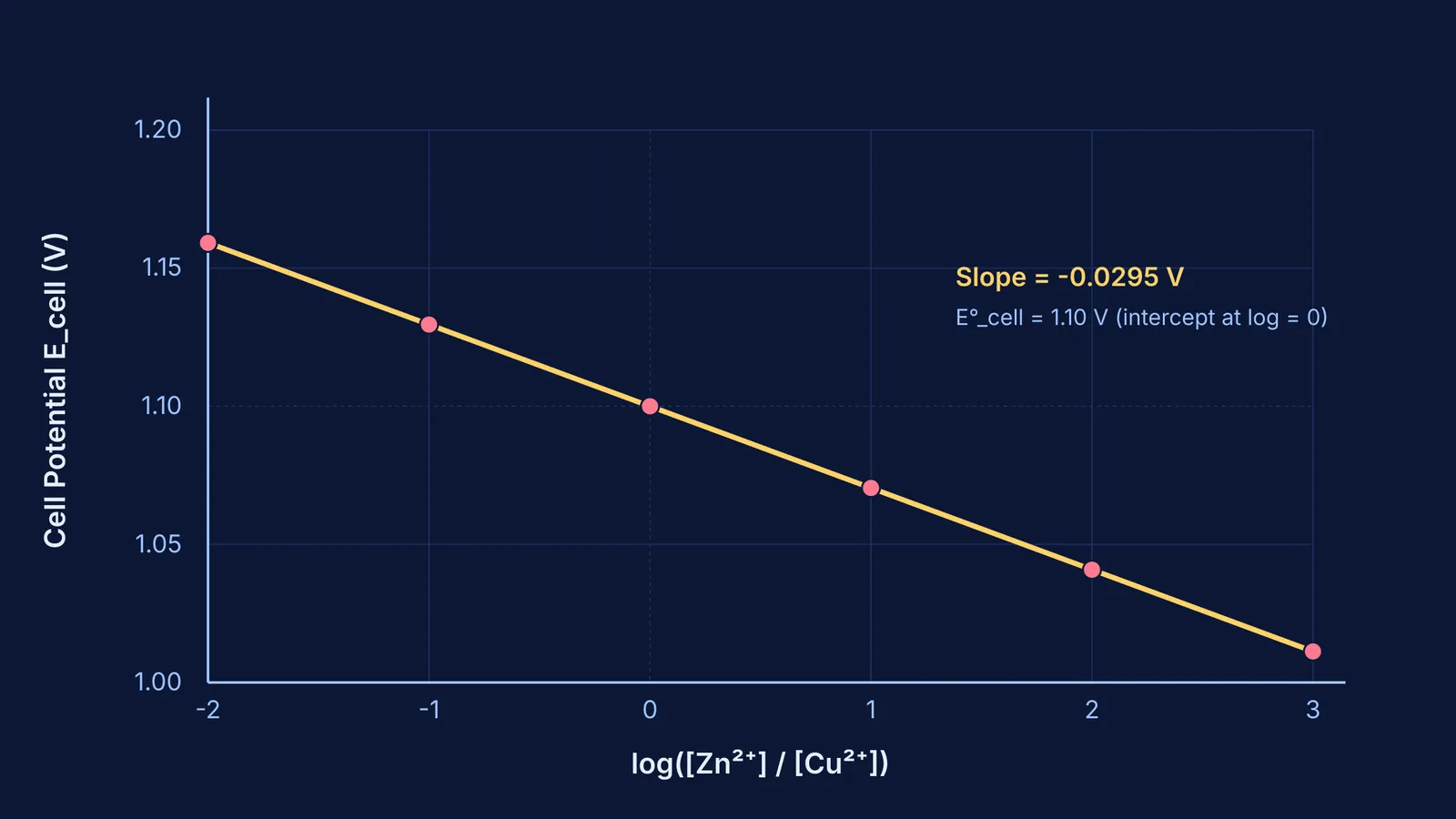
To verify the Nernst equation, plot measured E_cell on the vertical axis against log ([Zn²⁺] / [Cu²⁺]) on the horizontal axis.
Because the relation matches y = c + mx, the points form a downward straight line with a theoretical slope of −0.0295 V per decade and a y-intercept of 1.10 V. A slightly lower intercept in class is normal because voltmeters draw a small current, producing an internal potential drop across the cell and bridge.
What are the common viva questions for this practical?
Examiners use the practical viva to test your conceptual understanding of cell operation:
Why is a salt bridge necessary? It maintains electrical neutrality in each half-cell and completes the circuit without allowing solutions to mix. Removing it drops the voltage to zero instantly.
Why does the cell voltage decline over time? As the reaction proceeds, Cu²⁺ is consumed and Zn²⁺ accumulates. At chemical equilibrium, as detailed in electrochemistry theory, net cell potential drops to 0 V.
Why avoid KCl when silver electrodes are present? Chloride ions diffuse into the half-cell and precipitate insoluble AgCl, blocking the junction.
Connecting laboratory measurements to theory makes electrochemistry intuitive. Once you see how the reaction quotient Q compares to K, how concentration cells generate EMF, and how to calculate Gibbs free energy from cell EMF, cell potential becomes a clear measure of chemical driving force.


