

On this page
When students encounter word problems about cost, distance, or time, they are often told to cross-multiply. But before algebra takes over, there is a more intuitive approach. The unitary method builds proportional reasoning by breaking a problem down to the value of a single unit. It gives students a logical way to think about ratios rather than just following a formula.
What are unitary method word problems in Class 7?
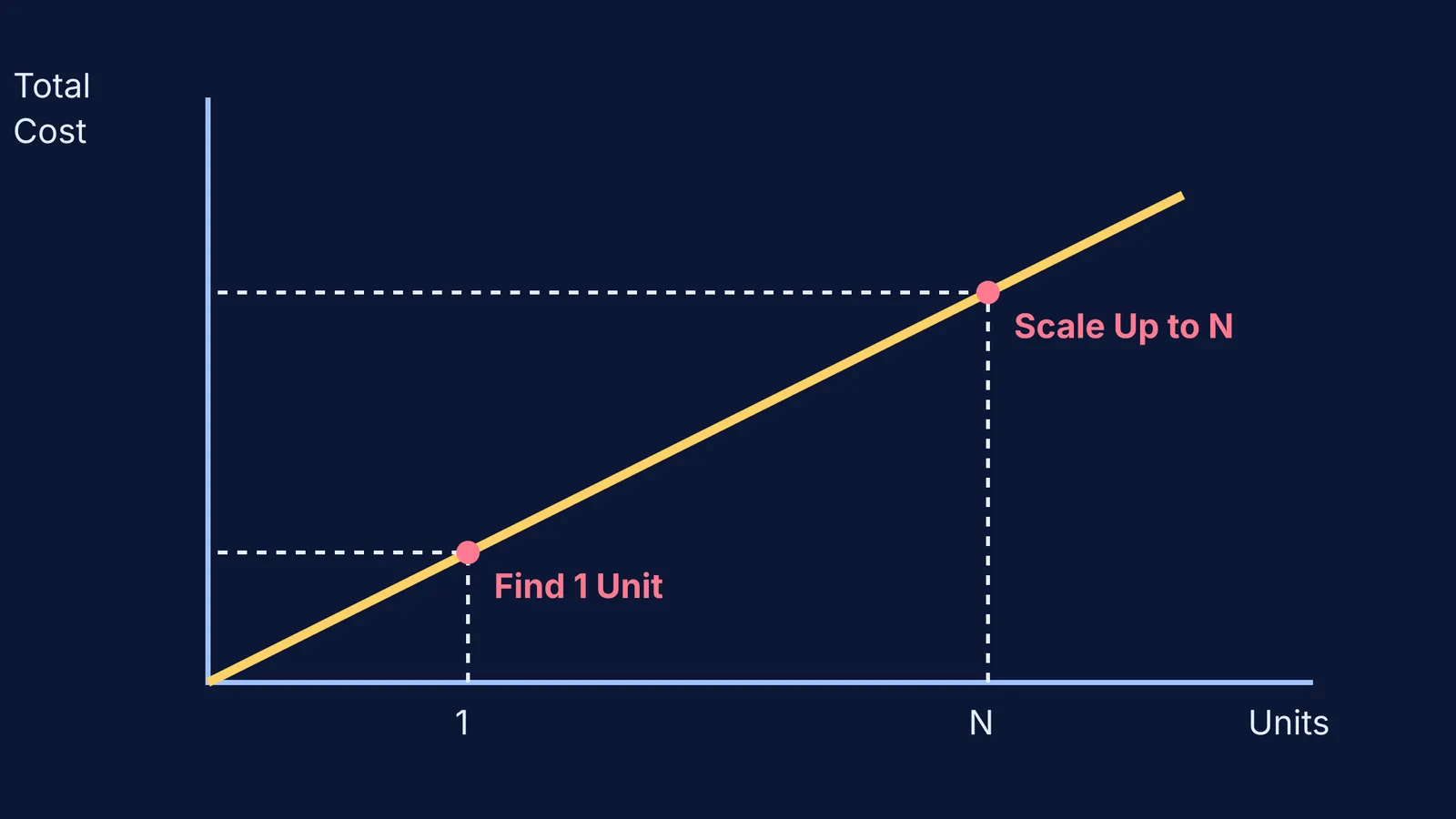
Unitary method word problems require you to find the value of a specific quantity by first calculating the value of one unit. A unit could be one kilogram, one hour, or one item. Once you know what one unit is worth, you can multiply that value to find the total for any number of units.
For example, if 5 apples cost ₹100, you first divide by 5 to find that 1 apple costs ₹20. Then, if you need the price of 8 apples, you multiply ₹20 by 8 to get ₹160.
This two-step process—divide to find one, then multiply to find many—is the core of the unitary method according to Wikipedia. It helps build a strong mathematical foundation for more advanced topics like Ratios and proportions for Class 7: a head start on Class 8.
Why do students struggle with proportional reasoning?
Moving from basic arithmetic to proportional reasoning is a major cognitive leap. Students often default to "additive reasoning"—looking at the absolute difference between numbers instead of their multiplicative ratio. If a recipe for 4 people needs 6 eggs, a student using additive reasoning might think that feeding 6 people requires 8 eggs (adding 2 to both sides), rather than 9 eggs (multiplying by 1.5).
Furthermore, a well-known study in *Learning and Instruction* observed the "illusion of linearity", where students over-generalise linear models and incorrectly apply simple proportional logic to non-linear problems (Van Dooren et al., 2004). This often happens when methods like cross-multiplication are taught as a rote rule rather than a logical progression. The mechanical nature of cross-multiplication strips away the context of the word problem.
To correct these fundamental misunderstandings, you can turn to the Fermi Problem Library. It has worked problems with a step-by-step solver that explains the reasoning rather than printing an answer, guiding students back to multiplicative thinking when they make additive errors.
How to set up a direct proportion table?
A table is the best way to organise the numbers in a word problem. It clearly maps out the relationship between the quantities. Direct variation means that as one quantity increases, the other increases at the exact same rate. When mapped on a graph, direct variation always forms a straight line that passes through zero.
Here is a practical framework to set up your table to ensure you never multiply or divide the wrong numbers:
Draw a table with two rows for your two variables (for example, Items and Total Cost).
Fill in the given pair of numbers in the first column.
Put a "1" in the top row of the middle column and calculate the single unit value below it.
Put your target number in the final column and multiply the unit value by it to find your answer.
This clear layout helps avoid the confusion students often face when tracking multiple variables, similar to the care needed when Working with fractions in Class 7: multiplying and dividing.
How to apply the unitary method to speed and distance?
One of the most practical applications of the unitary method is in calculating speed and distance. Speed itself is simply a unit rate—it tells you the distance travelled in exactly one unit of time, such as one hour or one second.
If a train travels 240 km in 3 hours, how far will it travel in 5 hours? Using the unitary method, you first find the distance covered in 1 hour. Dividing 240 by 3 gives you 80 km per hour. This is the unit value. To find the distance for 5 hours, you simply scale up by multiplying 80 by 5, which equals 400 km.
By seeing speed as a unit rate, students realise they are already using proportional reasoning every time they look at a speedometer.
Direct vs inverse proportion: how to avoid the mix-up?
Not all relationships move in the same direction. The biggest trap in word problems is applying direct proportion logic to an inverse situation.
Direct proportion: More items mean more cost. You divide to find one, then multiply to scale up.
Inverse proportion: More workers mean less time to finish a job. You multiply to find the total effort required, then divide to share the work.
If 3 workers take 4 hours to paint a wall, 1 worker will not take less time; they will take 12 hours (3 × 4). Then, 6 workers will take 2 hours (12 ÷ 6).
If you find these concepts hard to picture, Fermi's AI tutor can work out what you already know, build a plan for the session, and teach through it—writing on a board and drawing the figure to show exactly how inverse proportion curves downwards while direct proportion goes straight up. You can also explore Direct and inverse proportion in Class 8, with worked examples for more practice.
Building confidence before algebra
The true value of the unitary method is that it builds number sense and confidence before formal algebra is introduced. By anchoring abstract calculations to a concrete "one unit," students learn to trust their reasoning rather than second-guessing a memorised formula.
Parents and teachers can support this development by asking questions like "How much would just one cost?" whenever shopping or cooking together. These everyday conversations cement multiplicative thinking.
To practice these foundational skills, try a few examples in the Fermi Problem Library.


