

On this page
Put x = tan θ and all three forms of 2tan⁻¹x look like one-line proofs. The catch is the last step, where sin⁻¹(sin 2θ) is quietly replaced by 2θ. That step is only true when 2θ lies inside the range the inverse function is allowed to return.
NCERT's Class 12 chapter on inverse trigonometric functions says its properties are "valid within the principal value branches of the corresponding inverse trigonometric functions and wherever they are defined" (NCERT Class 12 Mathematics, Chapter 2). The NIST Digital Library of Mathematical Functions states inverse-trig addition formulas, such as Arctan u + Arctan v = Arctan((u+v)/(1−uv)), in a many-valued sense, where every value of one side is a value of the other (DLMF §4.24). Once you use principal values only, you need conditions on x.
What are the three forms of 2tan⁻¹x?
Let θ = tan⁻¹x. NCERT fixes the principal range of tan⁻¹ as (−π/2, π/2), so 2θ lies in (−π, π) (NCERT Chapter 2). The double-angle formulas give:
2x/(1+x²) = sin 2θ
(1−x²)/(1+x²) = cos 2θ
2x/(1−x²) = tan 2θ, for x ≠ ±1
Each inverse function gives back 2θ only when 2θ is inside its principal range. The same NCERT chapter gives those ranges as [−π/2, π/2] for sin⁻¹, [0, π] for cos⁻¹ and (−π/2, π/2) for tan⁻¹. Turn each condition on 2θ into a condition on x:
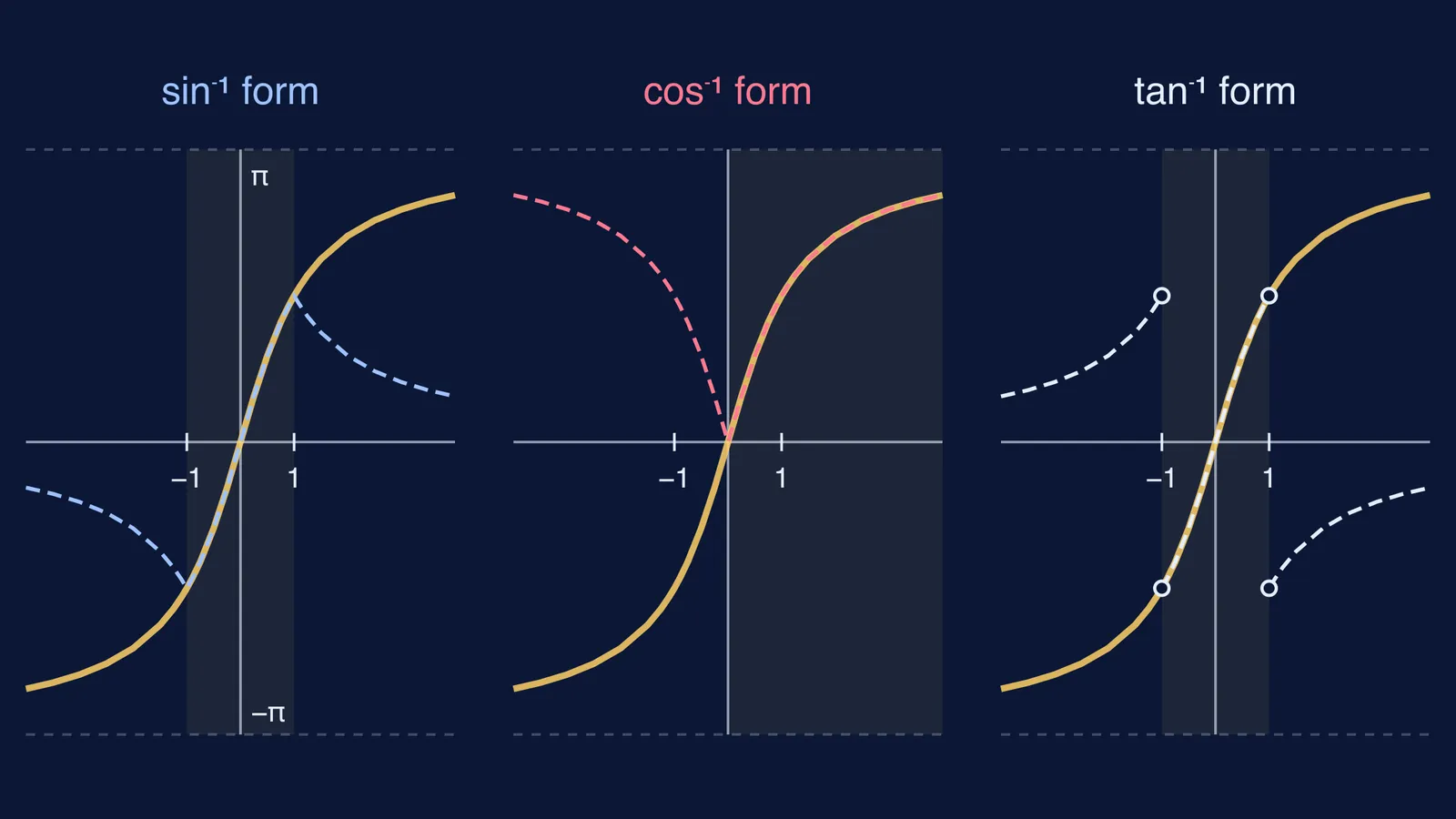
sin⁻¹ form: 2θ in [−π/2, π/2] means θ in [−π/4, π/4], so 2tan⁻¹x = sin⁻¹(2x/(1+x²)) for −1 ≤ x ≤ 1.
cos⁻¹ form: 2θ in [0, π] means θ in [0, π/2), so 2tan⁻¹x = cos⁻¹((1−x²)/(1+x²)) for x ≥ 0.
tan⁻¹ form: 2θ in (−π/2, π/2) means θ in (−π/4, π/4), so 2tan⁻¹x = tan⁻¹(2x/(1−x²)) for −1 < x < 1.
If principal value branches still feel shaky, start with our guide to inverse trigonometric functions and their principal values. The Fermi Concept Library also gives each concept its own lesson and its place in the map.
What happens when x is outside the range?
The forms still give an answer. It is just a different angle with the same sine, cosine or tangent. Find that angle and you have the correction:
sin⁻¹ form: for x > 1, sin⁻¹(2x/(1+x²)) = π − 2tan⁻¹x; for x < −1, it equals −π − 2tan⁻¹x.
cos⁻¹ form: for x < 0, cos⁻¹((1−x²)/(1+x²)) = −2tan⁻¹x.
tan⁻¹ form: for x > 1, tan⁻¹(2x/(1−x²)) = 2tan⁻¹x − π; for x < −1, it equals 2tan⁻¹x + π. At x = ±1 it is undefined.
Why is the cos⁻¹ form the odd one out? Its range [0, π] starts at zero, so it covers every x ≥ 0, including x > 1. The sin⁻¹ and tan⁻¹ ranges are centred on zero, so they cover small x on both sides instead. The graph at the top of this page shows all three.
This is the same branch idea behind why sin⁻¹(sin x) is not always x and why you add π to tan⁻¹x + tan⁻¹y when xy > 1.
How do you check a form with one number?
Try x = √3, where 2tan⁻¹√3 = 2π/3:
sin⁻¹(2√3/4) = sin⁻¹(√3/2) = π/3, which is π − 2π/3. Wrong, as predicted for x > 1.
cos⁻¹((1−3)/4) = cos⁻¹(−1/2) = 2π/3. Correct, as predicted for x ≥ 0.
tan⁻¹(2√3/(−2)) = tan⁻¹(−√3) = −π/3, which is 2π/3 − π. Off by π, as predicted.
Now x = −1/√3, where 2tan⁻¹x = −π/3. The sin⁻¹ and tan⁻¹ forms both give −π/3. The cos⁻¹ form gives cos⁻¹(1/2) = π/3, the right size with the wrong sign. With one value on each side of zero, you have seen each rule hold and fail where it predicts.
How does this show up in exam questions?
NCERT Exercise 2.2 asks for tan ½[sin⁻¹(2x/(1+x²)) + cos⁻¹((1−y²)/(1+y²))], given |x| < 1, y > 0 and xy < 1 (NCERT Chapter 2). Each condition has a job:
|x| < 1 puts x inside the sin⁻¹ range, so sin⁻¹(2x/(1+x²)) = 2tan⁻¹x.
y > 0 puts y inside the cos⁻¹ range, so cos⁻¹((1−y²)/(1+y²)) = 2tan⁻¹y.
Halving gives tan⁻¹x + tan⁻¹y, and xy < 1 means this is tan⁻¹((x+y)/(1−xy)) with no π correction.
So the answer is (x+y)/(1−xy). When a question states conditions like these, read them as a hint about which form to use. When it states none, test one value on each side before you trust the substitution.
Try this one from the same chapter's miscellaneous exercise: prove 2sin⁻¹(3/5) = tan⁻¹(24/7). Hint: sin⁻¹(3/5) = tan⁻¹(3/4), and 3/4 lies in (−1, 1), so the tan⁻¹ form applies.
If you keep losing the range at the last step, the Fermi Problem Library has worked problems with a step-by-step solver that explains the reasoning rather than printing an answer, so you can see exactly where the condition on x comes in.


