

On this page
Both root hairs and trichomes are hair-like outgrowths of a plant's epidermis, but they sit at opposite ends of the plant's water management system. Root hairs plunge into the soil to absorb as much water as possible, while trichomes sit exposed to the air to stop water from escaping. Understanding the difference between the two is a classic requirement for biology students.
What is the difference between trichomes and root hairs?
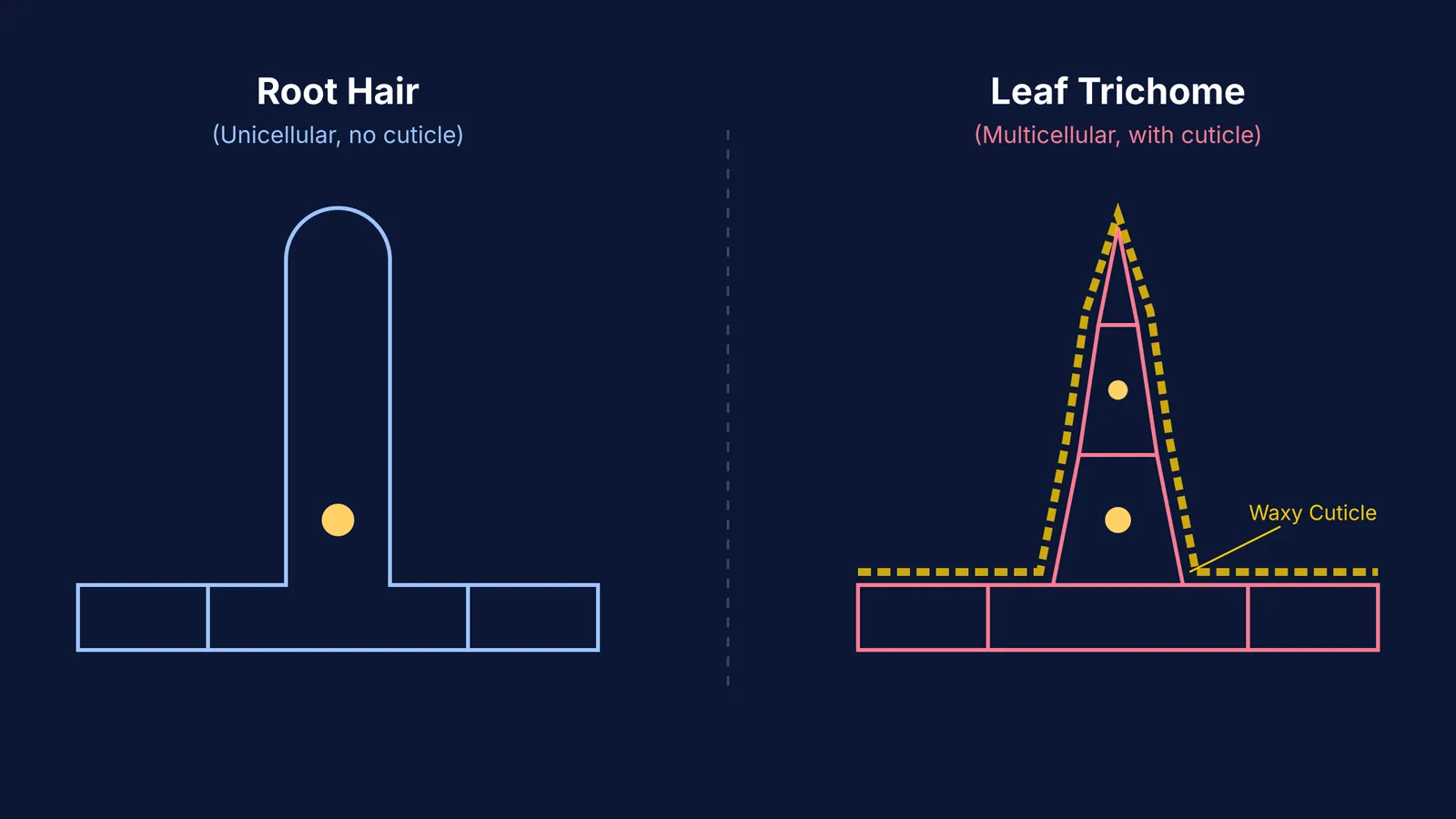
The primary difference lies in their location and their cellular makeup. Root hairs are found exclusively underground, concentrated in the zone of maturation just behind the growing tip of a root. They are always unicellular—simple extensions of specialized epidermal cells called trichoblasts. Their straight, unbranched, tubular shape is perfectly designed to slip between densely packed soil particles.
Trichomes, on the other hand, develop on the aerial parts of the plant, including stems, leaves and flowers. Unlike the uniform tubes on a root, trichomes exhibit immense variety. They can be unicellular or multicellular, and their shapes range from straight spikes to branched, star-like forms. Some even feature glandular heads that secrete sticky fluids, toxic chemicals or essential oils to deter grazing herbivores.
If you are revising plant tissues and notice concept gaps, the Concept Library covers every concept in biology, each with its own lesson and its place in the map.
How do root hairs increase absorption?
A plant cannot rely on the main, thick surface of its roots to draw in enough water and dissolved minerals to survive. Root hairs solve this problem by vastly multiplying the available surface area without requiring a massive investment of cellular material. Because they are the primary entry point for water, root hairs are strictly non-cutinized; the presence of a waxy cuticle would block osmosis entirely.
This surface area expansion is highly responsive to the plant's immediate environment. When nutrients are scarce, the plant signals for more epidermal cells to differentiate into root hairs. A 2016 study in *Frontiers in Plant Science* investigating the traditional rice genotype DJ123 found that under severe phosphorus deficiency, its root hairs elongated so significantly that they increased the total root surface area by 31%. This plastic response allows the plant to scavenge a much larger volume of soil for immobile nutrients without spending the heavy energy required to grow thick structural roots.
When you are preparing for exams and need to connect these microscopic details to whole-plant physiology, Fermi's AI tutor works out what you already know and builds a plan for the session, so you sit down to a clear next step.
How do trichomes prevent water loss?
While the root system aggressively hunts for water, the shoot system fights to retain it. Unlike root hairs, trichomes are cutinized, meaning they are covered in a thin, waxy layer that repels water and prevents it from seeping out of the epidermal cells.
Their primary physical trick for water conservation is creating a "boundary layer" of still air just above the leaf surface. By trapping a microscopic cushion of moist air, trichomes lower the concentration gradient between the saturated inside of the leaf and the dry atmosphere outside. This trapped humidity significantly slows the rate of transpiration through the stomata.
By slowing convective heat exchange, dense layers of trichomes also keep leaves cooler in direct sunlight, which reduces the internal vapor pressure and further drops the evaporation rate.
A quick comparison framework for exams
When tackling multiple-choice questions on plant anatomy, it is easy to mix up these two epidermal outgrowths. Use this three-point checklist to quickly tell them apart:
Location: If the structure is on the shoot (stems, leaves, flowers), it is a trichome. If it is located in the zone of maturation on a root, it is a root hair.
Cell structure: Root hairs are always strictly unicellular. Trichomes can be unicellular, but they are very frequently multicellular.
Cutinisation: Trichomes possess a waxy cuticle to stop water from escaping to the air. Root hairs always lack a cuticle so that soil water can easily enter the plant by osmosis.
Understanding these structures helps make sense of broader plant adaptations, whether you are looking at how meristems: apical, intercalary and lateral drive new growth, or observing phototropism, geotropism and other tropic movements in Class 10. Just as stem modifications like thorns and tendrils help a plant interact with its environment, microscopic epidermal hairs are finely tuned tools for survival.


