

On this page
When you pluck a guitar string or strike a tennis racket, you are setting up a transverse oscillation. Vibrating strings are the basis of string instruments such as guitars, cellos, and pianos (Wikipedia). But what governs how fast the string vibrates? The key lies in the tension of the string acting as a restoring force, pulling the mass back to its equilibrium position.
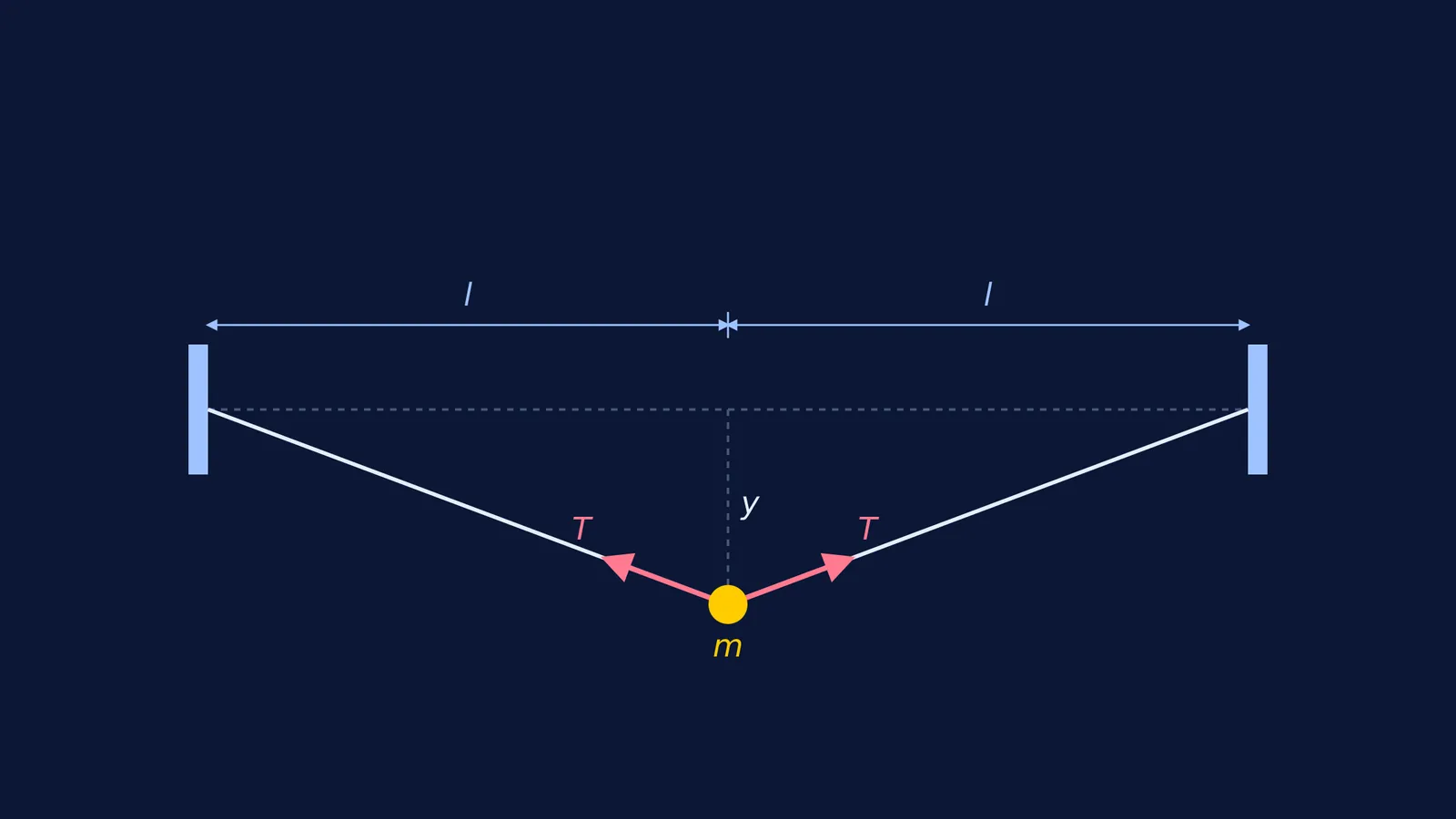
Imagine a total string length of 2l, stretched tightly between two fixed supports with a constant tension T. In the middle of this string—at a distance l from each end—sits a small mass m. When the string is at rest, it forms a straight horizontal line. If you pluck the mass, moving it sideways by a small transverse distance y, the string forms a shallow 'V' shape.
How does tension create a restoring force?
The tension acts along the length of the string, pulling away from the mass towards the two fixed ends. Because the mass is displaced vertically by a distance y, these two tension forces are no longer purely horizontal; they angle slightly inwards towards the central equilibrium line. To understand the net force acting on the mass, we need to consider both the horizontal and vertical components of this tension.
The two horizontal components of the tension pull in opposite directions. Because the setup is symmetrical and the mass is exactly in the middle, these horizontal components are perfectly equal and therefore cancel each other out entirely. As a result, the mass does not move left or right.
However, the vertical components of the tension both point in the same direction: back towards the equilibrium line. This is what creates the net restoring force. Hooke's law states that the restoring force is proportional to the distance of displacement (Wikipedia). Let θ be the small angle the displaced string makes with the straight equilibrium line. The vertical restoring force from one half of the string is T sin(θ). Since there are two halves of the string pulling symmetrically on the mass, we add these components together. The total vertical restoring force F is:
F = 2T sin(θ)
How to find the period of a small transverse oscillation?
For very small displacements where y is much less than l, the angle θ is tiny. In physics, we can use the standard small-angle approximation: sin(θ) ≈ tan(θ).
Looking at the right-angled triangle formed by the displacement, the opposite side is y and the adjacent side is l. Therefore, tan(θ) = y / l. Substituting this into our force equation gives:
F = 2T(y / l) = (2T / l)y
Notice that this is exactly the form of Hooke's law (F = ky), where the effective spring constant k is 2T / l. The tension components give a restoring force 2T y over l.
Because the restoring force is proportional to the displacement y, the mass undergoes simple harmonic motion. The standard formula for the period of a simple harmonic oscillator is 2π√(m / k).
By plugging in our effective spring constant, we get the final period of the transverse oscillation:
Period = 2π√(ml / 2T)
This formula reveals three crucial facts about transverse oscillations:
Increasing the mass m increases the period (it oscillates more slowly).
Increasing the length l of the string segment also increases the period.
Increasing the tension T decreases the period (it vibrates faster, which is why tightening a guitar string raises its pitch).
Three common mistakes in string oscillation problems
When tackling these questions in competitive exams, students often stumble on a few predictable hurdles:
Confusing total length with half-length: Formulas vary depending on whether the problem defines the total length as L or 2l. Always draw a diagram and label the distance from the mass to the support as l.
Forgetting the factor of two: The restoring force comes from both sides of the string. A single string segment only provides T(y/l). Forgetting to double this for the two halves is a classic error.
Applying it to large displacements: The derivation relies entirely on the small-angle approximation. If a question specifies a large initial pluck, the restoring force becomes non-linear, and the simple harmonic motion model breaks down.
If you want to practice your approach to these types of questions, our guide on how to solve physics problems step by step provides a reliable framework. Alternatively, you can test your intuition with a simple harmonic motion simulation to see how mass and stiffness affect the period.
A step-by-step plan for derivation questions
If an exam asks you to prove that a system undergoes simple harmonic motion, follow this reliable script:
Find the equilibrium position where the net force is zero. This is usually the starting point before any displacement.
Displace the mass by a small variable (like y or x) from the equilibrium position.
Draw a free-body diagram and resolve all the forces acting on the mass into components parallel and perpendicular to the direction of displacement.
Sum the components along the line of displacement to find the net restoring force acting on the object.
Use standard small-angle approximations, such as sin(θ) ≈ θ or tan(θ) ≈ θ, to simplify the geometry of the displaced system.
Factor the resulting equation into the standard form F = -ky, which proves that the system follows Hooke's law.
Substitute your effective spring constant k into the period formula 2π√(m / k) to find the final period of oscillation.
If you are preparing for exams like the JEE or NEET, recognising when a complex setup behaves like a simple spring is a core skill. If you need help bridging the gap between force vectors and simple harmonic motion, the Fermi Concept Library breaks down the fundamentals of tension and restoring forces. For hands-on practice, you can tackle similar setups in the Fermi Problem Library, where the step-by-step solver explains the reasoning behind each small-angle approximation.


