

On this page
A toroid is a solenoid bent into a ring until its ends meet. That one change means the magnetic field has nowhere to leak out, and the inductance formula takes four lines to derive.
What is the self inductance of a toroid formula?
Self inductance L is the flux linkage per unit current, L = NΦ/I, where Φ is the magnetic flux through one turn (OpenStax University Physics, Vol. 2, section 14.2).
For a thin toroid, meaning the core's thickness is small compared with its mean radius r, the self inductance is L = μ0N²A/(2πr), where N is the number of turns and A is the cross-sectional area of the core.
The constant μ0, the permeability of free space, is 1.25663706127 × 10⁻⁶ N A⁻² in the 2022 CODATA values (NIST). For exam work, μ0 = 4π × 10⁻⁷ T m/A is accurate to well within rounding.
Compare the long solenoid, L = μ0N²A/l (OpenStax, section 14.2). Put l = 2πr and you have the toroid formula.
Why does a toroid's magnetic field stay inside the core?
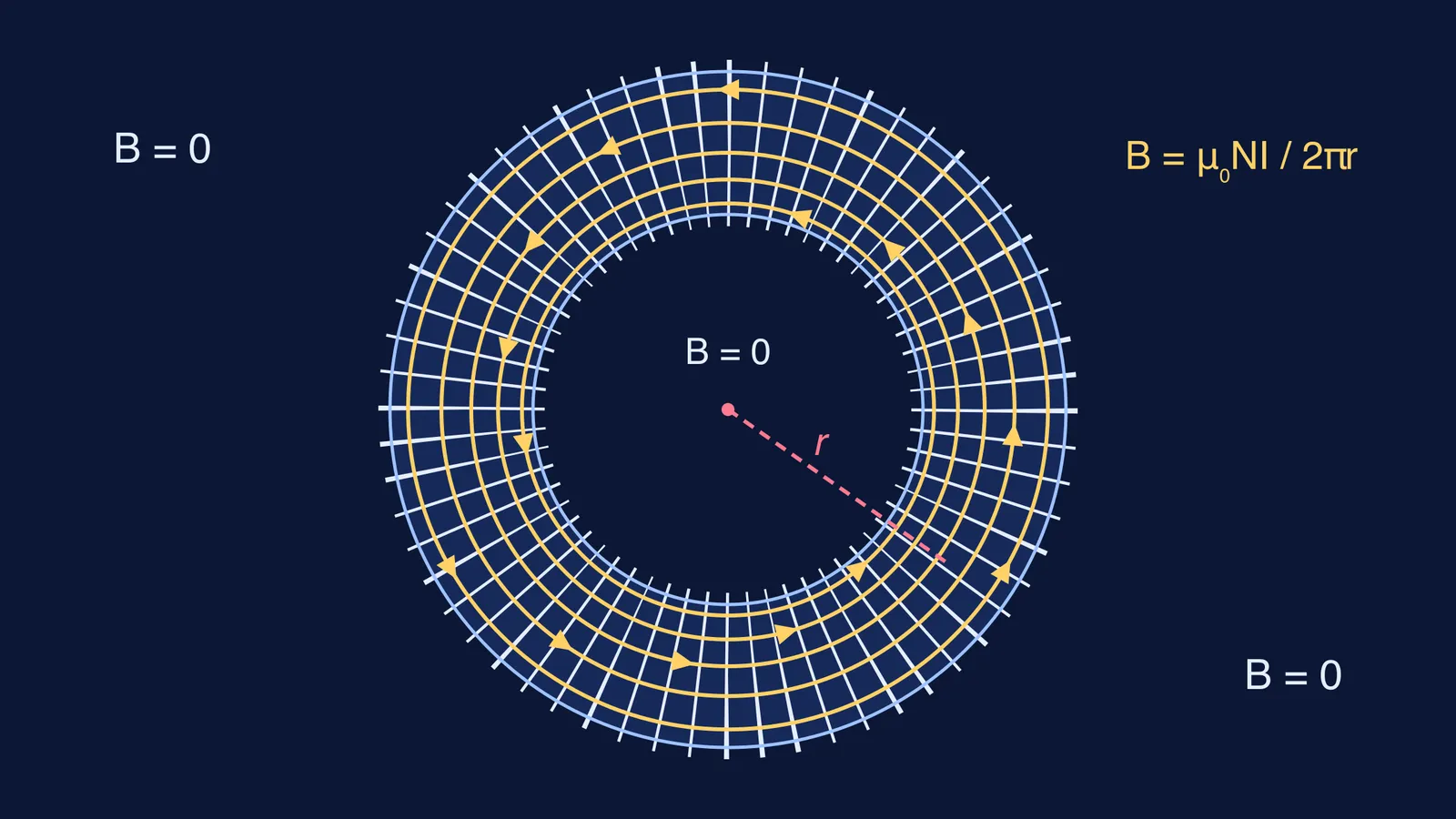
The argument is Ampère's law plus symmetry. By symmetry, the field must run along circles centred on the toroid's axis and have the same size all the way round each circle (OpenStax, section 12.6). So pick a circular loop of radius r and ask how much current passes through it.
A loop inside the core is threaded by every turn once, so the enclosed current is NI. Ampère's law gives B × 2πr = μ0NI, so B = μ0NI/(2πr).
A loop in the central hole encloses no current at all, so B = 0 there.
A loop outside the whole ring is crossed by each turn twice, once going up and once coming down, so the net current is zero and B = 0.
We cover the field side, with its common traps, in our post on the magnetic field of a toroid.
How do you derive L = μ0N²A/2πr step by step?
Field in the core, from Ampère's law: B = μ0NI/(2πr).
Flux through one turn, treating B as uniform over the thin cross-section: Φ = BA = μ0NIA/(2πr).
Flux linkage of all N turns: NΦ = μ0N²IA/(2πr).
Divide by I: L = μ0N²A/(2πr).
The current cancels, so L depends only on the coil's shape, its turns and what fills the core, the same point OpenStax makes for the solenoid (OpenStax, section 14.2). If self and mutual inductance still blur together for you, start with our explainer on self and mutual inductance.
Worked example: how large is a real toroid's inductance?
Take an air-cored toroid with 500 turns, mean radius r = 10 cm and a rectangular cross-section 2 cm wide and 1 cm high, so A = 2 cm² = 2 × 10⁻⁴ m². Use μ0 = 4π × 10⁻⁷ T m/A.
Thin-toroid formula: L = (4π × 10⁻⁷ × 500² × 2 × 10⁻⁴) / (2π × 0.1) = 1.0 × 10⁻⁴ H, or 0.1 mH.
Exact formula for a rectangular core, L = (μ0N²h/2π) ln(R2/R1) (OpenStax, section 14.2), with h = 1 cm, R1 = 9 cm, R2 = 11 cm: L = 5 × 10⁻⁴ × ln(11/9) ≈ 1.003 × 10⁻⁴ H.
The two agree to about 0.3%, because the core is thin (2 cm) next to its 10 cm radius.
With I = 2 A, the field at the mean radius is B = μ0NI/(2πr) = 2 × 10⁻³ T, or 2 mT.
Three quick checks before you move on:
Double N and L becomes four times larger, because N appears squared.
Double r with N and A unchanged and L halves, because the same turns are spread round a longer path.
Fill the core with iron and L grows by roughly the core's relative permeability, which is why we wrote about how an iron core changes a coil's inductance.
If a variant, such as a toroid with two windings, stumps you, the Fermi Problem Library has worked problems with a step-by-step solver that explains the reasoning rather than printing an answer.
When does the thin-toroid formula stop working?
The shortcut assumes B is the same across the whole cross-section. In fact B falls as 1/r, so a fat core has a stronger field on its inner edge than on its outer edge. When the core thickness is no longer small compared with r, use the ln(R2/R1) form, which adds up the flux strip by strip (OpenStax, section 14.2).
The usual mistakes are small ones: using the outer radius instead of the mean radius, forgetting to square N, and leaving A in cm². If the idea of flux linkage itself feels shaky, the Fermi Concept Library covers every concept in physics, each with its own lesson and its place in the map.


