

On this page
A toroid is a coil of wire wound around a ring, like a doughnut wrapped in thread. It is one of the cleanest uses of Ampère's law, because symmetry does almost all the work.
How do you choose the Amperian loop for a toroid?
Ampère's circuital law says that the line integral of B around any closed loop equals μ₀ times the net current passing through that loop. The skill is choosing a loop along which B is constant and tangent, so the integral becomes B times the loop's length.
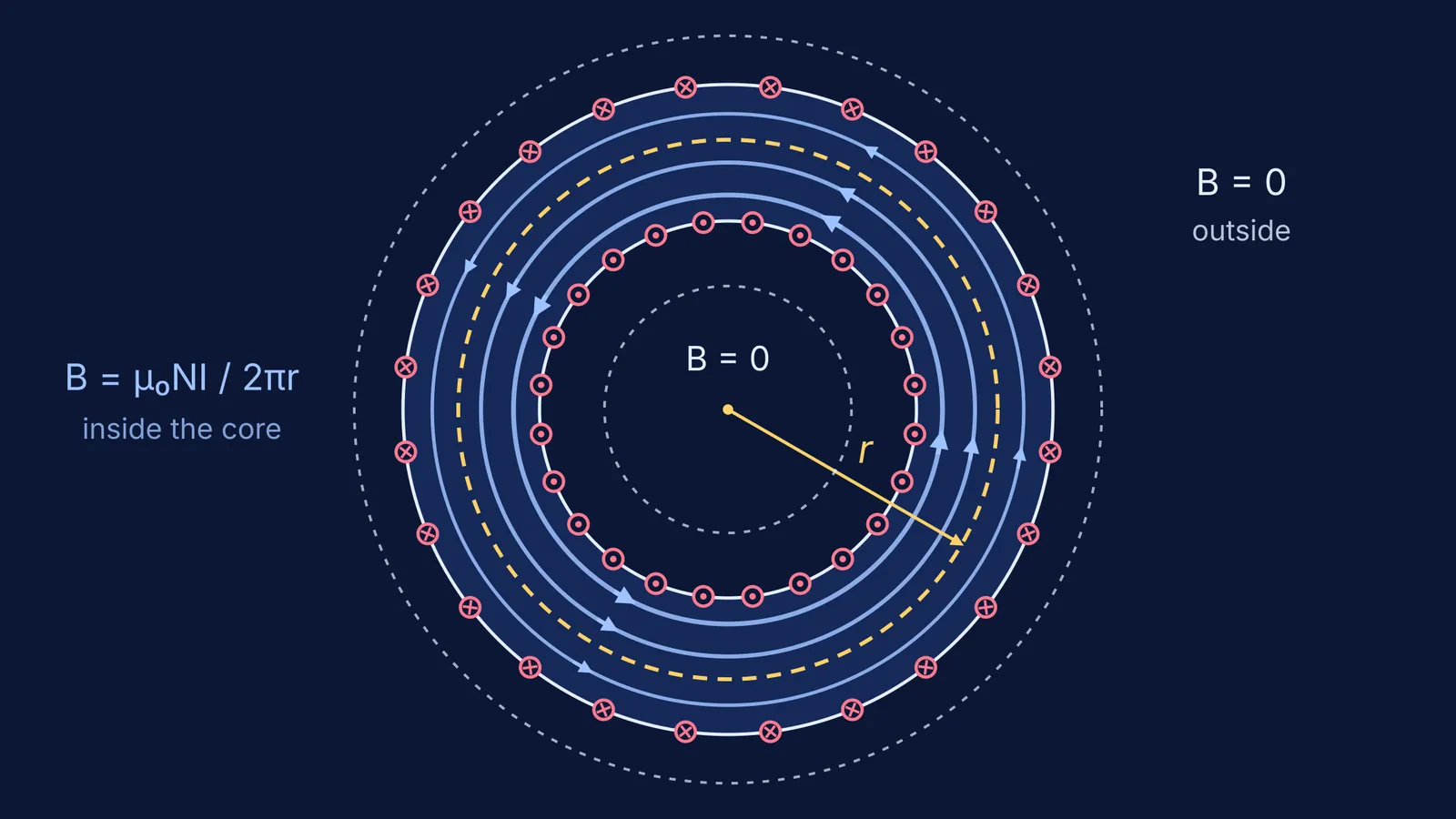
For a toroid, that loop is a circle centred on the toroid's axis. OpenStax University Physics Volume 2 gives the reason: for a tightly wound toroid, "the magnetic field must be tangent to and constant in magnitude along any circular path" centred on the axis.
You then draw three such circles:
One in the hole, with a radius smaller than the inner radius of the ring.
One inside the core, between the inner and outer radii.
One outside the whole toroid.
What is the magnetic field inside a toroid?
Take the circle of radius r inside the core. Its length is 2πr. All N turns pass through it, each carrying I in the same direction, so the enclosed current is NI. Ampère's law gives:
B × 2πr = μ₀NI
B = μ₀NI / 2πr
This is equation 12.33 in OpenStax University Physics, where N is the total number of turns and r is the distance from the central axis. In school problems μ₀ = 4π × 10⁻⁷ T m/A, which matches the NIST CODATA 2022 value of 1.25663706127 × 10⁻⁶ N A⁻² to the digits you will ever need.
The r in the denominator means the field is stronger near the inner edge of the core than near the outer edge. OpenStax notes that this variation is fairly small when the ring's central radius is much larger than the cross-sectional diameter of the coils.
Why is the magnetic field outside a toroid zero?
In the hole: a circle there passes through no wire at all. The enclosed current is zero, so B = 0.
Outside the ring: every turn crosses the flat surface of this circle twice, once on the inner side of the ring and once, in the opposite direction, on the outer side. The currents cancel, the net enclosed current is zero, and B = 0.
That is the ideal result. OpenStax adds that real turns form a helix, leaving a small field outside, and Ellingson's Electromagnetics I/07%3A_Magnetostatics/7.07%3A_Magnetic_Field_of_a_Toroidal_Coil) expects some "leakage of magnetic flux between the windings", which closely packed turns and a high-permeability core make negligibly small. Ellingson calls this containment the main advantage of toroidal inductors and transformers.
Worked example: how much does B change across the core?
Take a toroid with 500 turns carrying 2 A, inner radius 10 cm and outer radius 12 cm. Using the OpenStax result with μ₀ = 4π × 10⁻⁷ T m/A, μ₀/2π = 2 × 10⁻⁷, so B = (2 × 10⁻⁷ × 500 × 2) / r = (2 × 10⁻⁴) / r tesla.
At r = 10 cm (inner edge): B = 2.0 mT.
At r = 11 cm (mean radius): B ≈ 1.82 mT.
At r = 12 cm (outer edge): B ≈ 1.67 mT.
In the hole and outside the ring, B = 0. The field at the inner edge is 20% stronger than at the outer edge.
Straighten the same wire into a solenoid as long as the mean circumference, 2π × 0.11 m ≈ 0.69 m. That gives n = 500 / 0.69 ≈ 723 turns per metre, and B = μ₀nI ≈ 1.82 mT, the toroid's value at its mean radius.
To practise this method, the Fermi Problem Library has worked problems with a step-by-step solver that explains the reasoning rather than printing an answer.
How does a toroid compare with a long solenoid?
Section 4.7 of the current NCERT Class 12 Physics chapter, Moving Charges and Magnetism, derives B = μ₀nI for a long solenoid with a rectangular Amperian loop, noting that the field outside approaches zero as the solenoid gets longer. The chapter has no separate toroid derivation, but a toroid is the same coil bent into a ring: put n = N/2πr into B = μ₀nI and you get B = μ₀NI/2πr. The differences:
Amperian loop: a rectangle for the solenoid, a circle for the toroid.
Field inside: uniform for an ideal long solenoid; varies as 1/r across a toroid's core.
Field outside: zero for a solenoid only in the infinitely long limit; zero for an ideal toroid of any size.
Ends: a finite solenoid has ends, where the field on the axis drops to half its central value. A toroid has none, so its field lines are complete circles, a neat case of why magnetic field lines form closed loops.
For the straight-coil version, try visualising the magnetic field of a wire, loop and solenoid. If Ampère's law feels shaky, the Fermi Concept Library covers every concept in physics, each with its own lesson and its place in the map.