

On this page
We use three-pin plugs every day for heavy appliances like irons, refrigerators and heaters. But if you look closely at a standard plug, the top pin—the earth pin—is clearly longer and thicker than the other two. This is not a manufacturing accident. It is a precise safety feature mandated by national standard codes. The design uses basic electrical physics to ensure that even if an appliance breaks internally, it will not deliver a fatal shock to the person holding it.
Why is the earth pin longer?
The extra length ensures that it connects first and disconnects last. When you push a plug into the wall, the longer earth pin enters the socket first. This connects the metal casing of your appliance to the earth before the live and neutral pins connect to the main power supply. If there is a fault inside the appliance—for example, a loose live wire touching the outer metal case—the casing is already safely grounded before it becomes energized.
Conversely, when you pull the plug out, the shorter live and neutral pins lose contact first. The earth connection is the last to break, maintaining the safety net until the live circuit is entirely disconnected.
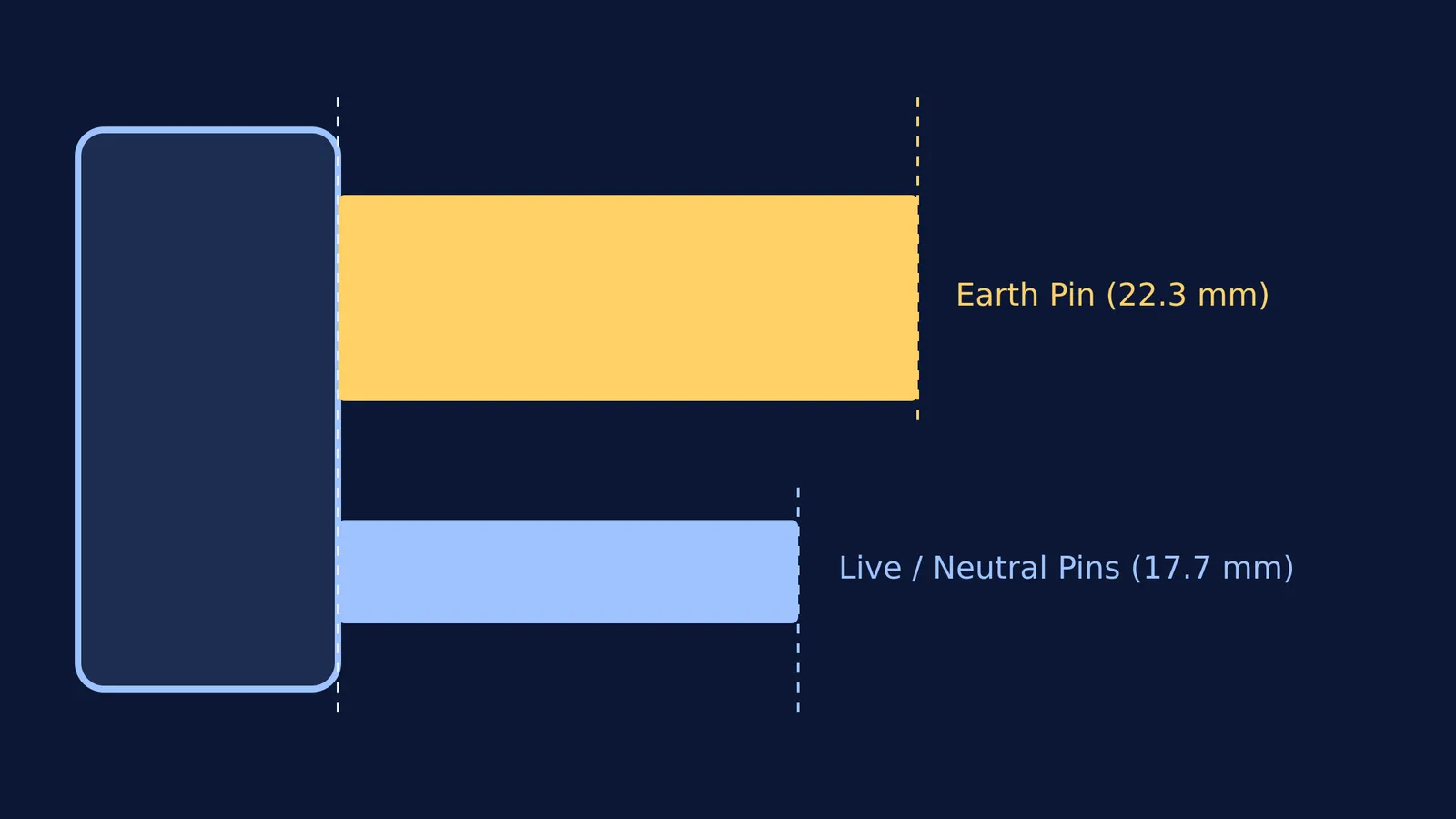
In addition, the extra length serves a mechanical purpose. Most modern sockets have built-in safety shutters that cover the live and neutral holes, preventing children from inserting objects into them. The longer earth pin acts as a key; as it enters the socket, it pushes a mechanism that opens these shutters, clearing the way for the other two pins to follow. Without a sufficiently long earth pin, you simply cannot plug the device in. According to the British BS 1363 standard, the earth pin is 22.3 mm long, while the live and neutral pins are only 17.7 mm.
Why is the earth pin thicker?
The earth pin is thicker for two main reasons: one electrical and one physical.
Electrically, the thickness lowers the resistance of the pin. The law of resistance states that resistance (R) is inversely proportional to cross-sectional area (A), given by the formula R = ρL/A. By making the earth pin thicker, its cross-sectional area is increased, which minimizes its electrical resistance. In the event of a short circuit, a massive fault current must travel to the ground immediately. The thick earth pin offers a low-resistance path, allowing the current to flow easily so that the circuit breaker trips or the fuse blows within milliseconds, cutting off the power.
Physically, the greater thickness acts as a mistake-proofing feature. Because it is much wider than the live and neutral pins, it physically cannot fit into the live or neutral slots of the socket. This ensures the plug can only be inserted in the correct orientation. If all three pins were the same size, a user might accidentally force the earth pin into the live hole, which would connect the metal body of the appliance directly to the live 240 V supply—a lethal hazard.
How does the earth wire protect you?
To see why this matters, consider what happens when a heavy appliance goes wrong. If the insulation on the live wire wears away and touches the metal casing of a washing machine, the entire machine becomes live. If there were no earth wire, the casing would sit at live voltage, waiting for someone to touch it. When a person touches it, the current would travel through their body to the ground, causing a severe or fatal electric shock.
With a properly connected earth wire, the story changes. The moment the live wire touches the grounded casing, a short circuit is created. Because the earth pin and the earth wire have a much lower resistance than a human body, almost all the current surges down the earth wire. This sudden spike in current causes the fuse to melt or the circuit breaker to trip, shutting off the electricity before anyone can get hurt.
Understanding how resistance and current keep us safe is a core part of the school physics syllabus. For example, if you are revising Electricity in Class 10: Ohm's law, resistors and electric power, you will see exactly how fault currents behave. You can also explore how high currents trip fuses in Heating effect of current: power, energy bills and fuses.
To build a deeper understanding of these rules, you can explore the Fermi Concept Library, which covers every concept in physics, chemistry, biology, mathematics and computing, each with its own lesson and its place in the map.
A practical checklist for plug safety
The design of the plug does a lot of the heavy lifting, but it still requires a safe environment to work. Here is how to make sure your appliances remain safe:
Never force a plug into a socket. If it does not go in easily, the safety shutters might be jammed or the earth pin might be bent.
If the earth pin is broken or missing, replace the plug immediately. An appliance will technically still turn on with just the live and neutral pins, but it has completely lost its safety ground.
Do not use a three-pin plug in an older two-pin socket by bypassing or removing the earth pin.
Check the wiring. If you wire a plug yourself, ensure the green-and-yellow earth wire is securely fastened to the top earth terminal, leaving a little slack so it is the last wire to pull loose if the cord is yanked.


