

On this page
The three-card problem is a classic puzzle in conditional probability that routinely tricks both students and experts. Originally framed as Bertrand's box paradox by Joseph Bertrand in his 1889 work *Calcul des Probabilités*, it is famous for demonstrating how our intuition about random choices can lead us astray when we misinterpret the sample space.
What is the three cards one red red, one blue blue, one red blue probability?
The setup is brilliantly simple. You have three identical-feeling cards:
Card 1 is red on both sides (red/red).
Card 2 is blue on both sides (blue/blue).
Card 3 is red on one side and blue on the other (red/blue).
You drop all three cards into a hat, mix them up, pull one out at random, and place it flat on a table. The face looking up at you is red. What is the probability that the face hidden underneath is also red?
The most common, intuitive answer is 1/2. Because you are looking at a red face, you know with absolute certainty that you did not draw the blue/blue card. That leaves two possibilities: you either drew the red/red card, or you drew the red/blue card. Since there are two remaining cards, it must be a 50-50 chance, right?
Why is the probability not 1/2?
This line of reasoning feels watertight, but it contains a critical mathematical flaw: it counts the cards, but the random event was selecting a *face*.
When you draw a card from the hat and place it on the table, you are choosing one of the six faces at random. The fact that the visible face is red is a piece of new information. We must update our probabilities based on this new information, which is the core principle behind conditional probability and Bayes' theorem.
The mathematical trap is assuming that because there are two cards left, those two cards are equally likely to be the one on the table. They are not. You are twice as likely to be looking at the red/red card because it has twice as many red faces that could have landed pointing up.
This is not just a trap for beginners learning the rules of chance. In a 1982 study published in *Cognition* (Bar-Hillel and Falk, 198290021-X)), researchers Maya Bar-Hillel and Ruma Falk tested psychology freshmen on this exact problem to assess their grasp of ambiguity and conditional probabilities. Out of 53 students, 35 incorrectly answered that the probability was 1/2, while only 3 correctly found the answer to be 2/3.
Counting red faces instead of cards
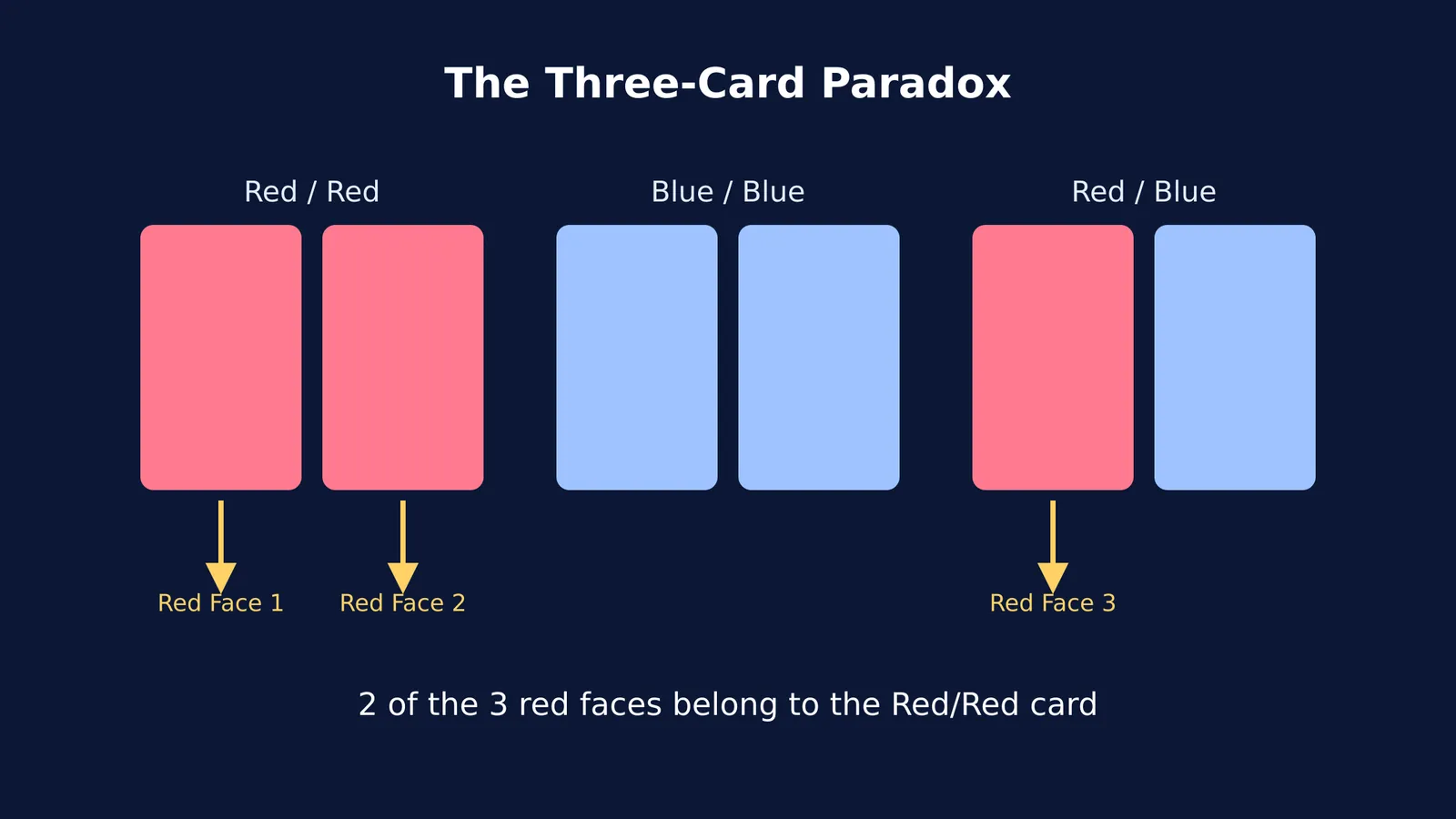
To see why the true probability is 2/3, we can build a simple framework that lists the entire sample space. Instead of thinking about the three cards, think about the six independent faces.
Let's label the three red faces to keep track of them:
Red Face 1 (on the red/red card)
Red Face 2 (on the red/red card)
Red Face 3 (on the red/blue card)
When you pull a card and see a red face, you are looking at one of these three specific faces. Each of these three outcomes was equally likely when you reached into the hat.
Now, look at what is on the hidden side in each of these three equally likely scenarios:
If you are looking at Red Face 1, the other side is Red Face 2 (which is Red).
If you are looking at Red Face 2, the other side is Red Face 1 (which is Red).
If you are looking at Red Face 3, the other side is the Blue Face (which is Blue).
Out of the three possible red faces you could be looking at, exactly two of them have a red face on the other side. Therefore, the probability that the other side is red is exactly 2/3.
Testing your intuition and improving your accuracy
This problem is a perfect example of why formal probability rules exist: human intuition is wired to look at the remaining options and divide them equally, even when the setup makes one option mathematically heavier. Identifying these cognitive traps is one of the hardest parts of mastering Probability in JEE maths: five reasoning mistakes and fixes.
When you encounter problems like this, writing out the full sample space prevents you from taking mental shortcuts. If you are practising these concepts, the Fermi Problem Library has worked problems with a step-by-step solver that explains the reasoning rather than printing an answer. It helps you catch where your intuition splits from the formal maths.
Whenever a probability answer seems a little too obviously 50-50, try breaking the problem down to its absolute smallest units. Count the faces, not the cards, and let the sample space do the work for you.


