

On this page
In 1897, J. J. Thomson used cathode-ray discharge tubes to show that cathode rays consist of negatively charged corpuscles—now called electrons—with a charge-to-mass ratio over a thousand times greater than hydrogen ions, as reported in the Philosophical Magazine. Because bulk matter is electrically neutral, Thomson concluded that every atom must contain an equal quantity of positive charge to balance its negative electrons.
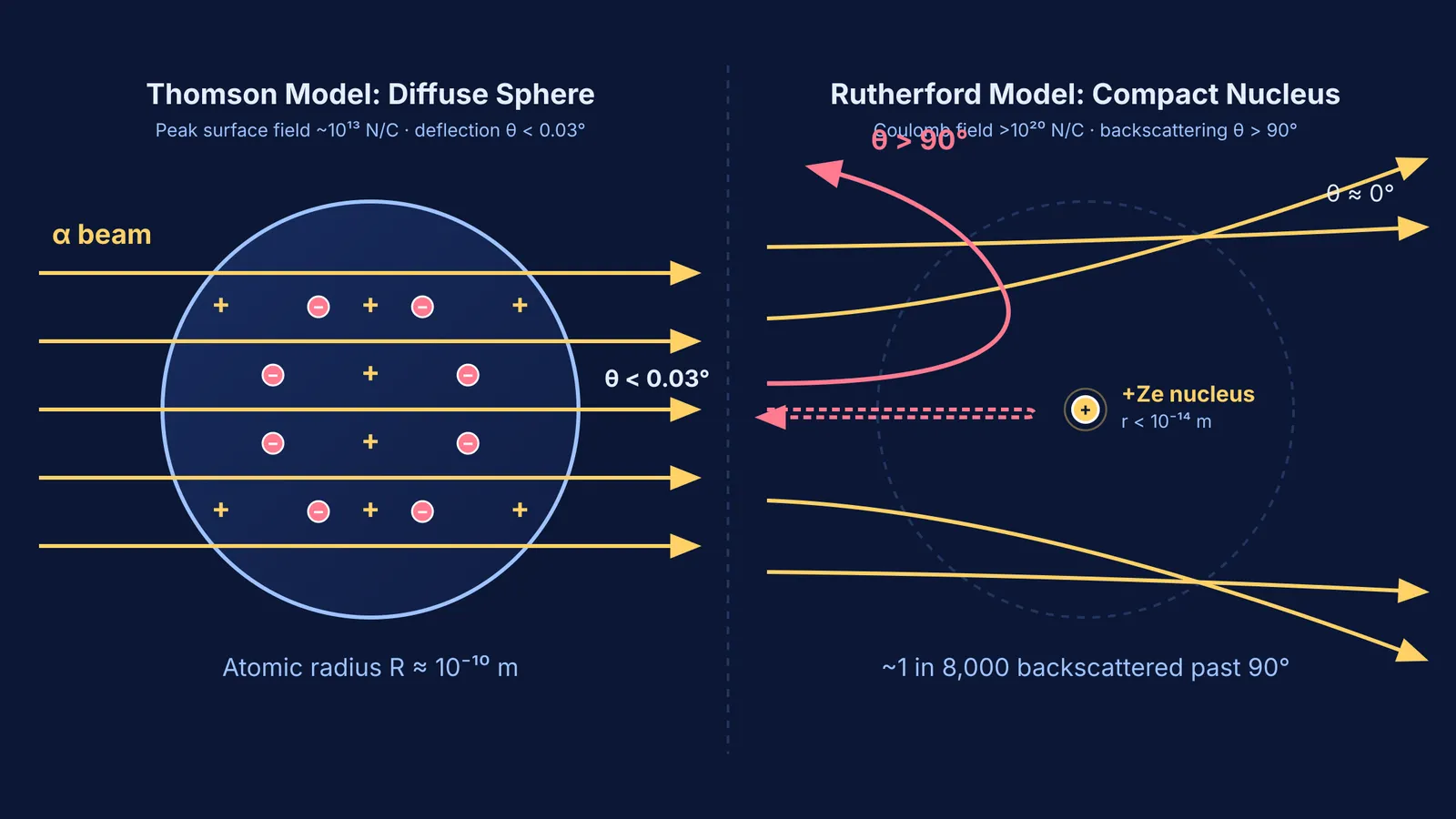
In 1904, Thomson published his atomic model in the Philosophical Magazine, proposing that an atom is a sphere of uniform positive electrification roughly 10⁻¹⁰ metres across. Within this diffuse positive sphere, negatively charged electrons were embedded like plums in a pudding. Thomson assumed the positive fluid was continuous, holding the atom's mass uniformly across its volume with electrons oscillating around equilibrium positions.
What did Thomson's model get right about atomic structure?
Although soon replaced, Thomson's plum pudding model broke John Dalton's 1808 claim that atoms are indivisible. As described in the NCERT Physics Class 12 textbook, the model established four key principles:
Subatomic constituents: By showing that electrons are universal parts of all elements, as explored in J. J. Thomson's cathode-ray experiments, it proved that atoms possess internal components that can be isolated and measured.
Electrical neutrality: The model correctly matched total positive charge to the sum of negative electron charges, explaining why undisturbed atoms carry no net electrostatic charge.
Electron mass share: By 1906, Thomson established that electrons account for less than 0.1% of atomic mass, showing that nearly all atomic mass must reside in the positive constituent.
Periodic arrangements: Thomson modeled concentric rings of circulating electrons to explain chemical periodicity, anticipating the link between electron configurations and chemical valence.
Why could Thomson's model not explain alpha particle scattering?
The plum pudding model failed when tested against alpha particle scattering. In 1909, Hans Geiger and Ernest Marsden fired 5.5 MeV alpha particles (charge +2e, mass ~ 7,300 times an electron) at a thin gold foil roughly 200 to 400 nanometres thick. Their results in the Proceedings of the Royal Society showed that while most particles passed straight through, about 1 in 8,000 was deflected past 90 degrees, with some bouncing directly backward.
Thomson's model could not explain this backscattering for three physical reasons:
Diffuse electric fields: Inside a uniformly charged sphere of radius R ≈ 10⁻¹⁰ metres and total positive charge Ze, Gauss's law gives an internal electric field E = Ze r / (4πε₀ R³), peaking at the surface at E_max = Ze / (4πε₀ R²). For gold (Z = 79), this peak field is roughly 1.1 × 10¹³ newtons per coulomb. The transverse impulse on a 5.5 MeV alpha particle gives a maximum single-atom deflection of θ_max ≈ 2Ze² / (4πε₀ R K) ≈ 0.024 degrees, or under 0.03 degrees including exterior fields.
Electron kinematics: An alpha particle has a mass of 6.64 × 10⁻²⁷ kilograms, while an electron has 9.11 × 10⁻³¹ kilograms. By momentum conservation, an elastic collision with an electron deflects an alpha particle by at most sin θ_max = m_e / m_α ≈ 0.008 degrees. Electrons are far too light to turn an alpha particle.
Multiple scattering limits: Thomson argued in 1910 that deflections could accumulate over multiple atoms. But a random walk through 1,000 atomic layers yields a root-mean-square deflection under 1 degree. The probability of random deflections adding up to 90 degrees is below 10⁻³⁵⁰⁰, making Geiger and Marsden's 1 in 8,000 count impossible.
As examined in Rutherford's gold foil experiment, Rutherford resolved the contradiction in his 1911 Philosophical Magazine paper. Explaining large-angle scattering required concentrating all positive charge into a central nucleus smaller than 10⁻¹⁴ metres, where the Coulomb field exceeds 10²⁰ newtons per coulomb.
What were the other major limitations of Thomson's model?
Thomson's model suffered from two further theoretical failures:
Continuous radiation spectra: Classical electrodynamics dictates that accelerating charges radiate energy. Oscillating electrons should emit a continuous spectrum and lose energy until collapsing, which could not explain the discrete lines of the hydrogen Balmer series.
Electrostatic instability: By Earnshaw's theorem in the Transactions of the Cambridge Philosophical Society, no static collection of inverse-square charges can maintain stable equilibrium.
Connecting Thomson's model to Rutherford's discovery is essential for solving problems on the distance of closest approach and impact parameter. The Fermi Concept Library maps every concept in physics and chemistry with dedicated lessons, helping you see where classical electrostatics broke down. When tackling numericals on Coulomb repulsion and kinetic energy conservation, the Fermi Problem Library provides worked problems with a step-by-step solver that explains the reasoning rather than printing an answer.


