

On this page
When studying thermodynamics for exams like JEE or NEET, students often encounter questions about the rate of heat transfer. A common source of confusion is understanding how the size and mass of an object change the time it takes to warm up or cool down.
Which reaches equilibrium faster, a small or large body?
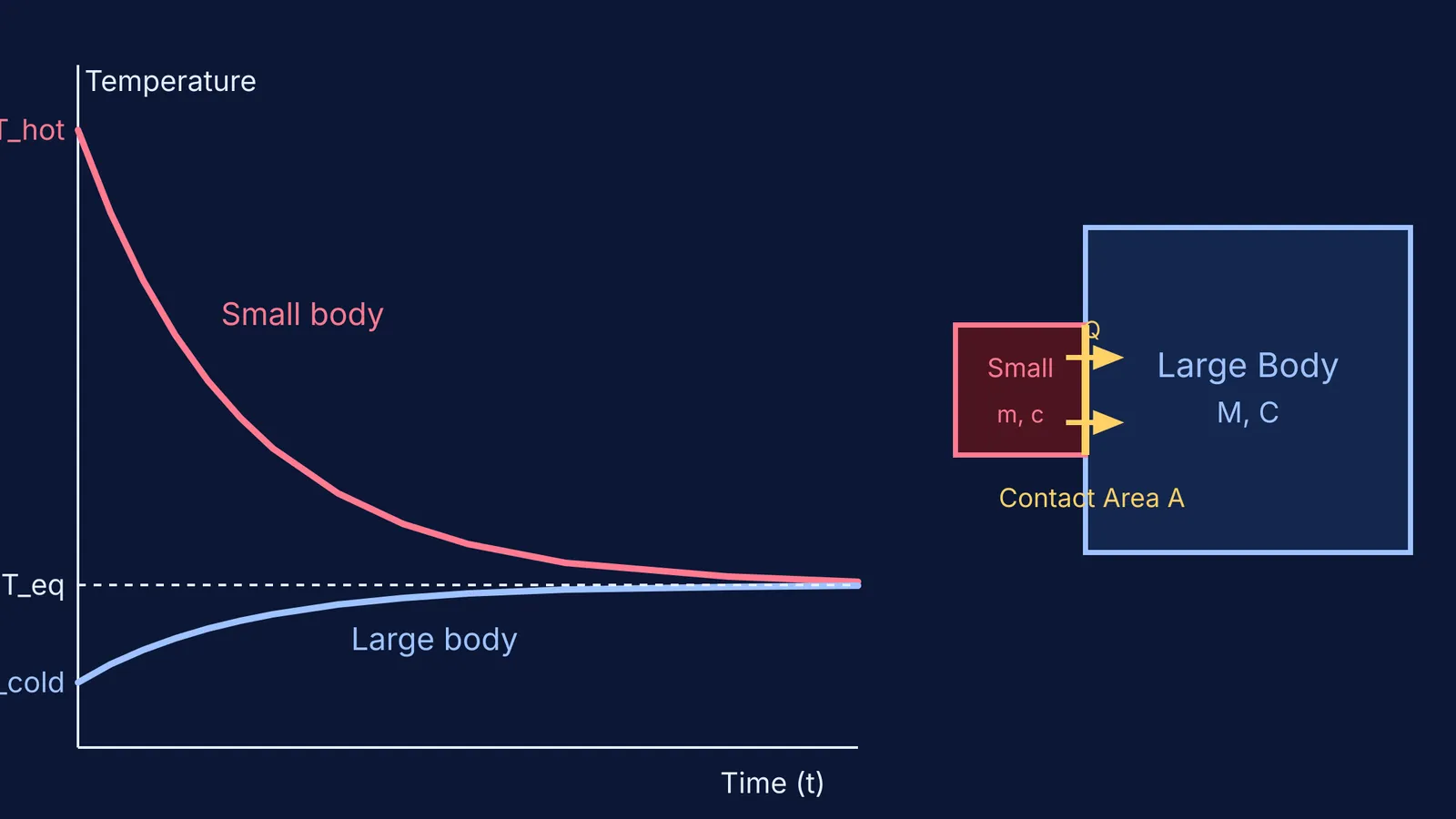
When a small, hot block is placed on top of a massive block of cold steel, you might wonder which one reaches thermal equilibrium first. The truth is that they reach it at the exact same moment. Thermal equilibrium is a shared state: it occurs when the two objects no longer transfer net heat to one another, which means their temperatures have become equal. One body cannot be in equilibrium with the other if the other is not in equilibrium with it.
However, the way they approach this shared temperature is vastly different. The small body undergoes a rapid temperature change, moving towards the final equilibrium point, while the large body's temperature barely shifts.
How does thermal mass affect equilibrium time?
Even though two objects in contact finish their temperature change together, the small object is doing most of the "changing".
The ability of an object to store thermal energy is its thermal mass, calculated as its mass multiplied by its specific heat capacity (m × c). A smaller body has less mass, meaning it requires far fewer joules of heat energy to change its temperature by one degree. As heat flows between the two bodies, the small body’s low thermal mass allows its temperature to drop or rise quickly. The large body’s immense thermal mass acts like an anchor, absorbing the heat with only a tiny shift in temperature.
What happens when bodies are placed in a room?
The scenario changes if you place a small hot stone and a large hot boulder into a large, cold room without them touching each other. In this case, the small stone reaches the room's temperature significantly faster.
The speed of this cooling process is governed by Newton's law of cooling. The law states that the rate of heat transfer is proportional to the contact area and the temperature difference between the object and its environment.
In physics, the time it takes an object to approach equilibrium with a constant-temperature environment is measured by the thermal time constant (τ), given by the formula:
τ = (m × c) / (h × A)
Where:
m is the mass
c is the specific heat capacity
h is the heat transfer coefficient
A is the contact surface area
According to the lumped capacitance model (Simon Fraser University), after one time constant has passed, the temperature difference between the object and its environment drops by about 63.2%. A larger mass (m) increases the time constant, meaning the object cools slower. Conversely, a larger surface area (A) speeds the process up.
How to use this in exam problems
When dealing with heat transfer questions in exams, reading the scenario carefully is crucial.
Isolated two-body systems: If two blocks are insulated from the outside world, use the conservation of energy. The heat lost by the hot body equals the heat gained by the cold body. If you are struggling to set up these equations, the Fermi Problem Library has worked problems with a step-by-step solver that explains the reasoning rather than printing an answer, helping you map out the mcΔT steps.
One body in a vast environment: If the question asks about a single object cooling in air or water, treat the environment's temperature as a constant. The object with the smaller time constant (τ) reaches equilibrium first.
Rate versus amount: Be careful to distinguish between the rate of temperature change (which is high for the small body) and the total heat energy transferred (which is exactly equal for both bodies in a closed system).
If you need a refresher on these foundational definitions, the Fermi Concept Library covers every concept in physics, chemistry, biology, mathematics and computing, each with its own lesson and its place in the map. This lets you review heat transfer coefficients and thermal time constants visually. You can also explore related topics to build a stronger intuition for thermodynamics, such as the heat in isobaric and isochoric processes: using nCpΔT and nCvΔT or calculating the time for ice to form on a pond: conduction with growing thickness.


