

On this page
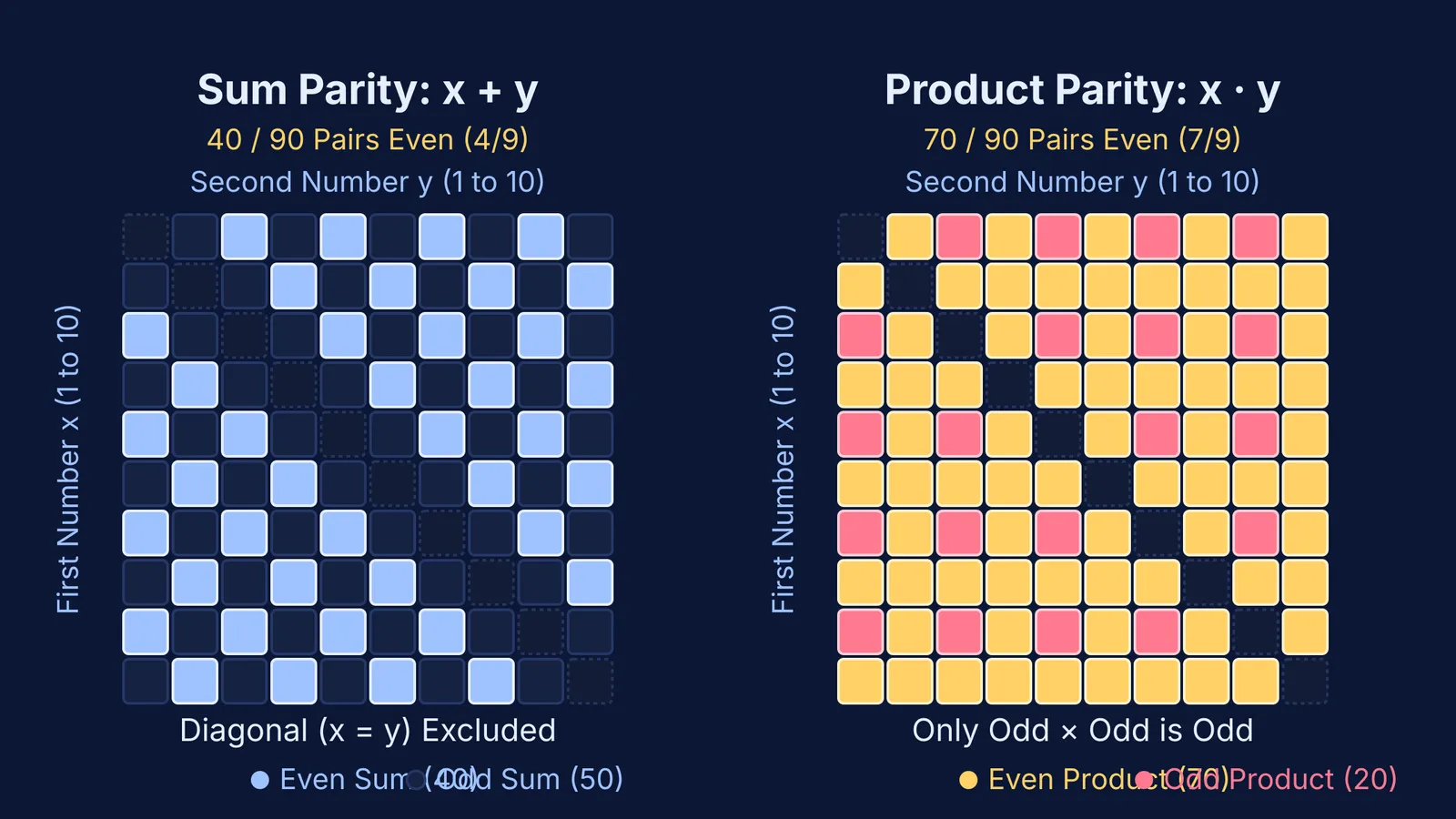
When choosing two numbers at random from consecutive integers, what is the probability that their sum is even? Most students immediately guess 1/2, assuming even and odd sums occur with equal likelihood. On standard secondary and competitive examinations, that quick intuition often costs marks. The true probability depends strictly on the parity split and replacement rules. For two distinct numbers chosen from 1 to 10 without replacement, the probability of an even sum is 4/9, rather than 1/2.
Why is the sum of two chosen numbers even?
To find whether the sum of two integers is even, you examine their arithmetic parity. An integer sum is even in exactly two situations:
both chosen numbers are odd (odd + odd = even)
both chosen numbers are even (even + even = even)
If you select one odd number and one even number, their sum is always odd. Therefore, an even sum is the union of two mutually exclusive events: selecting two odd numbers or selecting two even numbers. In the senior secondary curriculum prescribed by the Central Board of Secondary Education, probability carries 8 marks in Class 12 and combines with statistics for 12 marks in Class 11, where partitioning sample spaces into disjoint subsets is a core skill.
To evaluate any parity selection problem systematically, follow two steps:
Count the available numbers in each parity category: find the number of odd integers (n_o) and even integers (n_e) in the given set.
Determine whether the selection occurs with replacement or without replacement, which fixes the denominator and decides whether individual picks are independent.
How do you calculate the probability with and without replacement?
The calculation method depends entirely on whether the chosen numbers can repeat.
Selection with replacement. When two numbers are chosen with replacement from {1, 2, ..., 10}, each selection is an independent trial. Because the set contains 5 odd and 5 even numbers, each draw has a probability of 5/10 = 1/2 for either parity:
P(both odd) = (1/2) × (1/2) = 1/4
P(both even) = (1/2) × (1/2) = 1/4
Adding these disjoint outcomes gives P(sum is even) = 1/4 + 1/4 = 1/2. In this independent setting, the intuitive 1/2 answer holds. You can examine how independent draws differ from dependent draws in our guide to with and without replacement probability problems.
Selection without replacement. When two distinct numbers are chosen from {1, 2, ..., 10}, the total number of unordered pairs is ¹⁰C₂ = (10 × 9) / 2 = 45.
Now count the favourable pairs:
Both numbers are odd: choose 2 from 5 odds, giving ⁵C₂ = 10 pairs.
Both numbers are even: choose 2 from 5 evens, giving ⁵C₂ = 10 pairs.
Total favourable pairs equal 10 + 10 = 20, giving: P(sum is even) = 20 / 45 = 4/9
Why does this drop below 1/2? Whichever number you draw first leaves 9 numbers in the pool. Of those 9, only 4 share the parity of your first pick, while 5 have the opposite parity. The probability that the second number matches the first is therefore 4/9.
For any set of 2k consecutive integers containing k odds and k evens, the general formula is: P(sum is even) = [2 × ᵏC₂] / ²ᵏC₂ = (k − 1) / (2k − 1)
When k = 5, this yields (5 − 1) / (10 − 1) = 4/9. If the set has an odd total count, such as {1, 2, ..., 11} with 6 odds and 5 evens, total pairs equal ¹¹C₂ = 55. The favourable pairs are ⁶C₂ + ⁵C₂ = 15 + 10 = 25, producing a probability of 25/55 = 5/11. For further practice setting up these combinations, read our guide on selection problems with combinations.
Research by Carmen Batanero and colleagues analyzing 720 secondary students across 13 combinatorial problem types in Educational Studies in Mathematics showed that students frequently misapply independent sampling formulas to non-replacement tasks. Similarly, Marie-Paule Lecoutre's classic study on the equiprobability bias in Educational Studies in Mathematics highlighted how learners instinctively assume an equal 50% split for binary outcomes.
When working through multi-step counting problems where sampling rules change the calculation, the Fermi Problem Library provides worked problems with a step-by-step solver that explains the reasoning rather than printing an answer.
What is the probability that the product of two chosen numbers is even?
A common companion question asks for the probability that the product of the two chosen numbers is even. Multiplying integers follows a different rule than addition:
odd × odd = odd
even × even = even
odd × even = even
even × odd = even
An integer product is even whenever at least one factor is even. Rather than summing three separate cases (even-even, odd-even, even-odd), use complementary counting. The only outcome that yields an odd product is choosing two odd numbers: P(product is even) = 1 − P(both odd)
Using {1, 2, ..., 10} without replacement:
Total pairs = ¹⁰C₂ = 45
Both odd pairs = ⁵C₂ = 10
P(both odd) = 10 / 45 = 2/9
Subtracting from one gives P(product is even) = 1 − 2/9 = 7/9. Comparing the two companion questions side by side reveals a clear contrast:
P(sum is even) = 4/9
P(product is even) = 7/9
Failing to use complementary probability on product questions is one of the common reasoning mistakes in probability that costs time during examinations.
How can you avoid common traps in exam questions?
To solve parity selection questions accurately under exam conditions, apply this four-step checklist:
Write down the subset sizes: Split the set into odd and even counts before doing any arithmetic. For 1 to n, verify whether n is even (n/2 odds, n/2 evens) or odd ((n+1)/2 odds, (n−1)/2 evens).
Check the replacement condition: Look for phrases such as "without replacement", "drawn together", or "simultaneously", which require combination counting with ⁿC₂.
Distinguish sum from product: For an even sum, calculate P(both odd) + P(both even). For an even product, calculate 1 − P(both odd).
Apply the parity depletion check: If choosing two items without replacement from an equal split of odds and evens, your answer for an even sum must always be strictly less than 1/2.
If you are reviewing probability fundamentals, the Fermi Concept Library covers every concept in physics, chemistry, biology, mathematics and computing, each with its own lesson and its place in the map. For targeted practice, Fermi's AI tutor can work out what you already know and build a plan for the session, noticing where you get stuck between independent and dependent conditions.


