

On this page
When you turn off a ceiling fan, it does not stop instantly. Instead, it coasts to a halt. The time it takes is a classic demonstration of rotational kinematics, where a spinning object loses its kinetic energy due to opposing forces.
Why does a fan take so long to stop?
Once the electrical power is cut, the motor stops driving the blades. However, the fan has built up rotational inertia (also called moment of inertia). As ScienceABC explains, without an active brake to absorb this energy, the fan relies on passive forces:
Aerodynamic drag: The blades push against the air. A steeper blade pitch creates more air resistance, acting as a natural brake that slows the fan more quickly.
Bearing friction: The internal motor bearings generate friction. A well-lubricated fan has less friction and will spin for longer, whereas a dusty or older fan will stop much sooner.
Because these forces are relatively small compared to the inertia of the heavy spinning blades, a ceiling fan takes a surprisingly long time to decelerate.
How many seconds does it take for a ceiling fan to stop spinning?
In everyday conditions, a standard residential ceiling fan spinning at a high speed of 300 RPM—a typical rate noted by Wikipedia—often takes around 30 seconds to stop completely once the switch is turned off.
This gives us a perfect real-world example to calculate angular deceleration. If we assume the deceleration is constant, we can apply the equations of rotational motion.
Calculating the fan's angular deceleration
To find out how quickly the fan is slowing down, we use the first equation of rotational kinematics: ω = ω₀ − αt
Where:
ω is the final angular velocity (0, since the fan stops).
ω₀ is the initial angular velocity. For the fan at 300 revolutions per minute (RPM) from Wikipedia, we first convert this to revolutions per second: 300 / 60 = 5 rev/s. To get radians per second, multiply by 2π: 5 × 2π ≈ 31.4 rad/s.
t is the time taken to stop. Using our 30 seconds:
α is the angular deceleration.
Rearranging the formula to solve for α: α = ω₀ / t α = 31.4 rad/s / 30 s ≈ 1.05 rad/s²
So, the fan slows down at a rate of roughly 1.05 rad/s every second.
What forces cause this angular deceleration?
To understand why the angular deceleration is only 1.05 rad/s², we must look at the opposing torque. Newton's second law for rotation states that the net torque equals the moment of inertia multiplied by the angular acceleration.
For a ceiling fan, the moment of inertia is relatively large because the fan has long blades made of wood, plastic or metal. The mass of these blades is distributed far from the axis of rotation.
The opposing torque comes from two main sources:
Aerodynamic drag: As the fan blades spin, they collide with air molecules. This creates a drag force that opposes the motion. Drag depends on the shape of the blades and their pitch (the angle at which they are tilted). At higher speeds, such as 300 RPM as per Wikipedia, drag is the most significant slowing force because it increases with the square of the angular velocity.
Mechanical friction: The motor's bearings allow the fan to rotate smoothly. While they are designed to be as frictionless as possible, they still provide a constant, small opposing torque. When the fan slows down and aerodynamic drag becomes negligible, bearing friction becomes the primary reason the fan finally stops.
Because the total opposing torque is small and the moment of inertia is large, the resulting angular deceleration is very small. This is why a fan might take 30 seconds—or even a minute—to finally come to rest.
How many revolutions does a fan make before stopping?
We can also find out exactly how many times the fan spins while it is coasting to a halt. For this, we use the second equation of rotational motion: θ = ω₀t − ½αt²
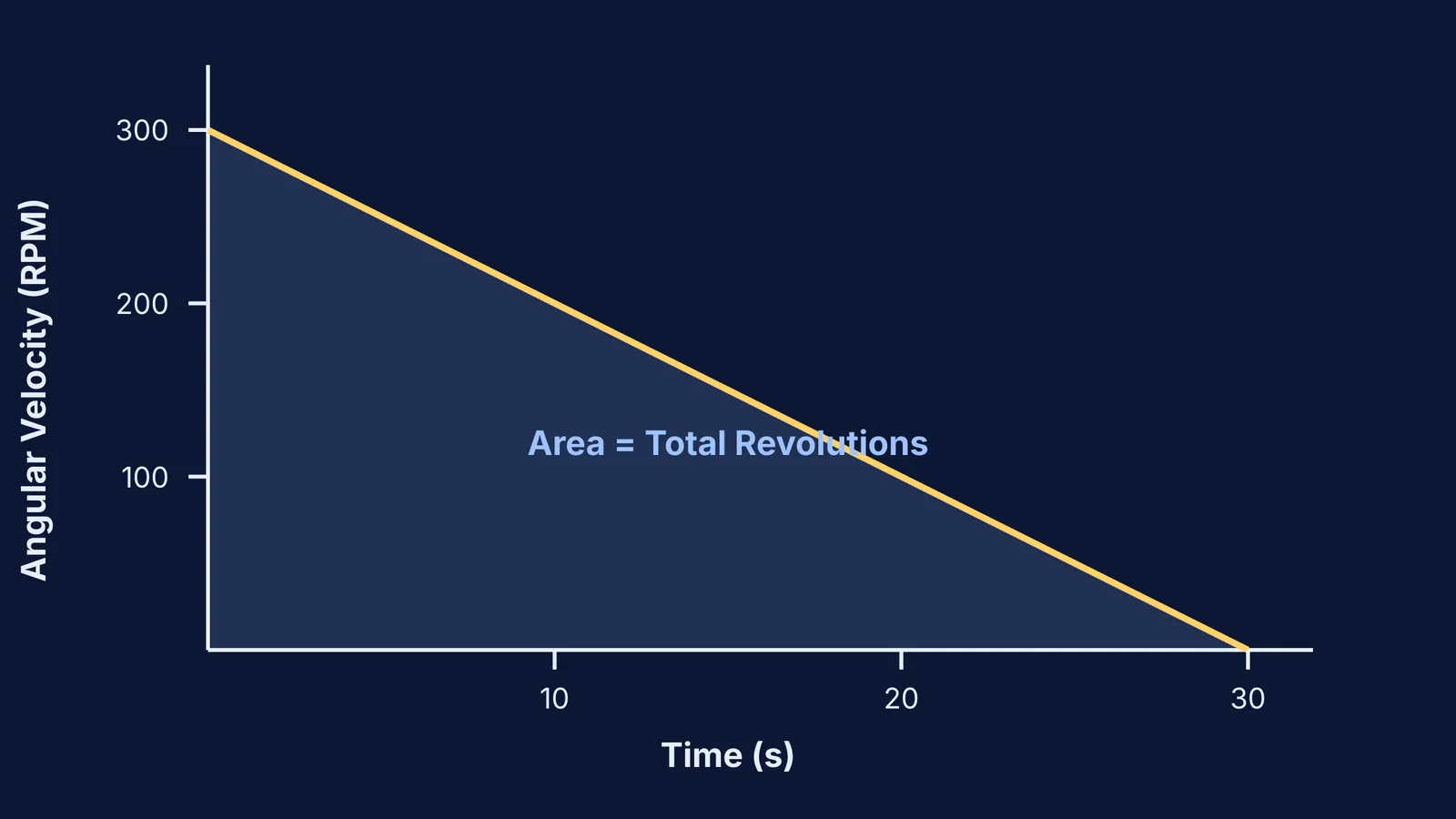
However, there is a quicker way using the average angular velocity. Since the deceleration is constant, the average speed is simply half of the initial speed of 300 RPM: Average speed = (5 rev/s + 0 rev/s) / 2 = 2.5 rev/s
If it spins at an average of 2.5 revolutions per second for 30 seconds, the total number of revolutions is: 2.5 rev/s × 30 s = 75 revolutions.
Alternatively, you can picture this on an angular velocity-time graph. The area under the line represents the total angular displacement. The area of a triangle is ½ × base × height, which gives ½ × 30 seconds × 5 rev/s = 75 revolutions.
These types of everyday physics problems are an excellent way to practise kinematics. If you want to master rotational motion, the Fermi Concept Library breaks down angular velocity, torque and moment of inertia step by step. You can also explore worked examples like distance in the nth second and variable acceleration as a function of velocity to see how these equations adapt to different scenarios.


