

On this page
What happens when you leave a piece of bread in a warm, moist container? Within days, it turns black and fuzzy. This is *Rhizopus stolonifer*, the common bread mold. While it might look like a simple nuisance, its ability to colonize food so quickly comes down to a highly efficient method of asexual reproduction: spore formation inside specialized structures called sporangia.
For students preparing for biology exams, understanding how *Rhizopus* reproduces is a classic case study in fungal life cycles. It shows how an organism balances rapid spreading with the need to survive when the environment dries out.
What are the key structures involved?
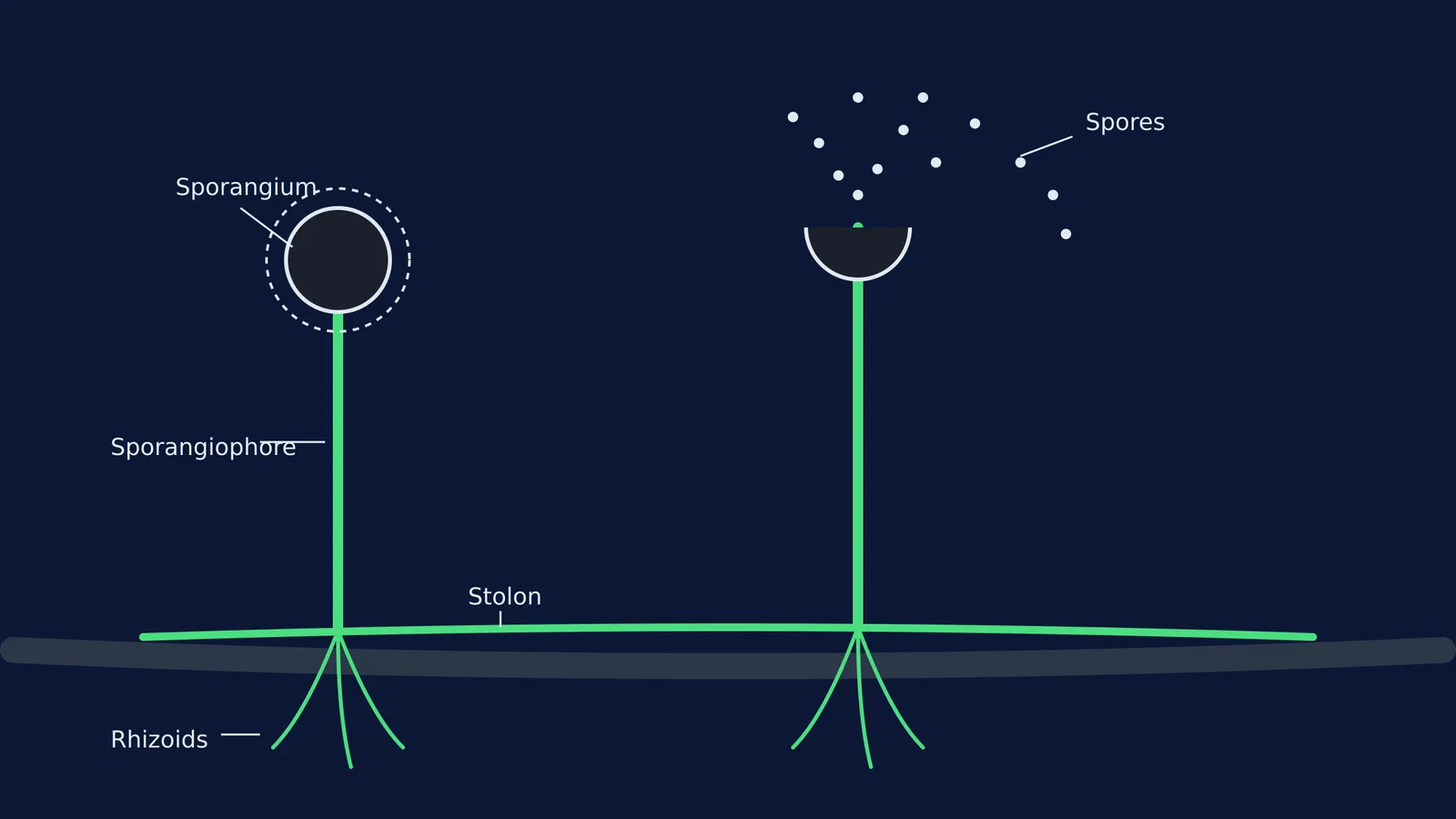
The fuzzy growth you see on bread is the vegetative body of the fungus, called the mycelium. It is made up of thread-like filaments called hyphae. To reproduce asexually, *Rhizopus* develops specific structures:
Stolons: Hyphae that grow horizontally across the surface of the food.
Rhizoids: Root-like hyphae that grow downwards to anchor the fungus and absorb nutrients.
Sporangiophores: Aerial hyphae that stand upright from the stolons.
Sporangium: The swollen, sac-like structure at the very tip of the sporangiophore where spores are made.
How does spore formation happen in Rhizopus sporangia?
As the sporangiophore grows upwards, its tip swells to form the sporangium. Inside this sac, the cytoplasm and nuclei divide rapidly in a process called cleavage. This creates many microscopic, non-motile reproductive units known as sporangiospores.
While these spores mature, the sporangium itself turns black—giving the mold its dark appearance. Eventually, the thin outer wall of the sporangium dries out and ruptures. Because the spores are incredibly light, they are easily caught by air currents and scattered over long distances.
How do spores survive and germinate?
A single sporangium can release many spores, but not all of them will find a good home immediately. To protect against this, each sporangiospore is covered by a thick, resilient wall that prevents it from drying out. They can remain viable in the air or on dry surfaces for long periods.
For a spore to actually "wake up" and germinate, it requires specific conditions:
Moisture: Spores must absorb large amounts of water to swell and push out a germ tube.
Temperature: According to its Wikipedia profile, *Rhizopus stolonifer* grows optimally between 25 and 30 °C, and its growth drops significantly outside this range.
Nutrients: Germination is much faster when the spore lands on a carbohydrate-rich substrate, like bread or fruit.
When these conditions are met, the spore germinates, grows new hyphae, and the cycle begins all over again.
If you are revising fungal life cycles and need to see how all these terms fit together, the Fermi Concept Library can help you trace the exact sequence from a germinating spore to a mature sporangium, making sure you never mix up a sporangiophore with a stolon.
How can you easily memorise the cycle for exams?
When studying this for an exam like NEET, reading a list of terms is rarely enough. Instead, practice drawing the cycle actively:
Draw a horizontal line for the stolon.
Draw roots going down (label them rhizoids).
Draw a stalk going up (label it the sporangiophore).
Draw a circle at the top (the sporangium) and fill it with dots (sporangiospores).
Draw one sporangium bursting to show dispersal by wind.
By connecting the visual structure to the function, the vocabulary becomes much easier to recall under pressure.
Read more on related topics in our guides to viruses, viroids and lichens and the steps of megasporogenesis.


