

On this page
Soil ecosystems sustain global food production and filter continental water supplies, yet modern industrial and agronomic practices increasingly overload topsoil with synthetic chemicals. When synthetic fertilisers, broad-spectrum pesticides, and plastic residues accumulate faster than natural biogeochemical cycles can break them down, soil fertility deteriorates. Understanding how chemical residues alter soil chemistry and subterranean food webs is essential for students exploring agricultural ecology and environmental chemistry.
What are the primary causes of soil pollution?
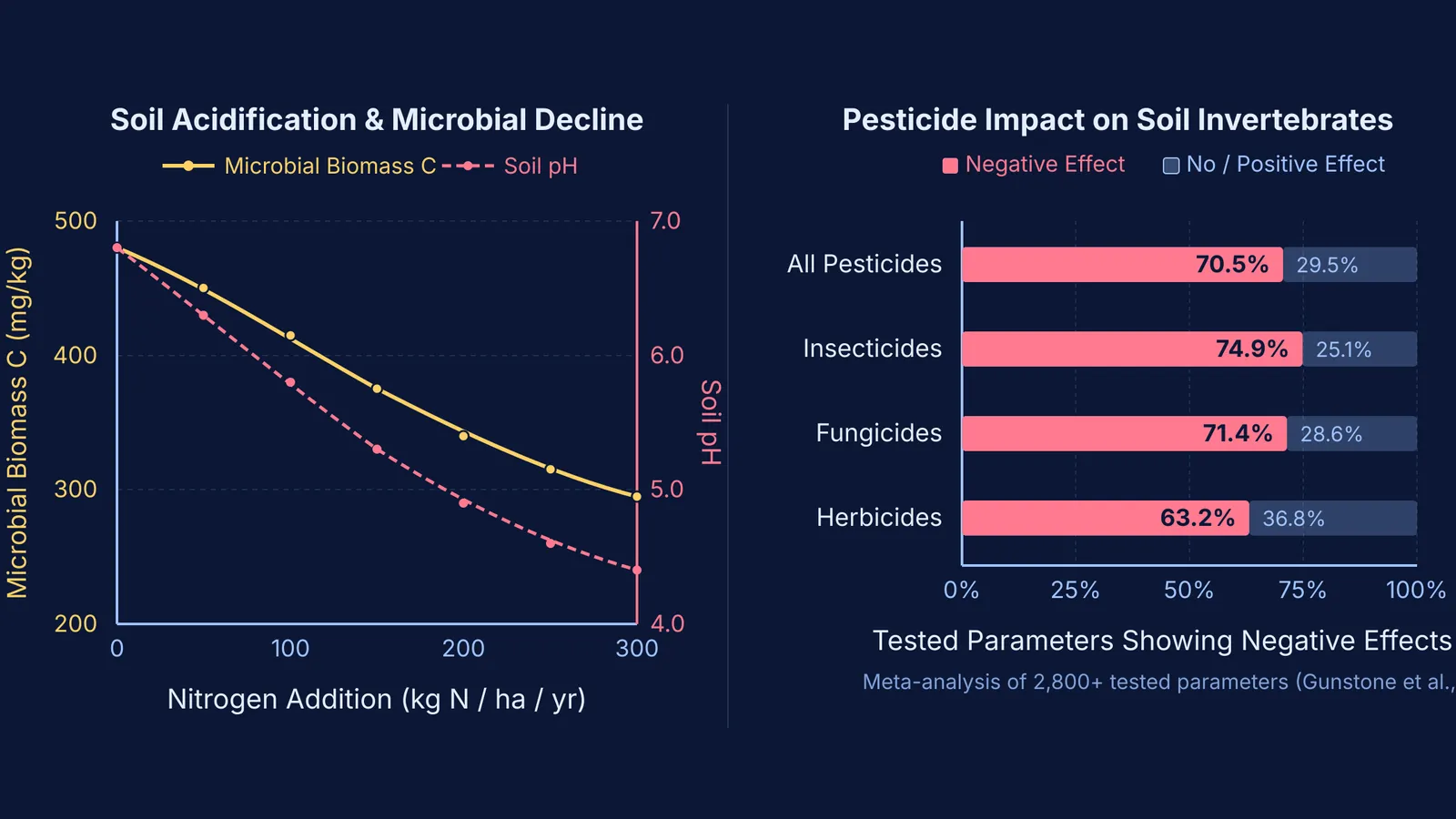
Agricultural expansion and chemical intensification drive the majority of non-point soil contamination across the globe. Between 2000 and 2017, global pesticide application expanded by 75%, while annual synthetic nitrogen fertiliser consumption surpassed 109 million tonnes (FAO and UNEP, 2021). When farmers apply nitrogen in excess of crop uptake capacity, the surplus alters soil stoichiometry and fuels chronic acidification.
Beyond agrochemicals, structural waste materials represent an escalating threat to arable land. According to the Food and Agriculture Organization, agricultural value chains consume roughly 12.5 million tonnes of plastic products each year for greenhouse sheeting, mulch films, and irrigation pipes. These polymers fragment under solar radiation and tillage into millions of microplastic particles per hectare. Concurrently, untreated industrial effluents and municipal sewage sludge introduce heavy metals like cadmium, copper, and lead into soil matrices. As explored in our analysis of biological magnification, persistent soil contaminants do not stay immobilised; they transfer upward through terrestrial food chains.
How do pesticides and fertilisers affect soil organisms?
Soils host intricate communities of earthworms, springtails, nematodes, and mycorrhizal fungi that maintain porosity and cycle nutrients. In an extensive synthesis of nearly 400 published investigations evaluating 275 soil invertebrate species, Gunstone and colleagues in Frontiers in Environmental Science revealed that pesticide exposure caused negative effects in 70.5% of more than 2,800 tested parameters. Insecticides and fungicides exhibited the highest toxicity, causing sharp reductions in earthworm cocoon production, cellular respiration, and burrowing activity.
Excessive synthetic fertilisers compound biological stress by disrupting microbial equilibrium. A global meta-analysis by Treseder in Ecology Letters synthesized 82 field trials and showed that nitrogen enrichment decreases total soil microbial biomass by an average of 15%. As chronic acidification strips calcium and magnesium from cation-exchange complexes, beneficial fungi and nitrogen-fixing bacteria diminish. Reversing this degradation requires the biological regeneration principles pioneered by George Washington Carver to restore depleted soil using legumes and organic matter.
How do microplastics and industrial wastes enter crops?
Subterranean contaminants do not remain restricted to interstitial pores; they directly invade crop tissues. Research published by Li and colleagues in Nature Sustainability demonstrated that submicrometre plastic beads penetrate root branching zones through mechanical cracks formed at lateral root emergence sites. Driven by the transpirational stream, these plastic particles move through the xylem into the stems and leaves of wheat (*Triticum aestivum*) and lettuce (*Lactuca sativa*).
When industrial waste, municipal wastewater, or contaminated sewage sludge introduce toxic metals like zinc and copper into agricultural soils, they significantly suppress soil microbial biomass carbon—depressing microbial populations by 7% to 12% even below statutory contamination thresholds, as evaluated in Environmental Pollution. Crop roots absorb mobile divalent metal ions through mineral transport channels, competing with essential micronutrients like iron and zinc. This induces root chlorosis and compromises harvest safety, highlighting the role of sustainable microbial inoculants explored in our guide to biocontrol agents and biofertilisers.
How can students analyse soil degradation problems?
Students studying environmental chemistry and biology encounter complex problems linking chemical stoichiometry, soil pH, and bioaccumulation. When reviewing how cation exchange capacity and redox equilibria govern contaminant mobility, the Fermi Concept Library provides structured lessons on every concept in physics, chemistry, biology, mathematics and computing, mapping how chemical equilibria govern soil nutrient dynamics.
To systematically evaluate soil pollution scenarios in exam questions or laboratory investigations, work through this four-step diagnostic approach:
Identify contaminant transport routes: Distinguish diffuse agricultural inputs from point-source industrial effluents and assess their residence times in the topsoil horizon.
Calculate stoichiometric imbalances: Quantify the ratio of applied nitrogen to crop assimilation, determining whether surplus ammonium will accelerate nitrification-driven proton release.
Quantify biological hazard thresholds: Compare toxicant concentrations against established ecotoxicological benchmarks, assessing how contaminant levels alter microbial population size and invertebrate survival.
Trace botanical uptake pathways: Determine whether pollutants enter crop roots apoplastically through lateral root emergence cracks or compete with essential micronutrients at membrane transporter sites.
When solving multi-step stoichiometry and nutrient-use efficiency calculations, the Fermi Problem Library offers worked problems with a step-by-step solver that explains the reasoning rather than printing an answer, ensuring you can connect microscopic root chemistry to whole-ecosystem outcomes.


