

On this page
The snow leopard (*Panthera uncia*) thrives in some of the most unforgiving environments on Earth. Found in the high mountains of Central and South Asia, including the Himalayas in India, this big cat faces freezing temperatures, deep snow, and thin air.
To survive in these conditions, the snow leopard has evolved a remarkable set of morphological and physiological traits. Whether you are studying animal adaptations for biology exams or just fascinated by mountain wildlife, these traits show how a body can tune itself to extreme cold and low oxygen. If you find it hard to picture how environments drive physical changes over generations, the Fermi Concept Library holds a lesson for every biology concept and shows its place in the wider map of science.
How does a snow leopard survive at high altitude?
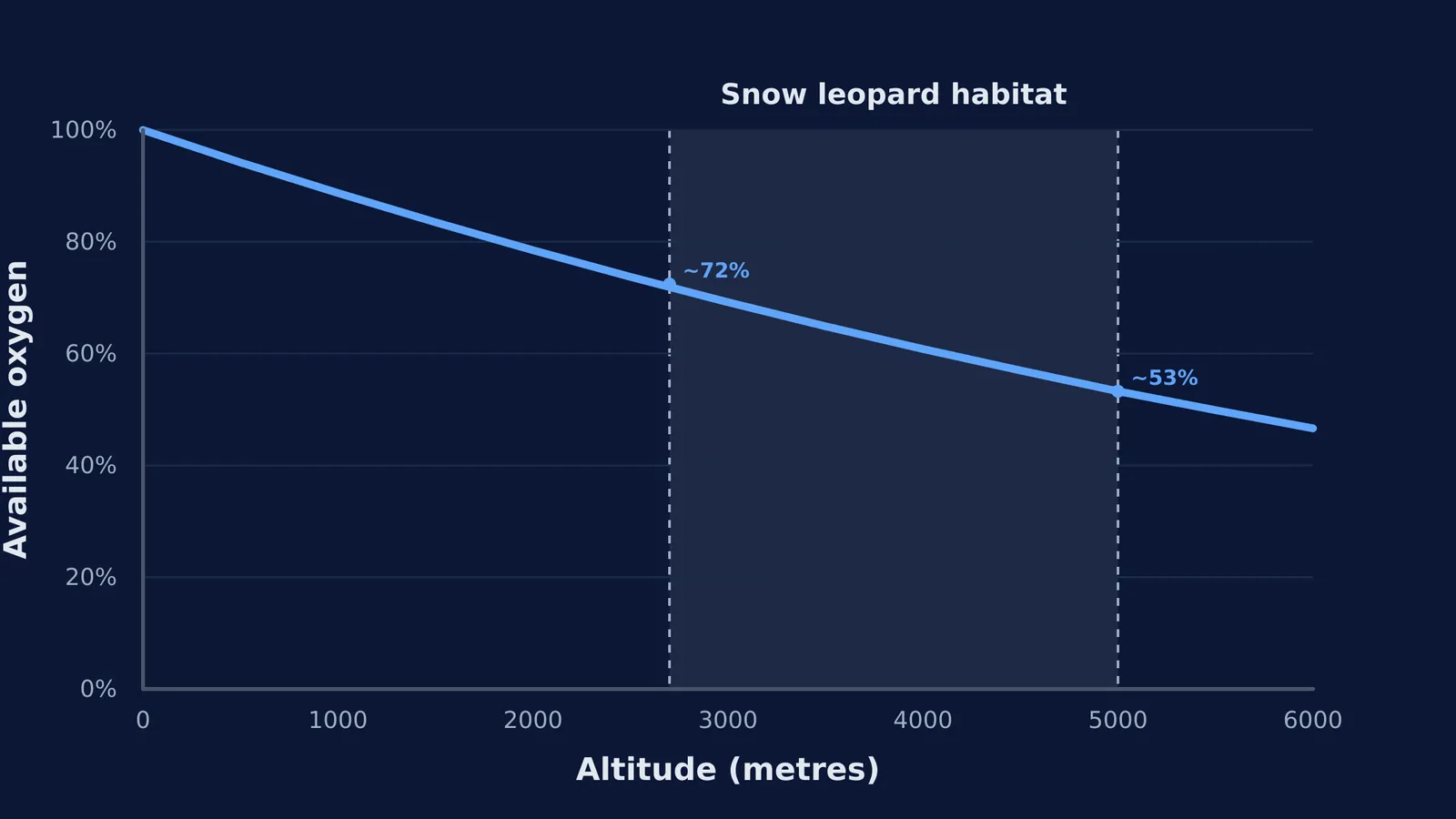
At elevations where most mammals struggle to catch their breath, snow leopards hunt and run with ease. The World Wide Fund for Nature (WWF) notes that snow leopards typically live at altitudes between 2,700 and 5,000 meters.
The air at this height is not only thin but also freezing cold. To handle this, snow leopards have a large, wide nasal cavity. This domed structure acts as an internal heater, warming the frigid mountain air before it reaches their lungs. They also possess well-developed chest muscles and large lungs, allowing them to draw in sufficient oxygen during strenuous climbs or pursuits across rocky slopes.
Why do snow leopards have thick fur and wide paws?
Temperature control is a constant battle in the snow. To prevent body heat from escaping, snow leopards possess an incredibly dense coat. While the fur on their back is thick, the fur on their belly can grow up to 12 cm long to insulate them from the freezing ground when they rest.
Moving through deep snow requires another physical adaptation. Their exceptionally large, wide paws act as natural snowshoes, distributing their body weight so they do not sink. The soles of their paws are also covered in fur, which provides extra insulation and serves as built-in grips to prevent slipping on ice. You can see highly specific environmental tuning in other species too, such as the distinct waste management systems of ammonotelic, ureotelic and uricotelic animals.
What is the function of a snow leopard's long tail?
A snow leopard's tail is one of its most striking features. Measuring between 80 and 105 cm, it is almost as long as the cat's entire body.
This massive tail serves three critical purposes:
Balance: When chasing prey across steep, uneven cliffs, the tail acts as a counterbalance. It allows the cat to make sudden turns and leaps of up to 15 meters in a single bound.
Warmth: When resting, the snow leopard wraps its bushy tail around its body and face like a thick scarf, trapping heat and protecting its nose from the biting wind.
Energy storage: Like many animals facing unpredictable food supplies, the snow leopard stores vital fat reserves in its thick tail to survive lean periods.
High-altitude adaptations in biology exams
Animal adaptations are a core topic in high school biology and competitive exams like NEET-UG. When studying, it is helpful to categorize adaptations by their purpose: thermoregulation (fur, fat), oxygen intake (nasal cavity, lungs), and mobility (paws, tail). Understanding these categories makes it easier to recall facts under pressure. If you are preparing for exams and need to review respiration or the formed elements of blood, Fermi's AI tutor works out what you already know and builds a plan for the session, giving you a clear next step.


