

On this page
Why does prime factorisation reveal the smallest multiplier?
In standard decimal notation, composite numbers hide their internal multiplicative structure. Looking at a number such as 252 does not immediately reveal whether its square root is an integer or which factors prevent it from forming a square. In a 2004 study published in the *Journal for Research in Mathematics Education*, researchers Rina Zazkis and Peter Liljedahl demonstrated that mathematical representations govern how learners perceive number properties (Zazkis & Liljedahl, 2004). While standard numerals are opaque to multiplicative structure, canonical prime factorisation provides a transparent representation where every factor and power is visible.
According to the Fundamental Theorem of Arithmetic, every integer greater than 1 can be expressed uniquely as a product of prime powers: n = p₁^(a₁) × p₂^(a₂) × … × p_k^(a_k). Taking the square root of a number divides each prime exponent by 2. For the resulting root to consist solely of integers, every exponent in the original number must be an even integer.
When a number is not a perfect square, at least one prime factor carries an odd exponent. To restore balance, you have two algebraic options: supply one additional copy of each unpaired prime through multiplication, or strip away the solitary prime through division. In both cases, the adjustment restores all exponents to even values.
How do you find the smallest number to multiply or divide?
Finding the least multiplier or divisor follows a systematic four-step procedure grounded in prime decomposition:
Decompose the number into its prime factors using successive division by primes.
Express the factorisation in exponent form, grouping identical prime factors into pairs.
Identify every prime factor whose exponent is odd.
Multiply these odd-powered prime bases together to obtain the required least number.
Consider the number 252, a standard problem from the NCERT Class 8 curriculum:
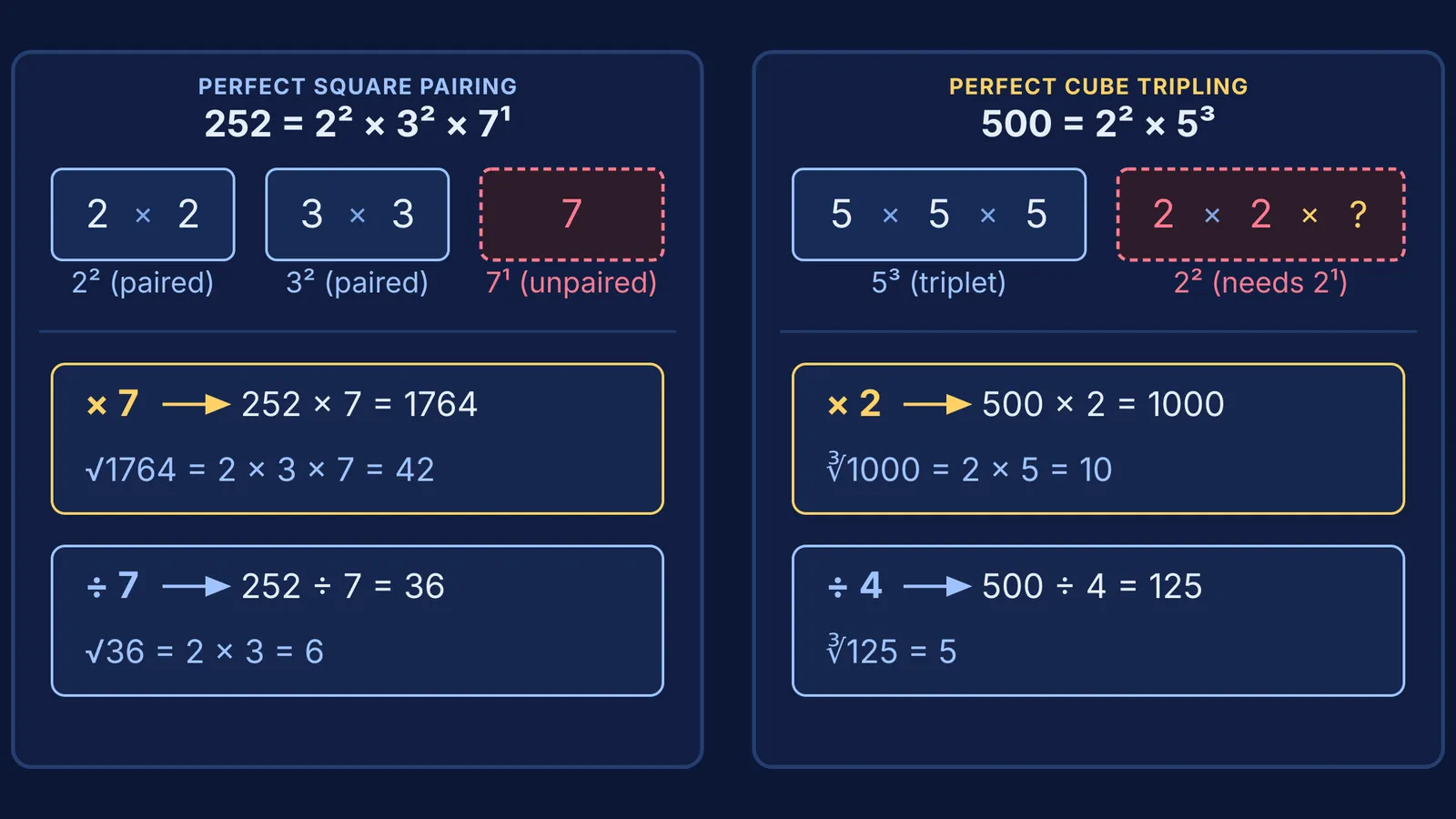
252 = 2 × 2 × 3 × 3 × 7 = 2² × 3² × 7¹
The prime factors 2 and 3 form complete pairs with exponent 2. The prime factor 7 appears with an odd exponent of 1, leaving it without a partner.
To make 252 a perfect square by multiplication, multiply by 7:
252 × 7 = 1764 = 2² × 3² × 7² = (2 × 3 × 7)² = 42²
To make 252 a perfect square by division, divide by 7:
252 ÷ 7 = 36 = 2² × 3² = (2 × 3)² = 6²
Under the official NCERT Learning Outcomes framework, students in Class 8 are expected to find square roots for numbers up to 4 digits using this factor method. Practising this pairing reinforces the core patterns taught in squares and square roots in Class 8.
How does the method change for perfect cubes?
For a number to be a perfect cube, every prime exponent in its canonical factorisation must be a multiple of 3 (such as 3, 6, or 9). While squares require factors to group in pairs, cubes require factors to assemble into triplets. Because of this three-way grouping, the smallest multiplier and the smallest divisor are rarely the same.
Consider the number 500. Its prime factorisation is:
500 = 2 × 2 × 5 × 5 × 5 = 2² × 5³
The prime factor 5 forms a complete triplet with exponent 3. The prime factor 2 has an exponent of 2, leaving its triplet incomplete:
To form a cube by multiplication, supply the complementary power needed to reach the next multiple of 3. Here, 2² needs 2¹ more: 500 × 2 = 1000 = (2 × 5)³ = 10³. The smallest multiplier is 2.
To form a cube by division, remove the excess factors so no partial group remains: 500 ÷ 2² = 500 ÷ 4 = 125 = 5³. The smallest divisor is 4.
While a square's multiplier and divisor always match, a cube's multiplier and divisor diverge based on the remainder modulo 3. If a prime's exponent has a remainder of 1 (such as 2¹), the multiplier must provide 2² = 4, whereas the divisor eliminates 2¹ = 2. In the NCERT Class 8 cubes chapter, this distinction is central to understanding cubes and cube roots in Class 8.
What common mistakes do students make in exam questions?
In timed exams, students commonly stumble over several avoidable traps:
Confusing multiplication with addition or subtraction. Questions that ask for the least number to add or subtract cannot be solved with prime factorisation. Those problems require the long division square root method to inspect the remainder. Prime factorisation applies only when multiplying or dividing.
Missing multiple unpaired primes. If a number has several odd exponents, you must multiply all of them together. For example, in 420 = 2² × 3¹ × 5¹ × 7¹, the unpaired factors are 3, 5, and 7. The smallest multiplier is 3 × 5 × 7 = 105.
Treating cube divisors like square divisors. In cube problems, students frequently divide by the prime base rather than the full remainder power. For 500 = 2² × 5³, dividing by 2 leaves 250, which is not a cube; you must divide by 2² = 4.
When students face multi-step factor trees or confuse division methods, the Fermi Problem Library provides worked problems with a step-by-step solver that explains the reasoning rather than printing an answer. For learners addressing gaps in exponent rules or prime decomposition, the Fermi Concept Library covers every concept in physics, chemistry, biology, mathematics and computing, each with its own lesson and its place in the map, linking foundational arithmetic to real numbers in Class 10.


