

On this page
What are slime moulds and how does a plasmodium form?
Slime moulds occupy a distinct ecological and evolutionary position within Kingdom Protista. While they share characteristics with multiple biological groups, taxonomists classify them as protists because they are eukaryotic organisms lacking complex tissue differentiation. In their vegetative state, slime moulds exhibit amoeboid creeping and engulf microbial prey through phagocytosis like protozoans. Yet during reproduction, they construct aerial spore-bearing capsules reminiscent of fungi, while their spores produce rigid cell walls containing cellulose like plants.
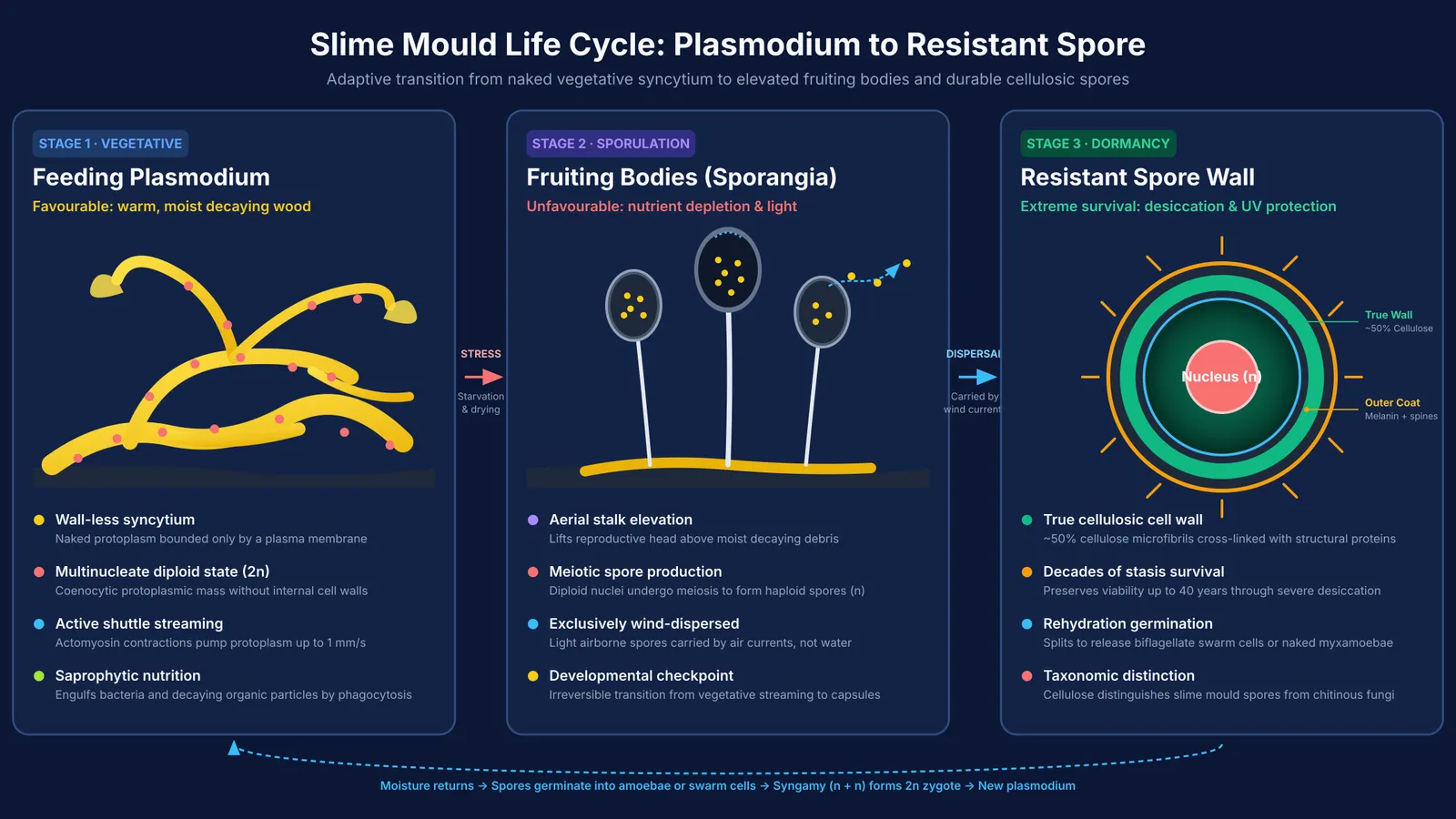
Under suitable, moisture-rich conditions with abundant decaying leaves and wood, slime moulds feed as saprophytes. Individual amoeboid units aggregate or undergo successive rounds of nuclear division without cytokinesis, generating a single, macroscopic, multinucleate mass of protoplasm termed a plasmodium. This streaming protoplasmic sheet completely lacks a cell wall, bounded only by a flexible plasma membrane and an extracellular slime sheath. A single plasmodium can crawl across decaying forest litter and spread over several feet.
Within the tubular network of the plasmodium, protoplasm flows through a phenomenon known as shuttle streaming. Rhythmic contractions of an actomyosin network pump cytoplasm back and forth, reaching velocities up to 1 mm/s (Nakagaki et al., 2000). This continuous hydrodynamic redistribution allows the organism to explore surrounding terrain, avoid repellents, and connect distant food sources along optimal transport routes (Tero et al., 2010). For students comparing single-celled and coenocytic organization, reviewing cell organelles and membranes clarifies how such vast protoplasmic sheets coordinate metabolic transport without internal partition walls.
Why does the plasmodium switch to fruiting bodies and spores?
When local nutrients run out or surrounding moisture evaporates, the vegetative plasmodium cannot sustain its sprawling protoplasmic network. Environmental stress, accompanied by light exposure, triggers an irreversible developmental shift known as sporulation.
The plasmodium ceases active migration, contracts its tubular veins, and condenses into localized mounds. These mounds surge upward, differentiating into delicate, elevated structures termed fruiting bodies or sporangia. Elevating the spore-bearing capsule above the substrate is essential for survival: it lifts reproductive cells away from wet decaying debris into ambient air currents for widespread dispersal.
Inside the apical capsule of each fruiting body, diploid nuclei undergo meiosis to produce haploid spores. Laboratory investigations show that sporulation is tightly regulated by nutrient deprivation and moisture loss; across more than 1,000 recognized myxomycete species, only approximately 10% have completed their full life cycle from spore to spore in artificial agar cultures (Haskins & Wrigley de Basanta, 2008).
Understanding how cellular organisms coordinate developmental transitions across varying environments requires tracing genetic pathways and morphological stages side by side. The Fermi Concept Library covers every concept in biology, each with its own lesson and its place in the map, helping you connect cellular signaling, ploidy shifts, and taxonomic groupings across protists and fungi.
What makes slime mould spores so resistant to extreme conditions?
The defining survival adaptation of slime moulds lies in their spores. While the feeding plasmodium is delicate and entirely wall-less, the spores possess true, rigid cell walls.
These true walls are predominantly composed of microfibrillar cellulose, which accounts for roughly 50% of the spore coat dry weight in model slime moulds, tightly bound to cysteine-rich structural proteins (Srinivasan et al., 2000). In many plasmodial species, the outer layer is further reinforced by melanin pigments and surface ornamentation such as spines or ridges. Melanin shields the dormant nucleus from solar ultraviolet radiation, while the cross-linked cellulosic scaffold resists desiccation and osmotic shock.
Because of this physical protection, slime mould spores remain viable across severe environmental extremes. Laboratory stasis tests and culture preservation records confirm that dormant spores can remain viable for up to 40 years before germinating upon rehydration (Haskins & Wrigley de Basanta, 2008).
This cellulosic composition also carries evolutionary significance. While true fungi construct cell walls out of chitin, slime mould spores rely on cellulose—a major reason taxonomists exclude them from how Kingdom Fungi differs in its four classes. When raindrops or damp conditions return, the spore wall splits open, releasing either naked myxamoebae or biflagellated swarm cells. These motile haploid cells feed, multiply, and eventually fuse in pairs (syngamy) to form a diploid zygote that grows into a new multinucleate plasmodium.
How do NEET questions test slime moulds and common traps?
The National Medical Commission (NMC) prescribes Class 11 Biological Classification as a core syllabus unit for NEET-UG. Past exam papers administered by the National Testing Agency (NTA) frequently test slime moulds through assertion-reason and multiple-choice questions designed around four subtle traps:
Condition inversion: Questions often claim that fruiting bodies form during favourable conditions. Remember the rule: favourable conditions yield the feeding plasmodium, whereas unfavourable conditions trigger fruiting body and spore differentiation.
Cell wall misplacement: Distractors frequently state that the plasmodium has a cell wall, or conversely that spores lack walls. The vegetative plasmodium is completely wall-less; only spores possess true walls.
Cell wall chemistry: Distractor options describe spore walls as chitinous. Slime mould spore walls contain cellulose, distinguishing them from fungi and atypical entities like viruses, viroids and lichens.
Dispersal agent trick: NEET options frequently replace air currents with water currents. Slime mould spores are aerial and dispersed exclusively by wind.
Use this systematic 4-point checklist whenever you evaluate a NEET question on slime moulds:
Check the environmental cue: Does the prompt specify favourable (plasmodium) or unfavourable (fruiting bodies) conditions?
Check the stage ploidy: Is it referring to the diploid multinucleate plasmodium or the haploid meiotic spores?
Verify wall presence and composition: Plasmodium = naked; spores = true cellulosic walls.
Confirm dispersal mode: Dispersed by air currents, not water.
Mastering these distinctions prevents marks loss on high-speed exam days. The Fermi Problem Library has worked problems with a step-by-step solver that explains the reasoning rather than printing an answer, helping you work through tricky diagnostic traps across biology questions.


