

On this page
A 2012 study of large longitudinal data sets in the US and UK found that a student's knowledge of fractions and division uniquely predicts their high school algebra and overall maths achievement 5 or 6 years later (Siegler et al., 2012). The transition from whole numbers to ratios and rational expressions is a major cognitive leap. As we explored in our review of how fractions and division predict later maths, mastering these forms early prevents students from hitting a wall in calculus or physics.
One of the most common places students stumble is when dealing with compound fractions—a fraction that has smaller fractions inside its numerator, its denominator, or both.
What is the problem with the invert and multiply method?
When a student first learns to divide fractions, they are taught to "invert and multiply." For a simple problem like (a/b) ÷ (c/d), this works perfectly.
However, in algebra, expressions are rarely that neat. Consider this complex fraction:
Numerator: 1/x + 1/y Denominator: 1/x − 1/y
If you try to apply the traditional invert and multiply method, you must follow four distinct steps:
Find a common denominator to add the terms in the top fraction.
Find a common denominator to subtract the terms in the bottom fraction.
Invert the newly formed bottom fraction.
Multiply the top fraction by the inverted bottom fraction.
Every step you add to an algebraic manipulation increases the risk of a careless error. You might drop a negative sign, flip the wrong term, or simply lose track of your variables. When dealing with advanced topics like integration by partial fractions, these multi-step simplifications become a massive drain on your time and focus during exams like the JEE.
How do you simplify a fraction within a fraction in algebra?
The most efficient way to simplify a compound fraction is the Least Common Multiple (LCM) method, often called "clearing the denominators." Instead of stacking operations, this method clears all internal fractions simultaneously.
Here is the three-step framework for clearing fractions:
Identify the inner denominators: Look at all the "little" fractions inside the main expression.
Find the LCM: Determine the least common multiple of all those inner denominators.
Multiply and distribute: Multiply both the main numerator and the main denominator by that LCM.
How do you clear denominators in one step?
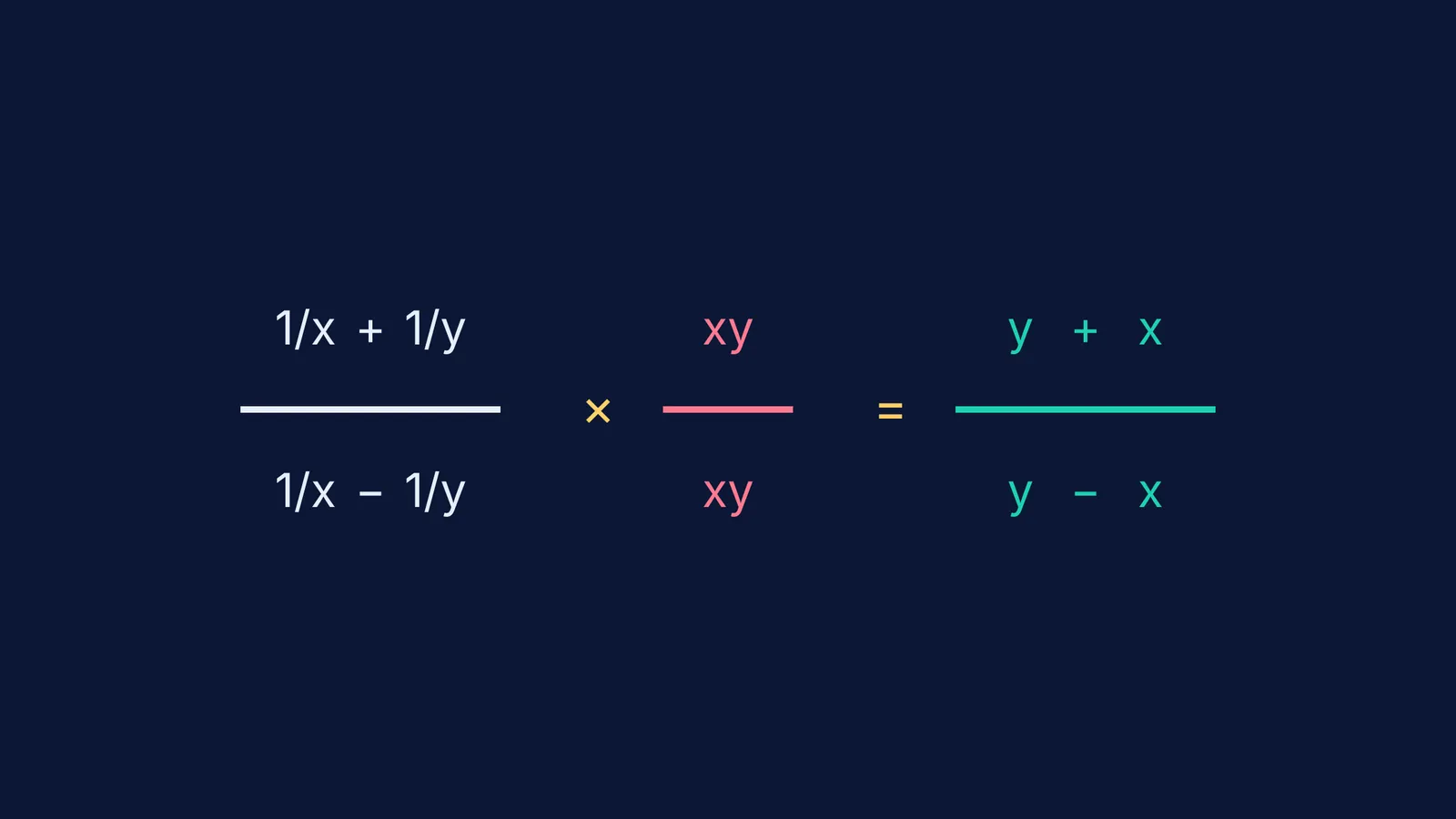
Let's apply this framework to our previous example:
Original expression: (1/x + 1/y) / (1/x − 1/y)
Step 1: The inner denominators are x and y. Step 2: The LCM of x and y is xy. Step 3: Multiply the entire top and the entire bottom by xy.
Top: xy × (1/x + 1/y) = y + x Bottom: xy × (1/x − 1/y) = y − x
The complex fraction instantly collapses into a clean, simple rational expression: (y + x) / (y − x)
What took four error-prone steps with the division method takes just one single distributive step with the LCM method. This technique scales beautifully. Whether you are working with fractions in Class 7 or solving complex rational limits in Class 12, clearing the denominators keeps your working memory free for the actual problem-solving.
How can an AI tutor build your algebraic fluency?
It is one thing to read about a mathematical shortcut, but it is another to remember to use it under exam pressure. Students often fall back on the messy methods they are most comfortable with.
This is where active practice makes a difference. The Fermi Problem Library provides worked problems with a step-by-step solver that explains the reasoning. If you are practising a problem and start taking the long, error-prone route, Fermi's AI tutor teaches rather than answers: it holds a line of reasoning across the session, notices where you are stuck, and decides whether to explain, ask, or show. It might pause to ask if you can find the LCM of the internal denominators instead. By guiding you to clear the fractions yourself, it builds the algebraic instincts you need to succeed.


