

On this page
When you need to prepare a solution hundreds or millions of times less concentrated than your starting stock, pipetting an imperceptible droplet introduces severe measurement error. Chemists and biologists overcome this physical limitation using a serial dilution: a stepwise, geometric sequence of transfers where each step dilutes the preceding solution by a fixed ratio. As explained in OpenStax Chemistry 2e Section 3.3, every dilution preserves the amount of solute transferred while increasing solvent volume, obeying the conservation relation C₁V₁ = C₂V₂.
In quantitative practice, the dilution factor (DF) describes the numerical multiplier by which volume expands and concentration drops. When you pipette an aliquot volume (V_aliquot) into a diluent volume (V_diluent), the final total volume is:
V_final = V_aliquot + V_diluent
The individual dilution factor represents the ratio of this final total volume to the initial aliquot volume transferred:
DF = V_final / V_aliquot
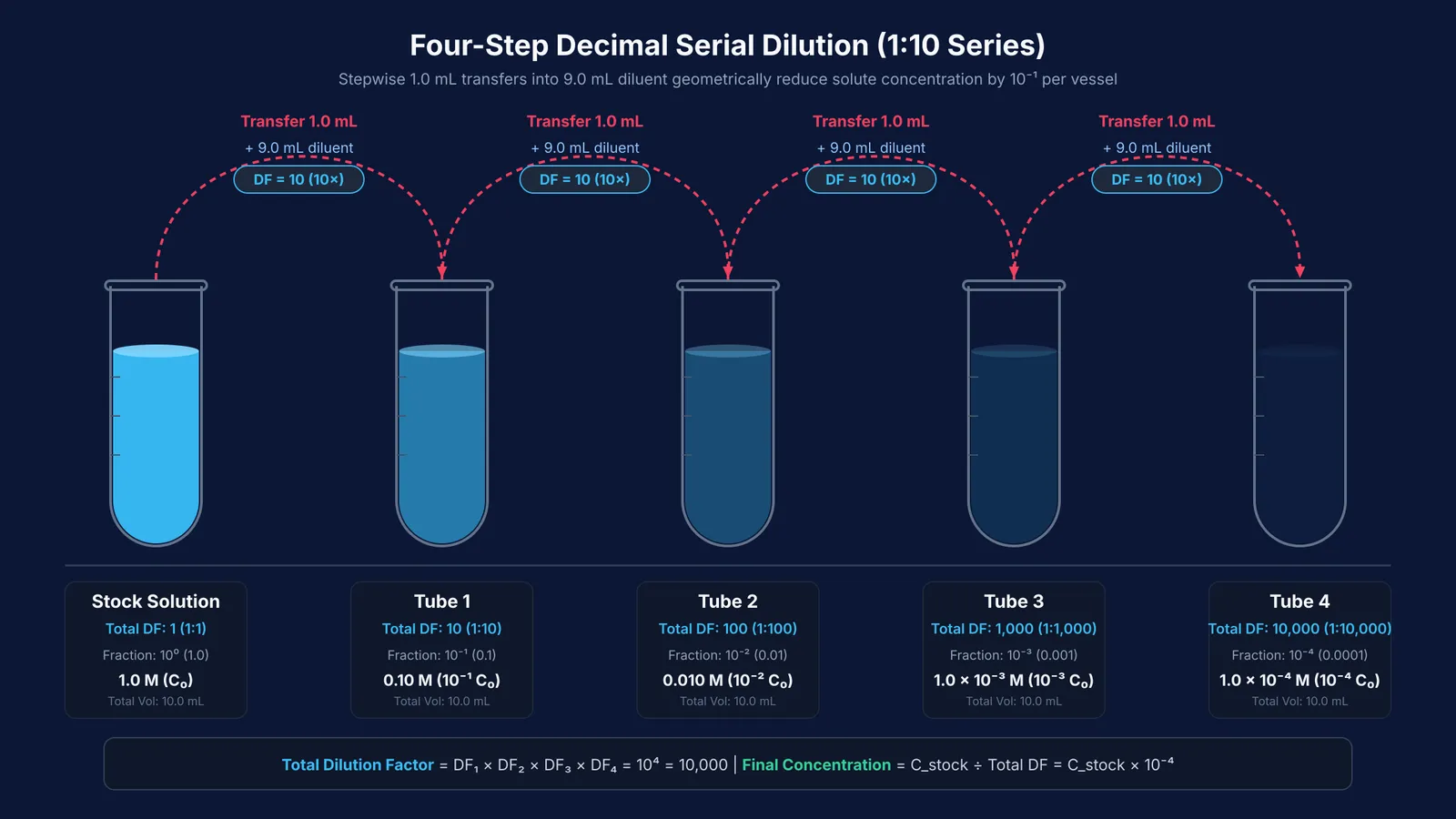
For example, when you pipette 1.0 mL of stock solution into 9.0 mL of solvent, the final volume becomes 10.0 mL. The dilution factor is 10.0 mL ÷ 1.0 mL = 10, commonly described as a 1:10 dilution or a 10-fold dilution. The dilution fraction is 1 / DF (here, 1/10 or 10⁻¹), meaning the solute concentration in the new vessel is exactly one-tenth of the parent solution drawn. The Fermi Concept Library covers every concept in physics, chemistry, biology, mathematics and computing, each with its own lesson and its place in the map, showing where solution stoichiometry and volumetric dilution fit.
How do you calculate individual and total dilution factors?
Rather than mixing each diluted standard from scratch, a serial dilution uses tube 1 to prepare tube 2, tube 2 to prepare tube 3, and so on. As documented in OpenStax Chemistry 2e Section 3.3, each successive transfer scales down the concentration of the preceding vessel, causing the cumulative dilution factor to compound multiplicatively:
Total Dilution Factor = DF₁ × DF₂ × DF₃ × ... × DFₙ
In a standard four-step decimal series:
Step 1: 1.0 mL stock into 9.0 mL diluent gives DF₁ = 10 / 1 = 10.
Step 2: 1.0 mL from tube 1 into 9.0 mL diluent gives cumulative DF = 10 × 10 = 100 (10²).
Step 3: 1.0 mL from tube 2 into 9.0 mL diluent gives cumulative DF = 100 × 10 = 1,000 (10³).
Step 4: 1.0 mL from tube 3 into 9.0 mL diluent gives cumulative DF = 1,000 × 10 = 10,000 (10⁴).
Individual dilution factors do not need to be identical at each stage. If a protocol uses an initial 5-fold dilution (1.0 mL into 4.0 mL diluent, DF = 5) followed by two consecutive 10-fold transfers (DF = 10 each), your total dilution factor is simply 5 × 10 × 10 = 500. For single-stage preparation rules, see our practical guide on diluting solutions to find final molarity.
How do you find the final concentration after multiple transfers?
Finding the solute concentration in any downstream vessel uses the standard dilution relation described in OpenStax Chemistry 2e Section 3.3. You can divide the starting stock concentration by the cumulative dilution factor, or multiply by the cumulative dilution fraction:
C_final = C_stock / Total Dilution Factor = C_stock × (1 / Total Dilution Factor)
Consider this worked laboratory calculation:
Stock solution: Copper(II) sulfate at 0.50 M.
Transfer series: Four successive tenfold transfers (1.0 mL into 9.0 mL water).
Cumulative factor: Total DF = 10⁴ = 10,000.
Final concentration: In vessel 4, C₄ = 0.50 M ÷ 10,000 = 5.0 × 10⁻⁵ M.
The arithmetic also works in reverse when analyzing biological cultures. According to OpenStax Microbiology Section 9.1, serial dilutions reduce dense suspensions to a countable range of 30 to 300 colonies per plate, avoiding statistical noise below 30 and colony overlap above 300. If plating 0.1 mL from a 1:10,000 dilution tube yields 50 colonies, you back-calculate the original culture density by multiplying 50 colonies by the dilution factor of 10,000 and the volume factor of 10 (since 0.1 mL is 0.10 mL of 1 mL), yielding 5.0 × 10⁶ colony-forming units per millilitre (CFU/mL).
Why do small pipetting errors compound across serial dilutions?
Serial dilutions avoid pipetting sub-microlitre volumes into large flasks, but they introduce compounding error: every vessel serves as the stock for the subsequent transfer.
A study by A. J. Hedges in the International Journal of Food Microbiology00022-3) demonstrated through theoretical modeling and computer simulations that volumetric pipetting imprecision compounds systematically across serial transfers. A minor systematic bias of +2% at each transfer does not simply add 2% to the final tube; across five successive transfers, it compounds to (1.02)⁵ = 1.104, introducing a 10.4% cumulative error into the final vessel.
To minimize this variance, testing protocols demand strict physical handling rules. The FDA Bacteriological Analytical Manual Chapter 3 mandates that in decimal dilutions (1 mL into 9 mL of sterile diluent), technicians must shake each container 25 times in a 30 cm arc within 7 seconds before making the next transfer. Incomplete mixing creates localized pockets that skew subsequent transfers. For algebraic error propagation across formulas, see our guide on combining absolute and percentage errors in measurement, along with our primer on converting between molarity, molality and mole fraction.
The Fermi Problem Library provides worked problems with a step-by-step solver that explains the reasoning rather than printing an answer, helping you master multi-stage dilution problems with confidence.
What is a practical checklist for serial dilution calculations?
When planning a serial dilution protocol, such as the decimal transfers outlined by the FDA Bacteriological Analytical Manual, follow this five-step routine:
Check volume units: Ensure aliquot and diluent volumes share identical units (both mL or both µL).
Determine total volume: Add V_aliquot and V_diluent to find V_final for each vessel.
Compute individual factors: Divide V_final by V_aliquot at each transfer step.
Multiply cumulative factors: Calculate Total DF = DF₁ × DF₂ × ... × DFₙ (or 10ⁿ for n tenfold steps).
Calculate final concentration: Divide stock concentration by Total DF, or multiply target concentration by Total DF to determine the required starting stock.


