

On this page
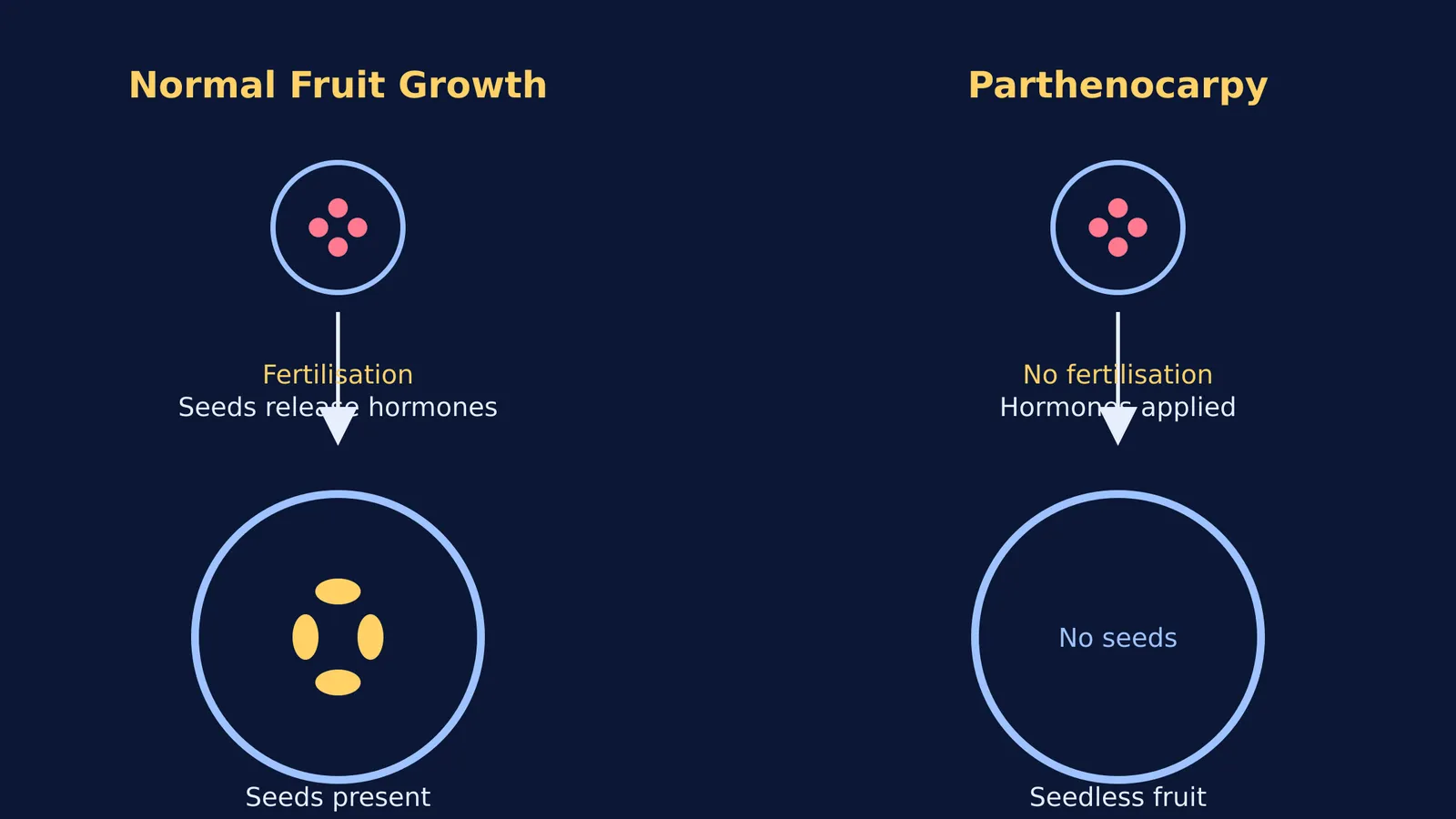
Normally, a fruit is a ripened ovary that develops after the ovules inside have been fertilised by pollen. The fertilised ovules become seeds, which contain the genetic material for the next generation. However, in botany and horticulture, parthenocarpy is the natural or artificially induced production of fruit without fertilisation of the ovules, leaving the fruit seedless.
In a natural setting, fertilisation acts as a biological checkpoint. If pollination fails, the flower usually drops off to conserve the plant's energy. But some plants, such as bananas and certain pineapples, carry a mutation that allows the ovary to expand into a fruit regardless. Because they cannot reproduce sexually by seed, farmers propagate them by vegetative means, taking cuttings or offshoots to grow new plants. This mechanism is entirely different from apomixis and polyembryony, where seeds actually form without fertilisation taking place, and it shouldn't be confused with the distinction between false fruits and parthenocarpy, where floral parts other than the ovary swell to form the flesh of the fruit.
How do auxins trigger fruit growth?
The ovary does not simply grow on its own. When fertilisation happens, the developing seeds start releasing vital growth hormones, primarily auxin (indole-3-acetic acid or IAA). This chemical signal diffuses into the surrounding ovary wall, telling the cells to divide, expand, and accumulate sugars to become a fleshy fruit.
Botanists discovered that they could trick a flower into keeping its ovary. By spraying synthetic auxins directly onto the stigma or ovary of an unpollinated flower, the plant receives the "grow" signal even though there are no seeds inside to produce it. For instance, in a 2007 study on tomatoes, researchers found that mutations in an Auxin Response Factor (ARF8) uncouple fruit initiation from fertilisation, resulting in naturally seedless tomatoes. When natural pollination is prevented by extreme temperatures or heavy rain, farmers often use these auxin sprays on their tomato crops to ensure a consistent harvest.
Why are gibberellins used on grapes?
While auxins are often the primary trigger for initial cell division and fruit set in tomatoes, gibberellins (GAs) are crucial for the subsequent cell elongation phase and are the hormone of choice for producing seedless grapes.
Gibberellic acid (GA₃) is applied commercially to seedless table grapes, such as the widely grown Thompson Seedless variety. A 1996 evaluation of GA₃ application timing on these grapes found that sprays during the prebloom and bloom stages are actually detrimental to bud viability for the next season. Interestingly, in these commercial grapes, fertilisation actually takes place, but the embryo aborts early in a condition known as stenospermocarpy. Because the seeds die prematurely, they stop producing the natural gibberellins needed to swell the berry to a commercially viable size. The external GA₃ spray replaces that missing hormone, leading to the large, plump, seedless grapes sold in supermarkets.
If you are confusing these hormones while revising for biology exams, you can look them up in the Fermi Concept Library. It covers every concept in physics, chemistry, biology, mathematics and computing, each with its own lesson and its place in the map.
What are the different types of seedlessness?
When reviewing plant reproduction and fruit development, it helps to distinguish how the different "seedless" mechanisms work on a biological level:
Parthenocarpy: The ovary develops into a fruit without any fertilisation taking place (e.g. bananas and seedless cucumbers).
Stenospermocarpy: Fertilisation occurs normally, but the seeds abort while they are still microscopic (e.g. commercial seedless grapes).
Artificial Parthenocarpy: Unpollinated flowers are sprayed with exogenous hormones, such as auxins or gibberellins, to force the ovary to swell into a fruit.


