

On this page
Seeds are the ultimate biological survival capsules, designed to protect the fragile plant embryo through harsh seasons until conditions are right for growth. While most seeds lose their viability after a few months or years, a few extraordinary species have evolved the ability to enter a state of deep dormancy that can last for centuries. For students studying sexual reproduction in flowering plants, the NCERT curriculum highlights three fascinating extremes: the oldest viable seed ever recorded, a remarkable 2,000-year-old runner-up, and plants that trade longevity for sheer numbers.
Which is the oldest viable seed?
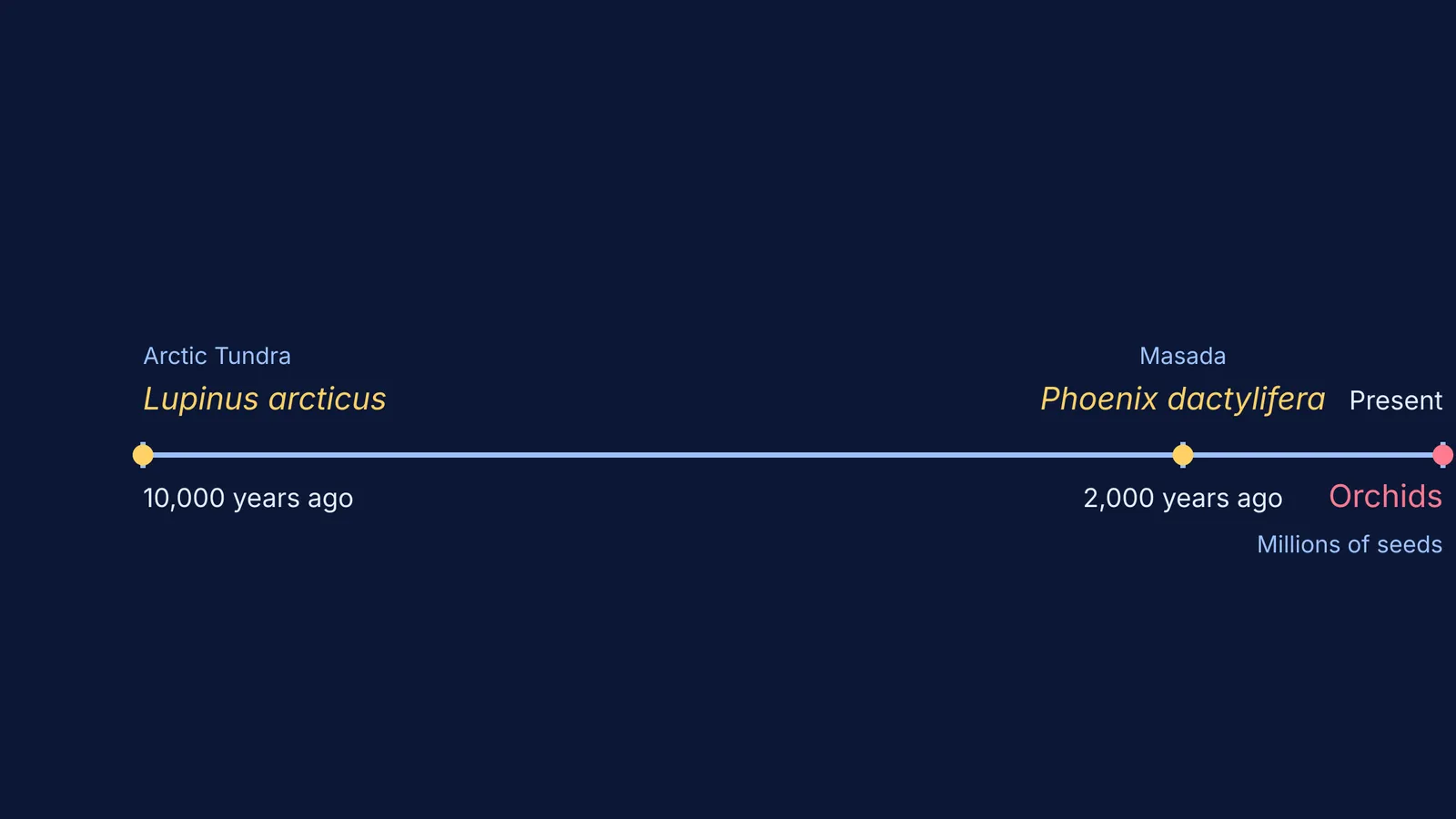
According to the NCERT biology syllabus, the record for the oldest viable seed belongs to the arctic lupine (*Lupinus arcticus*). The seeds were excavated from ancient lemming burrows buried deep in the permafrost of the Arctic tundra.
In a 1967 study published in *Science*, researcher A. E. Porsild reported that the seeds germinated within 48 hours of being placed on wet filter paper, eventually growing into healthy, flowering plants. Based on the surrounding geology and animal remains, the seeds were estimated to have an age of 10,000 years (Porsild et al., 1967).
This 10,000-year record remains the standard fact taught in biology classrooms today. Interestingly, later radiocarbon dating of the seeds by other scientists in 2009 suggested these specific seeds might have been modern contaminants that fell into the ancient burrows during mining operations (Zazula et al., 2009). However, for the purpose of the board exam, the 10,000-year dormancy of *Lupinus arcticus* is the expected answer.
If you find yourself mixing up these extreme examples, the Fermi Concept Library maps out every concept in biology with its own lesson, so you can focus on exactly what you need to know.
The Masada date palm: 2,000 years old?
The second major record belongs to the Judean date palm (*Phoenix dactylifera*). During archaeological excavations at King Herod’s palace near the Dead Sea in Israel—a fortress known as Masada—scientists discovered ancient seeds perfectly preserved by the region's extreme aridity.
Dr. Sarah Sallon and her team managed to germinate one of these seeds after pre-treating it with warm water and hormones, affectionately naming the resulting tree "Methuselah." Direct radiocarbon dating of the seed shell fragments clinging to the roots confirmed the seed was approximately 2,000 years old, dating back to between 155 BCE and 64 CE (Sallon et al., 2008). This remains the oldest directly dated seed to have successfully grown into a viable plant, and the team later germinated several more ancient seeds from the same region to study their genetics.
How many seeds do orchids produce?
While the lupine and date palm survive through extreme longevity, orchids use a different strategy: overwhelming numbers. Certain parasitic species like *Orobanche* and *Striga* produce vast numbers of tiny seeds, but orchids take this to the absolute extreme.
Orchid seeds are microscopic—often called "dust seeds." A single seed capsule from the Swan Orchid (*Cycnoches chlorochilon*) has been recorded containing approximately 3,770,000 seeds, often rounded up to 4 million in biological literature (Arditti & Ghani, 2000). Because these seeds lack a developed endosperm to provide food, they must form a symbiotic relationship with specific soil fungi immediately after landing. Producing millions of them is necessary just to ensure a few survive to germination.
Understanding what happens after fertilisation is just as critical. You can explore the structures that house these seeds in our guide to False fruits and parthenocarpy: what counts as a true fruit.
A framework for memorising biological extremes
When facing multiple extreme examples in a single chapter, passive reading is rarely enough. Use this three-step framework to lock these facts into your memory:
Link the organism to its environment: The arctic lupine (*Lupinus arcticus*) survived because it was frozen in the Arctic tundra. The date palm (*Phoenix dactylifera*) survived because it was desiccated in the dry environment near the Dead Sea.
Anchor the numbers: Associate "10,000" exclusively with the frozen tundra and "2,000" with the ancient palace.
Compare strategies: Contrast the *time* strategy (long dormancy of the lupine and date palm) with the *volume* strategy (millions of microscopic seeds in orchids, *Orobanche*, and *Striga*).
By grouping these facts logically rather than trying to memorise them as isolated bullet points, you will be much less likely to mix them up under exam pressure.


