

On this page
Connect a battery to a resistor, and it delivers some amount of electrical power. Swap in a different resistor, and the power usually changes. But a surprising result in circuit physics says that if two different resistors happen to draw the exact same power from a battery, you can instantly find the battery's internal resistance without any further measurements.
What happens when a battery delivers the same power to two resistors?
If a battery with an electromotive force (EMF) E and internal resistance r is connected to an external resistor R, a current I flows through the circuit. The power P delivered to the external resistor is given by P = I²R.
Because the total resistance of the circuit is R + r, the current is I = E / (R + r). The power delivered is therefore P = [E / (R + r)]² R.
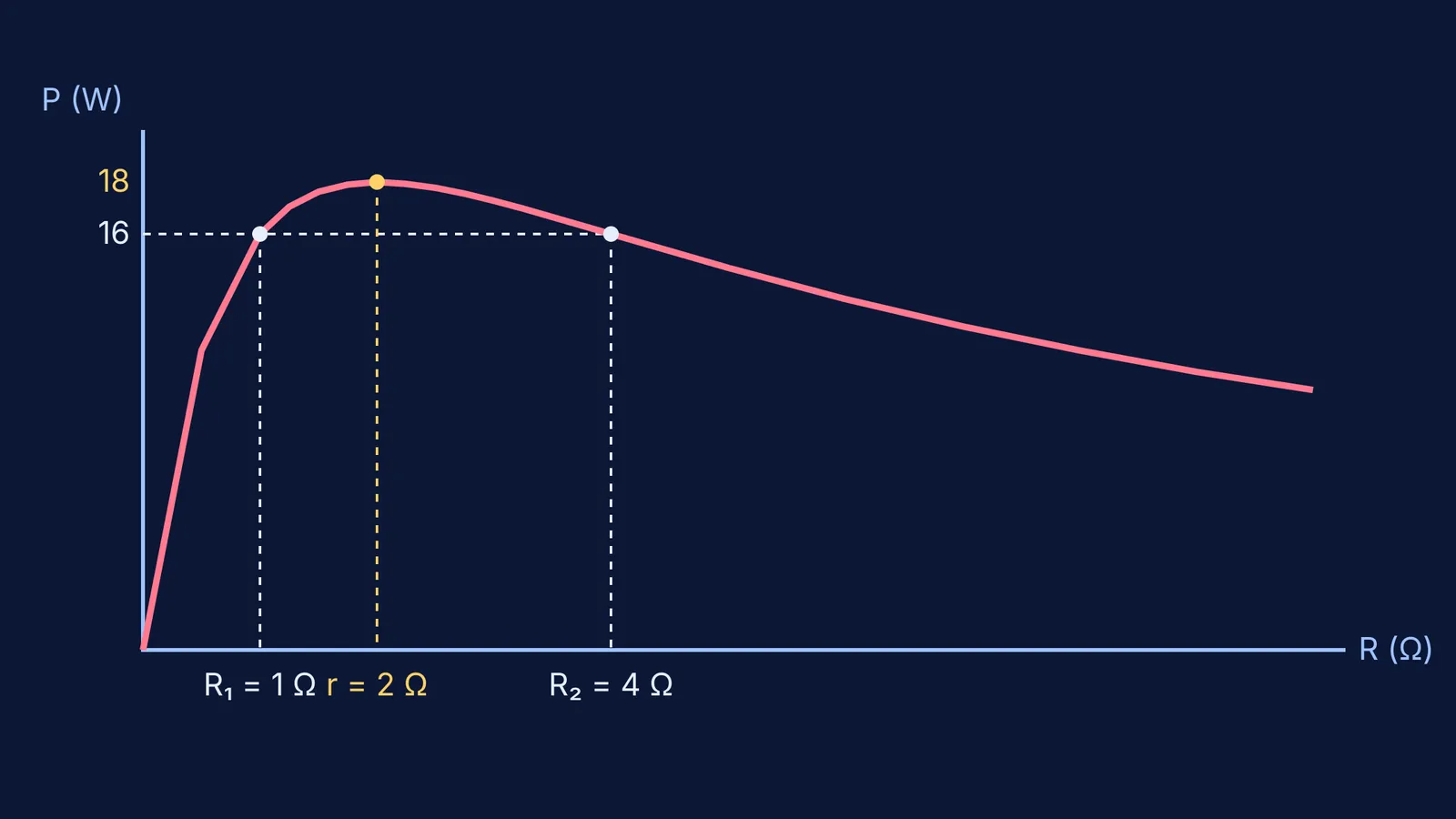
If you plot this power against the external resistance R, you do not get a straight line. The power starts at zero when R = 0 (a short circuit), rises to a peak, and then drops back toward zero as R becomes very large.
This bell-shaped curve means that for any power output below the maximum, there are exactly two possible external resistances that will draw that power: one smaller than the internal resistance, and one larger. If these two resistances are R₁ and R₂, the battery's internal resistance is their geometric mean: r = √(R₁R₂).
How do you prove the internal resistance formula?
We know that the power delivered to R₁ is equal to the power delivered to R₂. We can set up the equation: [E / (R₁ + r)]² R₁ = [E / (R₂ + r)]² R₂
Since the battery's EMF E is not zero, we can divide both sides by E²: R₁ / (R₁ + r)² = R₂ / (R₂ + r)²
Cross-multiplying gives: R₁ (R₂² + 2R₂r + r²) = R₂ (R₁² + 2R₁r + r²)
Expanding both sides: R₁R₂² + 2R₁R₂r + R₁r² = R₂R₁² + 2R₁R₂r + R₂r²
The term 2R₁R₂r appears on both sides, so it cancels out: R₁R₂² + R₁r² = R₂R₁² + R₂r²
Next, we group the terms with r² on one side and the rest on the other: R₁r² − R₂r² = R₂R₁² − R₁R₂²
Factor out r² on the left and R₁R₂ on the right: r² (R₁ − R₂) = R₁R₂ (R₁ − R₂)
Because R₁ and R₂ are two different resistances, R₁ − R₂ is not zero. We can divide both sides by it, leaving: r² = R₁R₂ r = √(R₁R₂)
How does this relate to maximum power transfer?
According to the maximum power transfer theorem, a source with a fixed internal resistance delivers the maximum possible power to a load when the load resistance equals the internal resistance (R = r).
At this peak, there is only one resistance value that draws the maximum power. For any lower power target, the symmetry of the curve dictates two solutions. One resistance is lower than r (drawing a high current but dropping a small voltage), and the other is higher than r (dropping a high voltage but drawing a small current). Both combinations result in the exact same power being converted to heat or work in the external circuit.
When tackling these concepts, circuit physics can sometimes feel like a maze of algebra. To build a stronger foundation, the Fermi Concept Library explains every concept in physics, chemistry, biology, mathematics and computing. If you are struggling with homework, the Fermi Problem Library has worked problems with a step-by-step solver that explains the reasoning rather than printing an answer.
Is higher resistance or lower resistance better?
Even though the 1 Ω and 4 Ω resistors in our example draw the same 16 W of power, the battery is working much harder in one case than the other. The difference lies in the efficiency of the circuit, which can be understood using the maximum power transfer theorem.
When the external resistance is smaller than the internal resistance (the 1 Ω case), the total resistance of the circuit is low. A large current of 4 A flows through the circuit. Because this large current also flows through the battery's 2 Ω internal resistance, a significant amount of power is lost as heat inside the battery. The battery generates 48 W in total, but only 16 W reaches the external resistor. The efficiency is just 33%.
When the external resistance is larger than the internal resistance (the 4 Ω case), the total resistance is higher, so a smaller current of 2 A flows. The power lost inside the battery drops sharply. The battery generates 24 W in total to deliver the same 16 W to the outside circuit. The efficiency rises to 67%.
While the maximum power transfer theorem tells us how to get the most absolute power out of a source, it does not give the best efficiency. At the point of maximum power (R = r), exactly half the power is wasted inside the battery, making the efficiency 50%. If you are designing a circuit to preserve battery life, you generally want the load resistance to be much larger than the internal resistance so that most of the energy goes to the device, not into heating the battery itself.
A worked example with real numbers
Let us put the numbers together to verify the formula. Suppose you have a 12 V battery with an unknown internal resistance. You find that it delivers exactly 16 W of power whether you connect it to a 1 Ω resistor or a 4 Ω resistor.
Using the rule, the internal resistance is: r = √(1 × 4) = 2 Ω
We can verify this by checking the power for both cases: For the 1 Ω resistor: Total resistance = 1 + 2 = 3 Ω Current I = 12 / 3 = 4 A Power P = I²R = 4² × 1 = 16 W
For the 4 Ω resistor: Total resistance = 4 + 2 = 6 Ω Current I = 12 / 6 = 2 A Power P = I²R = 2² × 4 = 16 W
The battery delivers the same power in both scenarios, confirming our result. And because r = 2 Ω, if you want to extract the maximum possible power from this battery, you would connect a 2 Ω resistor, which would draw 18 W.


