

On this page
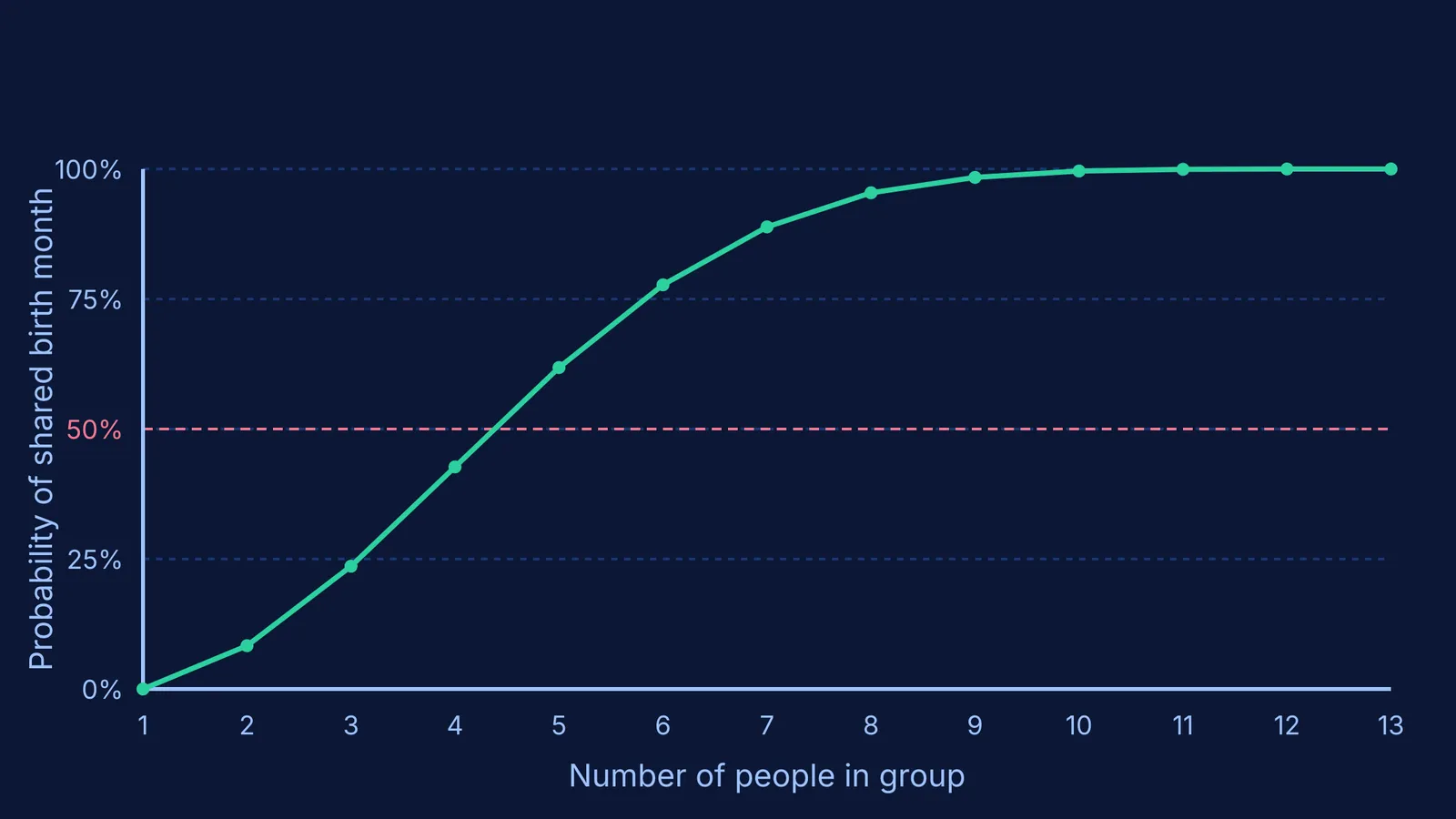
You only need five people in a room to have a 61.8% probability that two of them share a birth month, according to the mathematics of the birthday problem. While it takes 13 people to guarantee a match, the odds cross 50% as soon as a fifth person joins the group. This is calculated by finding the chance that everyone has a different month and subtracting it from 100%.
What is the probability two people have the same birth month?
It is common to underestimate how likely coincidences are in a group setting. When you hear "sharing a birth month", your brain might immediately jump to the question: *What is the probability that someone shares MY birth month?* If you only think about your own month (say, August), you would need a much larger group to find a match.
However, the mathematical question is about *any* two people in the room sharing a month. Because each new person who walks through the door can match with anyone already inside, the number of possible pairs grows much faster than the number of people. With just five people, there are 10 distinct pairs.
Using the standard formula from the birthday problem, here is how the probability of at least one shared birth month increases with the group size:
2 people: 8.3%
3 people: 23.6%
4 people: 42.7%
5 people: 61.8%
6 people: 77.7%
7 people: 88.9%
By the time you have seven people, it is highly likely (almost 90%) that two of them celebrate a birthday in the same month. The famous version of this puzzle shows that for exact birthdays, a 50% probability requires a group of just 23 people out of 365 possible days. The logic scales perfectly whether you are dealing with 365 days or 12 months.
How do you calculate the probability of a shared birth month?
When trying to find the probability of "at least one" match, calculating all the different ways people could share a month (two people sharing one month, three people sharing one month, two pairs of people sharing different months) becomes incredibly complicated.
To solve this easily, mathematicians calculate the exact opposite: the probability that *no one* shares a birth month, and then subtract that result from 1 (or 100%).
Here is the worked example for a group of five people using the birthday problem method:
First person: They can be born in any of the 12 months. The probability is 12/12 (which is 1).
Second person: To avoid a match, they must be born in one of the remaining 11 months. The probability is 11/12.
Third person: They must be born in one of the remaining 10 months. The probability is 10/12.
Fourth person: They must be born in one of the remaining 9 months. The probability is 9/12.
Fifth person: They must be born in one of the remaining 8 months. The probability is 8/12.
To find the probability that all five people have different birth months, you multiply these fractions together. This uses the exact same logic as calculating probabilities with and without replacement when drawing cards from a deck: (12/12) × (11/12) × (10/12) × (9/12) × (8/12) = 95,040 / 248,832 = 0.3819 (or 38.2%).
This tells you there is a 38.2% chance that everyone in the group has a unique birth month. Finally, subtract this from 100% to find the probability of a match: 100% − 38.2% = 61.8%.
If you are practising probability for a board exam or entrance test and get stuck on a calculation like this, the Fermi Problem Library has worked problems with a step-by-step solver that explains the reasoning rather than printing an answer. Breaking the problem down into independent steps makes the multiplication much more intuitive.
When is a shared birth month guaranteed?
In a group of 13 people, the probability of a shared birth month is exactly 100%, which is a classic demonstration of the pigeonhole principle.
This fundamental idea in combinatorics states that if you distribute *n* items into *m* containers, and *n* is greater than *m*, at least one container must hold more than one item.
If you consider the 12 months of the year as the "containers" and the 13 people as the "items", it becomes impossible for everyone to have a unique birth month. Even if the first 12 people are born in 12 completely different months—January through December—the 13th person must share a month with someone who is already in the group.
This dramatic jump—from a 61.8% chance at just five people to an absolute certainty at 13 people—shows how quickly probabilities shift as the sample size approaches the number of possible outcomes. For further reading on navigating overlapping probability rules, reviewing independent vs mutually exclusive events is a great next step to solidify your understanding.


