

On this page
Many agricultural crops, including tobacco, are highly susceptible to infection by the root-knot nematode *Meloidogyne incognita*. This microscopic, soil-dwelling parasite invades the roots of the plant. Once inside, it establishes a feeding site and causes the root cells to divide rapidly, forming swollen nodules or "galls". These galls physically disrupt the root's vascular tissue—the xylem and phloem—severely reducing the plant's ability to absorb water and essential nutrients from the soil. The result is stunted growth, wilting, and a drastic drop in crop yield.
How does RNA interference silence genes?
To defend against this pest without relying on chemical pesticides, biotechnology uses a precise genetic tool called RNA interference (RNAi). RNAi involves small RNA processing found naturally in all eukaryotes. It silences specific mRNA molecules, preventing them from being translated into proteins. This process, first understood through Andrew Fire and Craig Mello's discovery of RNA interference, stops the flow of genetic information right before the protein is built.
In a normal cell, DNA is transcribed into a single strand of messenger RNA (mRNA), which ribosomes then read to build a protein. RNA interference interrupts this step. In the case of nematode-resistant tobacco, scientists introduce genes into the plant that are specific to the nematode. The host plant transcribes this inserted DNA to produce two strands of RNA: a sense strand (which looks like the normal mRNA) and an anti-sense strand (which is its exact opposite).
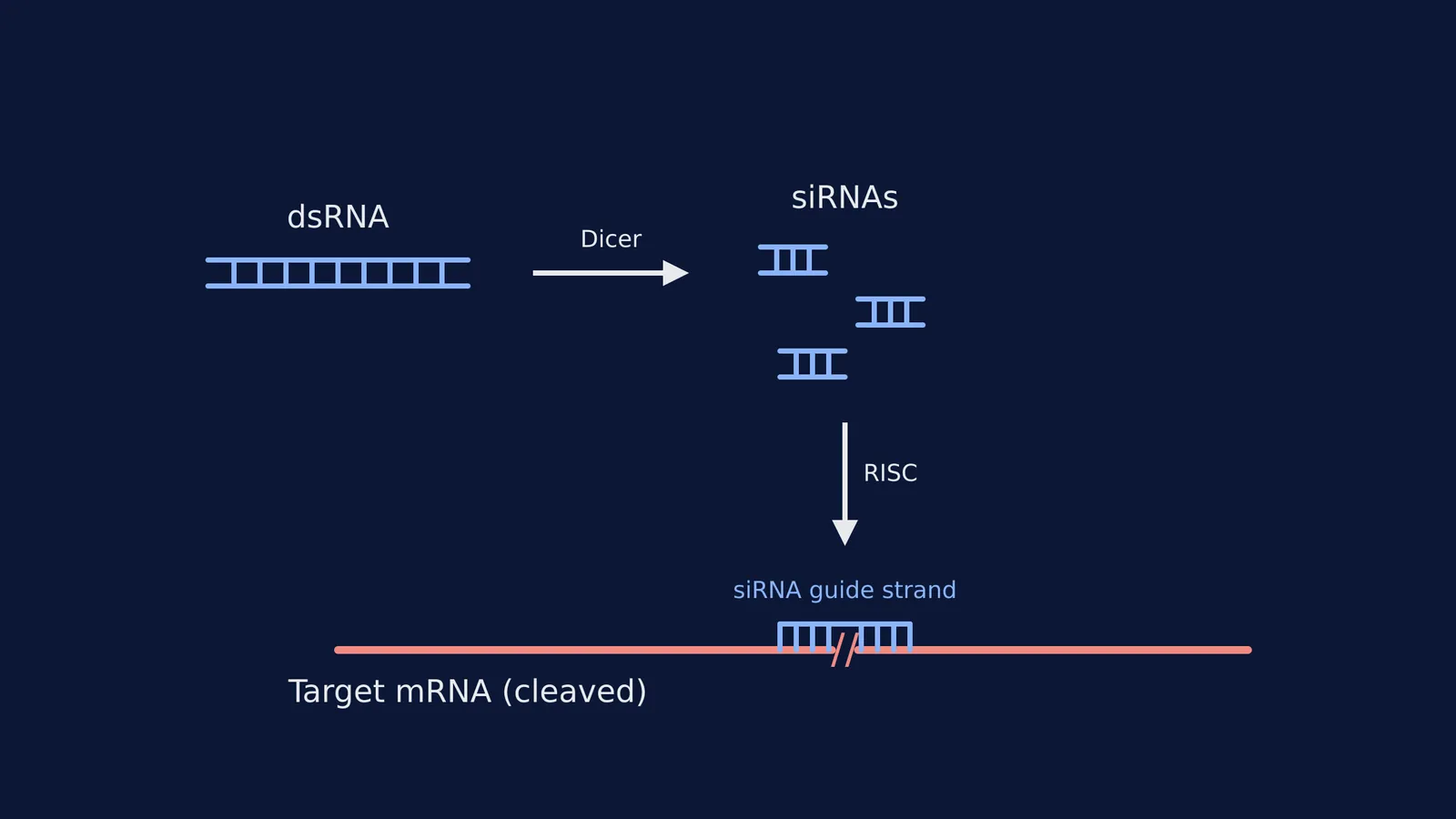
Because the sense and anti-sense strands are complementary, their bases pair up to form a double-stranded RNA (dsRNA) molecule. This dsRNA is the trigger for the entire silencing process.
What happens when the nematode attacks?
When *Meloidogyne incognita* attacks the transgenic tobacco plant, it feeds on the root cells. During this feeding, the nematode ingests the plant's cytoplasm, taking in the dsRNA that the plant has produced.
Once the dsRNA enters the nematode's cells, it is recognised as a foreign or regulatory signal. The nematode's own cellular machinery cuts the long dsRNA into smaller fragments known as small interfering RNAs (siRNAs). These fragments then guide a specialized protein complex to find the nematode's own, naturally occurring mRNA that matches the sequence.
When the complex finds the matching mRNA, it cleaves it. Without the intact mRNA, the nematode cannot manufacture the specific protein that the gene codes for. If the targeted gene is essential for survival—such as those involved in chitin biosynthesis or development—the parasite cannot grow or reproduce, and the plant remains protected.
How are Agrobacterium vectors used in tobacco?
To get the nematode-specific genes into the tobacco plant in the first place, scientists use a biological delivery system. *Agrobacterium tumefaciens* is a soil bacterium that naturally infects plants. In nature, it uses a piece of circular DNA called a Ti (tumor-inducing) plasmid to transfer its own genes into the plant's genome.
In the laboratory, scientists "disarm" this plasmid by removing the disease-causing genes and replacing them with the nematode-specific genes. This turns the bacterium into a harmless *Agrobacterium* vector. When the vector is applied to tobacco plant cells in a tissue culture, it inserts the engineered DNA directly into the host genome. The cells are then grown into full plants, ensuring that every cell in the transgenic tobacco has the genetic instructions to produce the protective dsRNA.
Recent studies show the measurable impact of this biotechnology. In a 2021 study, researchers found that host plant delivery of dsRNA targeting the nematode's dicer gene impaired its development, reducing nematode infection by 71%. Another 2020 study silenced chitin biosynthesis genes in transgenic plants, which saw the number of eggs and root knots drop by 60–90%.
What is the step-by-step mechanism of RNA interference?
When revising biotechnology applications for NEET, use this sequence to trace the mechanism of pest resistance:
Identify a gene essential for the nematode's survival.
Use an *Agrobacterium* vector to introduce this gene into the tobacco plant genome.
The transgenic plant transcribes both sense and anti-sense RNA from the inserted gene.
The complementary RNA strands bind together to form double-stranded RNA (dsRNA).
The nematode feeds on the transgenic root and ingests the dsRNA.
The dsRNA initiates RNA interference inside the nematode's cells.
The target mRNA is cleaved and silenced, stopping protein synthesis.
The parasite dies, conferring resistance to the crop.
When studying complex genetic pathways, it is easy to forget whether the silencing happens before or after transcription. If you are struggling to picture how sense and anti-sense RNA combine inside a cell, the Fermi Concept Library contains every concept in physics, chemistry, biology, mathematics and computing, each with its own lesson and its place in the map.


