

On this page
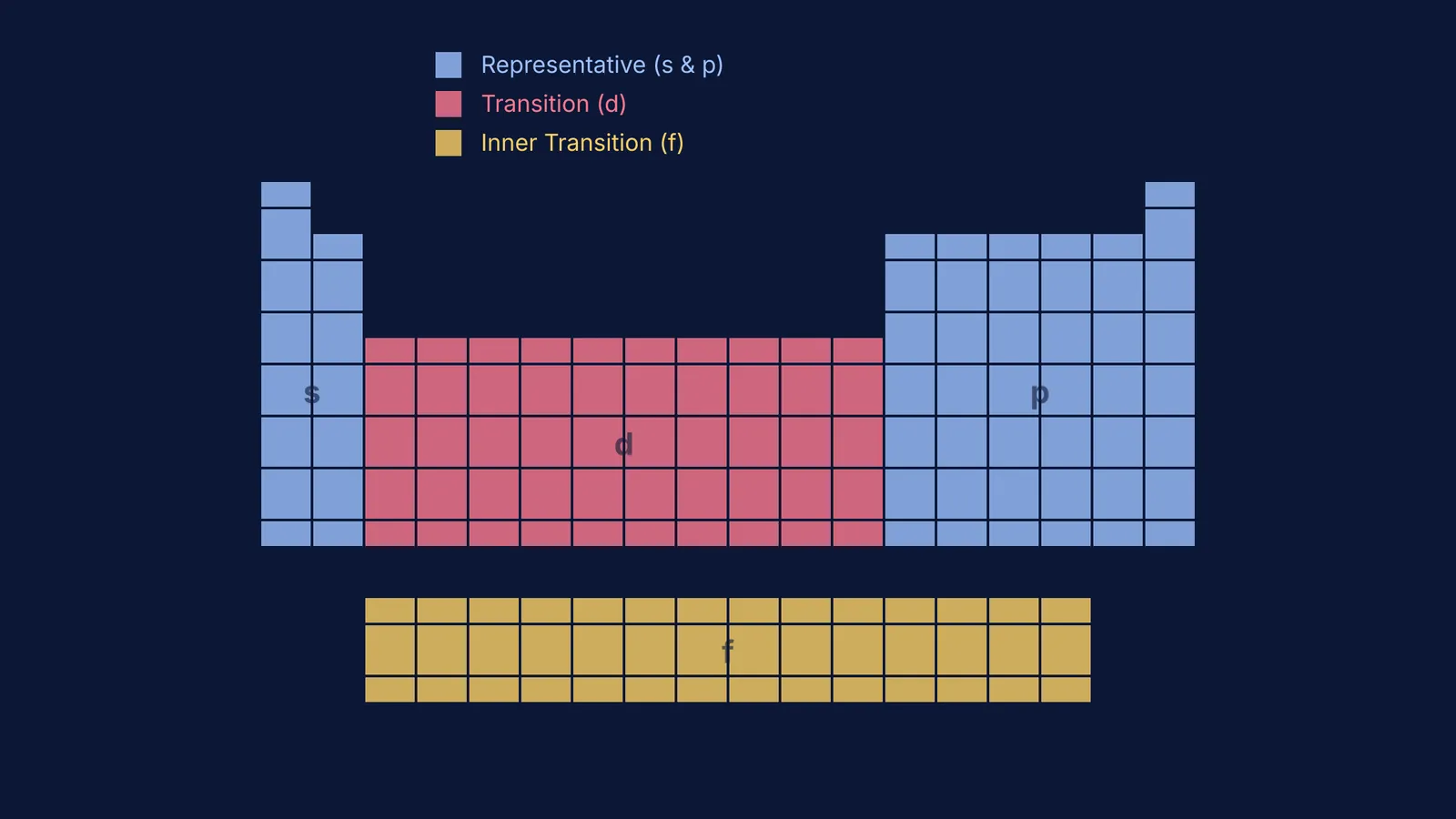
The modern periodic table divides elements into blocks based on their electron configuration. The primary difference between representative, transition and inner transition elements lies in which subshell is actively being filled as you move across a row.
What are representative elements?
Also known as main group elements, representative elements are those where the last electron enters the outermost shell (the n shell). This includes elements filling the s and p subshells.
Groups: They span groups 1 and 2 (the s-block) and groups 13 to 18 (the p-block).
Subshell filled: The outermost ns or np orbitals.
Valence configuration: ns¹ to ns² np⁶.
Typical properties: These elements include highly reactive metals on the left (like sodium and calcium), non-metals on the right (like oxygen and chlorine), and metalloids in between. For instance, sodium (Na) has the configuration [Ne] 3s¹, placing its final electron squarely in the outermost third shell. Because their valence electrons are on the outside, they readily lose, gain or share them to achieve a stable octet. They follow the most predictable periodic trends. For example, how metallic character changes across a period and down a group shows a clear decrease as you move right across these representative groups.
What are transition elements?
Transition elements are metals that have partially filled d orbitals, either in their neutral ground state or in their common oxidation states. They form the d-block of the periodic table, bridging the highly reactive s-block and the less reactive p-block.
Groups: They occupy groups 3 to 12.
Subshell filled: The penultimate shell, which is one shell inside the outermost level, specifically the (n-1)d subshell.
Valence configuration: (n-1)d¹⁻¹⁰ ns¹⁻².
Typical properties: Take iron (Fe) for example: its configuration is [Ar] 4s² 3d⁶. Even though the fourth shell is the outermost, the electrons actively being added across the period are filling the 3d subshell. Transition elements are hard metals with high melting and boiling points. They act as excellent catalysts (like iron in the Haber process) and exhibit variable oxidation states. Many of their compounds form beautifully coloured ions in solution, whereas full or empty d-subshells result in colourless ions (see why Sc³⁺, Ti⁴⁺, Zn²⁺ and Cu⁺ ions are colourless).
What are inner transition elements?
Inner transition elements are metals where the last electron enters the f subshell. To keep the periodic table compact, they are placed in two separate rows at the bottom.
Groups: They formally belong to Group 3 but form their own distinct f-block.
Subshell filled: The anti-penultimate shell, which is two shells inside the outermost level, specifically the (n-2)f subshell.
Valence configuration: (n-2)f¹⁻¹⁴ (n-1)d⁰⁻¹ ns².
Typical properties: Consider uranium (U), with the configuration [Rn] 7s² 5f³ 6d¹. The seventh shell is the outermost, but the 5f subshell, two levels deep, is where the defining electrons reside. The first row is the 15-element lanthanide series (elements 57 to 71), which have remarkably similar chemical properties and commonly show a +3 oxidation state. The second row is the 15-element actinide series (elements 89 to 103). All actinides are radioactive, and those beyond uranium are synthetically created in laboratories.
How do the three types compare?
To quickly tell them apart on an exam, look at their structure and position:
Location of the last electron: Representative elements place it in the outermost shell. Transition elements place it one shell deep. Inner transition elements place it two shells deep.
Valence electrons: Representative elements use only their outermost s and p electrons for bonding. Transition elements use both their outermost s electrons and their penultimate d electrons. Inner transition elements can use electrons from their s, d and f subshells, leading to complex chemistry.
Position on the table: Representative elements flank the table on the far left and right. Transition elements form the wide bridge in the middle. Inner transition elements sit detached at the bottom.
How can you remember which subshell fills when?
A common point of confusion is keeping track of the n, n-1, and n-2 shells. When you learn how many subshells and orbitals are in each shell n, the order of filling follows the Aufbau principle based on energy levels:
Outermost (n): In representative elements, electrons fill the highest energy level currently active (e.g. filling the 3s and 3p subshells in period 3).
Penultimate (n-1): In transition elements, the s-orbital of the outermost shell is already full, and electrons drop back to fill the d subshell one layer down (e.g. filling 3d after 4s).
Anti-penultimate (n-2): In inner transition elements, electrons fill the f subshell two layers down (e.g. filling 4f while the 6s is full).
If you are stuck trying to write out a long electron configuration for an exam, the Fermi Concept Library can help you map out the blocks and understand the exceptions. Fermi's AI tutor teaches you the reasoning behind orbital energy rules; it notices where you are stuck and builds a plan to help you master the periodic table step by step.


