

On this page
It shows up in probability chapters and JEE practice sets: switches, each closed with some probability and independent of the others, connect two points. What is the probability that current flows? You need two rules and one habit, and together they handle most versions of the question.
How do you find the probability a series circuit works?
In series, current flows only if every switch is closed. That is an AND, and for independent events AND means multiply. The NIST/SEMATECH e-Handbook of Statistical Methods sums up the series model as "multiply reliabilities". It lists two assumptions you should check in any question: the system fails as soon as the first component fails, and each component fails independently of the others.
Take three switches in series, closed with probabilities 0.9, 0.8 and 0.7. The circuit works with probability 0.9 × 0.8 × 0.7 = 0.504. A series chain can never be more reliable than its weakest switch, so a quick check is that your answer is no higher than 0.7.
If independence is shaky for you, this guide to independent events covers when you are allowed to multiply.
How do you find the probability a parallel circuit works?
In parallel, current flows if at least one switch is closed. That is an OR, and the common mistake is to add: 0.9 + 0.8 + 0.7 = 2.4, which is impossible for a probability. Use the complement instead. A parallel circuit fails only if every switch is open, and the open probabilities are 0.1, 0.2 and 0.3.
The NIST handbook's parallel model says you multiply the component failure probabilities to get the system's failure probability, assuming the components operate independently. So P(works) = 1 − (0.1)(0.2)(0.3) = 1 − 0.006 = 0.994.
How do you solve a mixed series-parallel network?
The NIST handbook's section on complex systems says such systems can often be evaluated by successive applications of the series and parallel formulas, replacing each section with an equivalent single component. In practice:
Write p (works) and q = 1 − p (fails) next to every switch.
Find a block that is purely series or purely parallel.
Replace it with one equivalent switch and write its new p.
Redraw and repeat until one switch is left.
Sanity check: adding a parallel branch can never lower the answer; adding a series switch can never raise it.
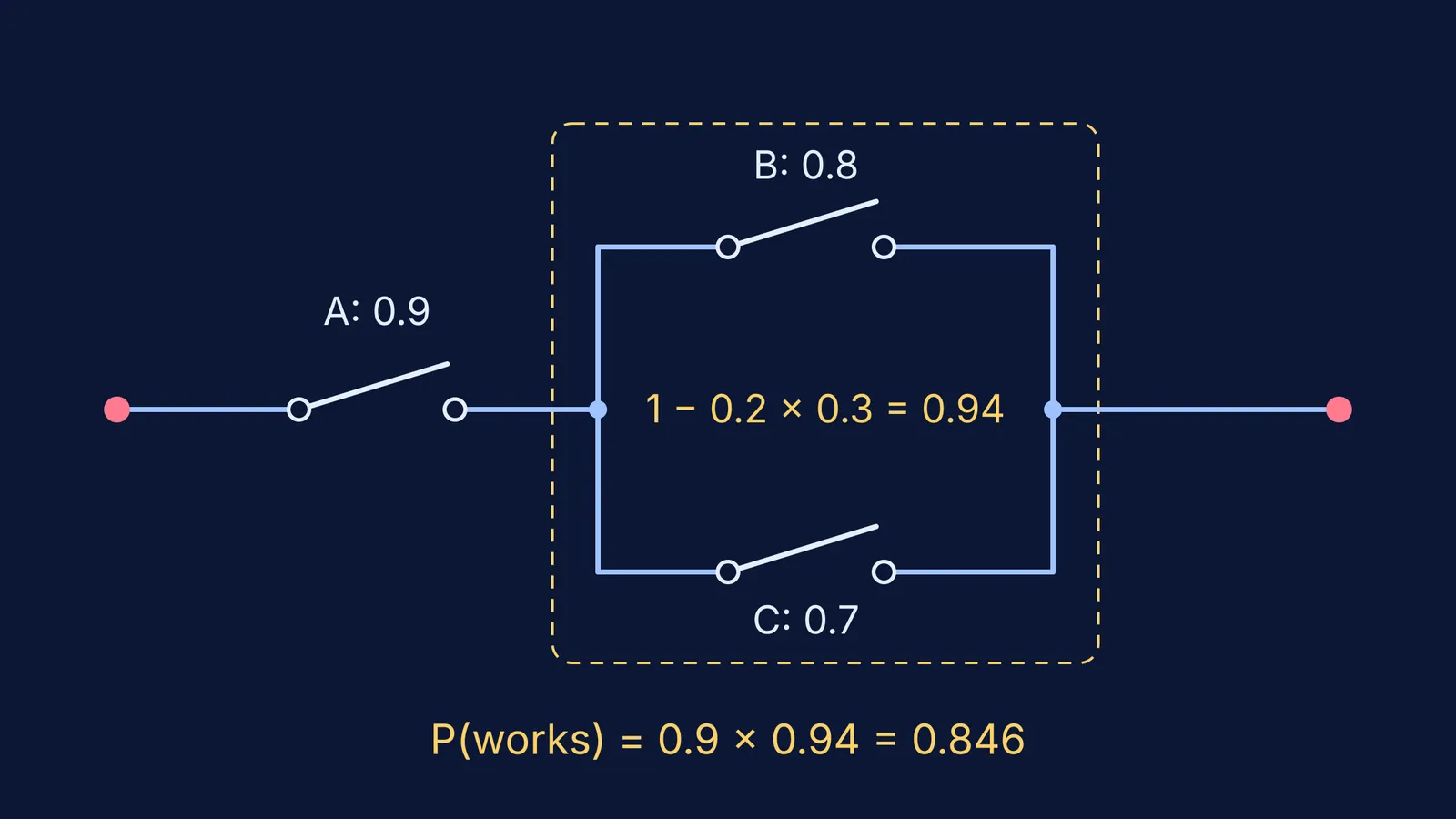
Worked example 1: A in series with B and C in parallel
Use A = 0.9, B = 0.8, C = 0.7. The parallel block works with probability 1 − (0.2)(0.3) = 0.94. Now A and that block are in series: 0.9 × 0.94 = 0.846.
Worked example 2: A and B in series, the pair in parallel with C
Same switches, different wiring. The series pair works with probability 0.9 × 0.8 = 0.72, so it fails with probability 0.28. In parallel with C: 1 − (0.28)(0.3) = 1 − 0.084 = 0.916. The wiring alone moved the answer from 0.846 to 0.916, which is why you redraw after every step.
What if the network will not reduce?
The NIST page on complex systems warns that this reduction works for many, but not all, systems. The usual exam case is the bridge: A and B along the top, C and D along the bottom, and switch E joining the two middle points. No block is purely series or parallel, so condition on E.
If E is closed, the network is (A or C) in series with (B or D).
If E is open, it is (A then B) in parallel with (C then D).
With every switch at 0.9: E closed gives (1 − 0.01)² = 0.9801; E open gives 1 − (1 − 0.81)² = 0.9639. Weight each case by E's probability: 0.9 × 0.9801 + 0.1 × 0.9639 ≈ 0.978. This is the same total-probability step used in conditional probability and Bayes' theorem.
Which mistakes cost marks?
Adding probabilities for parallel switches instead of using the complement.
Multiplying when the question says switches are linked (for example, operated together), so they are not independent.
Carrying over resistor habits: series resistances add, but series probabilities multiply.
Answering "fails" when the question asked "works", or the reverse. Underline the word before you start.
More traps like these are collected in common probability mistakes and how to avoid them.
If you keep picking the wrong block to reduce first, the Fermi Problem Library has worked problems with a step-by-step solver that explains the reasoning rather than printing an answer. If the gap is independence itself, the Fermi Concept Library gives each concept its own lesson.
Next time you meet a switch network, label every p and q first, then reduce one block at a time.


