

On this page
A reduction formula turns an integral with a power n into the same integral with a smaller power, such as n−1 or n−2. You apply it repeatedly until you reach something easy, like ∫eˣ dx. The three families here, ∫sinⁿx, ∫secⁿx and ∫xⁿeˣ, all come from integration by parts.
What is the trick behind every reduction formula?
NCERT's Class 12 textbook states integration by parts in words: the integral of the product of two functions = (first function) × (integral of the second function) − integral of [(differential coefficient of the first function) × (integral of the second function)] (NCERT Mathematics Part II, Chapter 7, Section 7.6). In symbols, this is ∫u dv = uv − ∫v du, the form used in OpenStax Calculus Volume 2.
Then follow four steps:
Write the power as a product: one factor you can integrate easily (dv) and the rest (u).
Integrate by parts. The new integral carries a lower power.
If the new integral has a leftover factor such as cos²x or tan²x, rewrite it with an identity so the original integral Iₙ appears again.
Collect the Iₙ terms on one side and divide.
The choice matters: the same NCERT section shows that swapping the roles in ∫x cos x dx produces a higher power of x. Pick the u whose derivative lowers the power.
How do you derive the reduction formula for ∫sinⁿx dx?
Let Iₙ = ∫sinⁿx dx. Split sinⁿx = sinⁿ⁻¹x · sin x and take u = sinⁿ⁻¹x, dv = sin x dx. Then du = (n−1)sinⁿ⁻²x cos x dx and v = −cos x.
Parts: Iₙ = −sinⁿ⁻¹x cos x + (n−1)∫sinⁿ⁻²x cos²x dx
Identity: cos²x = 1 − sin²x, so the last integral is Iₙ₋₂ − Iₙ
Collect: nIₙ = −sinⁿ⁻¹x cos x + (n−1)Iₙ₋₂
Divide by n: Iₙ = −(1/n)sinⁿ⁻¹x cos x + ((n−1)/n)Iₙ₋₂. This matches the statement and proof on ProofWiki's page for powers of sine.
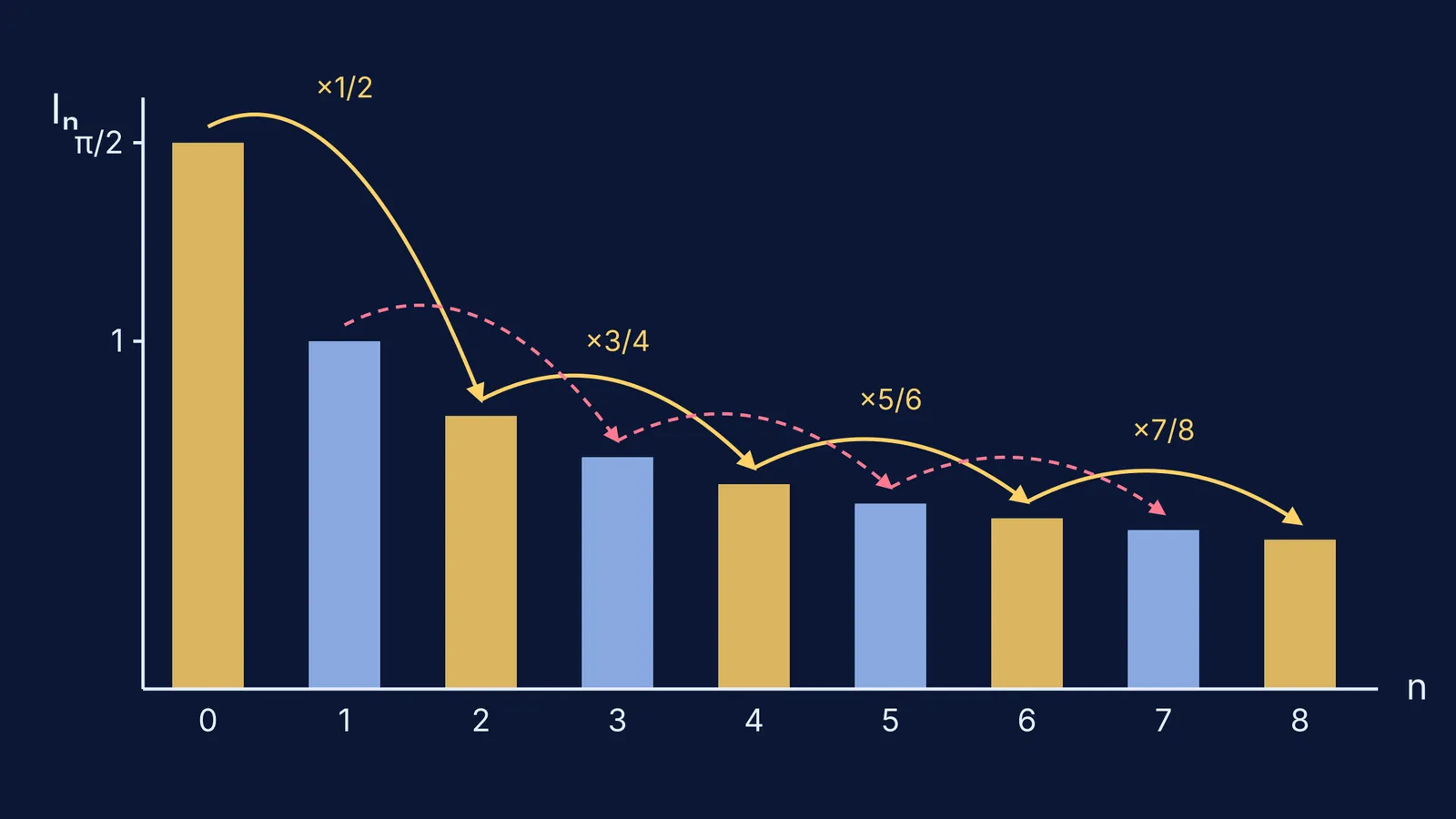
Apply it to n = 4. I₄ = −¼sin³x cos x + ¾I₂, and I₂ = −½sin x cos x + ½x. So ∫sin⁴x dx = −¼sin³x cos x − ⅜sin x cos x + ⅜x + C. Between 0 and π/2 the sin-cos terms vanish and you get 3π/16, the same value the Wallis formula for powers of sine gives.
How do you derive the reduction formula for ∫secⁿx dx?
Let Iₙ = ∫secⁿx dx. This time split off sec²x, because its integral is tan x. Take u = secⁿ⁻²x and dv = sec²x dx, so du = (n−2)secⁿ⁻²x tan x dx and v = tan x.
Parts: Iₙ = secⁿ⁻²x tan x − (n−2)∫secⁿ⁻²x tan²x dx
Identity: tan²x = sec²x − 1, so the last integral is Iₙ − Iₙ₋₂
Collect: (n−1)Iₙ = secⁿ⁻²x tan x + (n−2)Iₙ₋₂
So Iₙ = (1/(n−1))secⁿ⁻²x tan x + ((n−2)/(n−1))Iₙ₋₂, the rule OpenStax lists for powers of secant. For n = 3 it is the same working as the loop trick for the integral of sec³x.
Apply it to n = 4. I₄ = ⅓sec²x tan x + ⅔∫sec²x dx = ⅓sec²x tan x + ⅔tan x + C.
How do you derive the reduction formula for ∫xⁿeˣ dx?
Here differentiating xⁿ lowers the power. Take u = xⁿ and dv = eˣ dx, so du = nxⁿ⁻¹dx and v = eˣ. One application gives Iₙ = xⁿeˣ − nIₙ₋₁, with no identity needed. OpenStax works the same idea on ∫x²e³ˣ dx by applying parts twice.
Apply it to n = 3.
I₃ = x³eˣ − 3I₂
I₂ = x²eˣ − 2I₁
I₁ = xeˣ − I₀, and I₀ = eˣ
Substitute back: I₃ = eˣ(x³ − 3x² + 6x − 6) + C
The coefficients 1, −3, 6, −6 match the general result on ProofWiki's page for xⁿ times an exponential.
How do you check a reduction formula answer?
Differentiate it. For I₃, the derivative of eˣ(x³ − 3x² + 6x − 6) is eˣ(x³ − 3x² + 6x − 6) + eˣ(3x² − 6x + 6) = x³eˣ.
Test n = 2. The sinⁿ formula should give x/2 − (sin 2x)/4 + C, which you know from the double-angle identity.
Know where the chain stops. Even powers of sin and sec end at I₀ = x. Odd powers end at I₁: −cos x for sine, log|sec x + tan x| for secant.
The same differentiate-and-test habit works for any answer, including one from a chatbot: see how to check an AI's integral by differentiating.
If a step breaks, the Fermi Problem Library has worked problems with a step-by-step solver that explains the reasoning rather than printing an answer. If the gap is an earlier idea, such as integration by parts itself, the Fermi Concept Library gives each mathematics concept its own lesson and its place in the map.


