On this page
Pyridine looks like benzene with one CH swapped for N, and that one swap reverses its chemistry. Benzene reacts readily with electrophiles and resists nucleophiles. Pyridine does the opposite: it reacts reluctantly with electrophiles, and only at C3, but it lets a strong nucleophile such as sodium amide attack C2. Understand why, and you can predict answers instead of memorising them.
What does the nitrogen do to the ring?
Nitrogen is more electronegative than carbon, so it pulls electron density towards itself. Pyridine has a dipole moment of 2.215 D, which shows that pull (Wikipedia: Pyridine). The same source notes that pyridine resembles nitrobenzene, not benzene, in how it reacts with electrophiles.
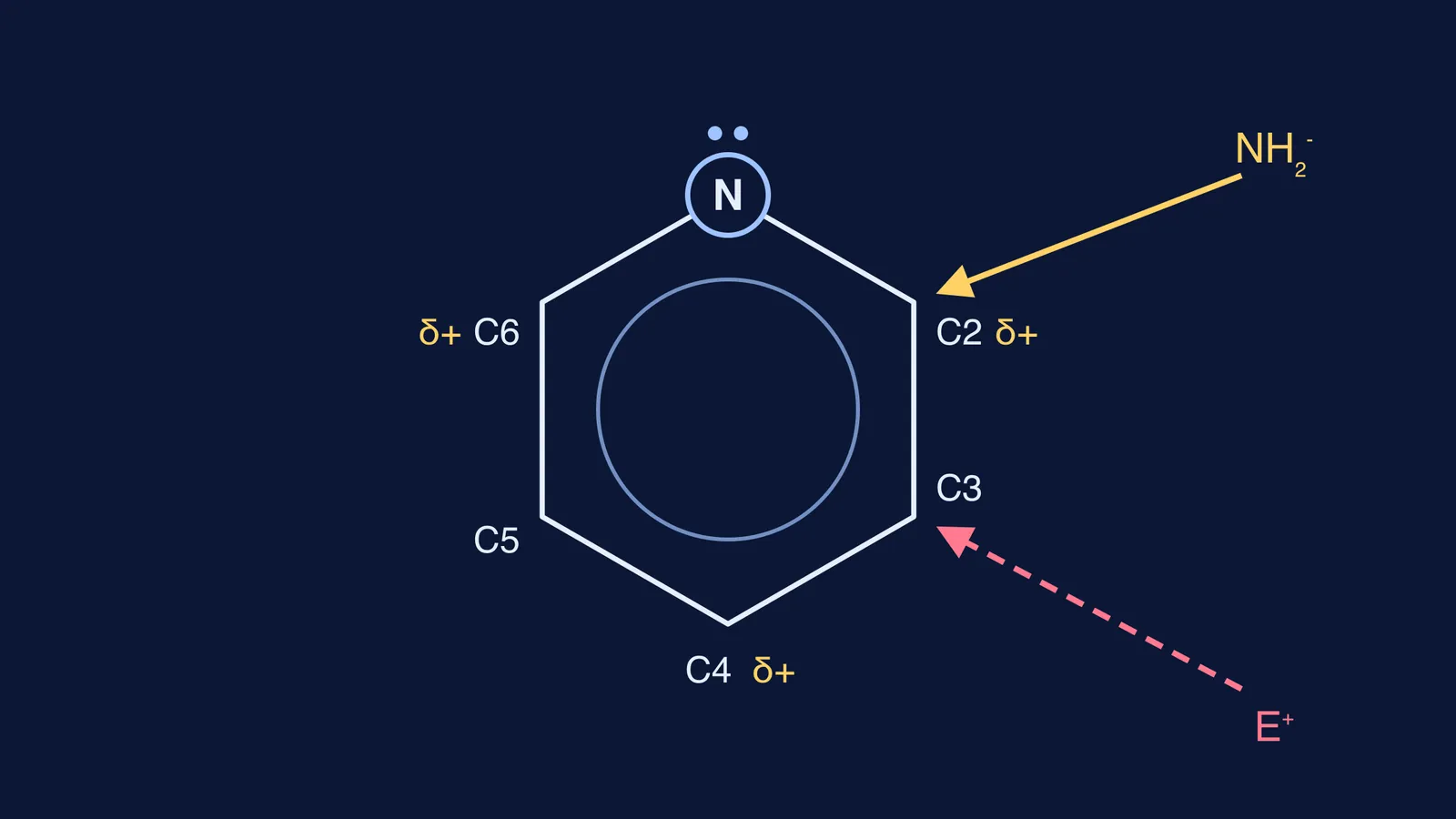
The pull is not even around the ring. Draw the resonance forms that push π-electrons onto nitrogen and you find a positive charge on C2, C4 and C6, never on C3 or C5. So the carbons next to and opposite the nitrogen are electron-poor (δ+), and C3 is the least poor carbon. LibreTexts makes the same point: because nitrogen is more electronegative than carbon, these charge-separated resonance forms contribute significantly, and pyridine's larger dipole moment compared with piperidine supports this (LibreTexts: Heterocyclic amines).
There is a second problem for electrophiles. The nitrogen's lone pair lies in the plane of the ring, not in the aromatic π-system, so it is free to grab a proton or a Lewis acid. The pKa of the pyridinium ion is 5.25 (Wikipedia: Pyridine). In the strongly acidic mixtures used for nitration or sulfonation, the nitrogen is readily protonated, and the reagents and catalysts used in these reactions coordinate with the nitrogen lone pair, increasing the positive charge at positions 2, 4 and 6 (LibreTexts).
Why does electrophilic substitution in pyridine go to C3?
Use the benzene test: draw the sigma complex formed when E+ attacks each position, with its three resonance forms.
Attack at C2: one resonance form puts the positive charge on nitrogen, which then has only six electrons. An electronegative atom with an incomplete octet is a very poor place for a positive charge.
Attack at C4: the same problem; one resonance form again puts the positive charge on nitrogen.
Attack at C3: the positive charge sits on C2, C4 and C6 only. Nitrogen never carries it.
So the C3 intermediate is the least bad, and C3 wins. But every intermediate is destabilised by the nearby nitrogen, which is why the reaction is slow. Wikipedia describes direct nitration as sluggish and says sulfonation is even more difficult (Wikipedia: Pyridine). Chemists have studied this reaction in detail; Johnson, Katritzky and co-workers examined the nitration of pyridines at the 3-position as free bases and as conjugate acids (J. Chem. Soc. B, 1967).
Why do nucleophiles like NaNH2 attack pyridine at C2?
Now flip the charges. A nucleophile adds to an electron-poor carbon and makes a negatively charged intermediate. Attack at C2 or C4 lets one resonance form put that negative charge on nitrogen, the electronegative atom that holds it best. Attack at C3 does not. So nucleophilic substitution usually happens at the 2- or 4-position (Wikipedia: Pyridine).
The Chichibabin reaction is the classic case: pyridine and sodium amide give 2-aminopyridine. Aleksei Chichibabin reported it in 1914, and it runs in liquid ammonia or an aprotic solvent such as xylene (Wikipedia: Chichibabin reaction). The mechanism is addition, then elimination (LibreTexts: Chichibabin reaction/Reactions/Organic_Reactions/Clemmensen_Reduction/Chichibabin_Reaction)):
NH2- adds to the δ+ carbon at C2, pushing electrons onto the ring nitrogen to form an anionic σ-adduct.
The nitrogen pushes its electrons back into the ring, forming C=N and expelling a hydride ion (H-).
The hydride takes a proton and leaves as hydrogen gas; a work-up step then gives 2-aminopyridine.
The unusual step is losing H- as a leaving group; the H2 gas is the clue.
How do you predict the product in an exam?
Run this three-question check on any pyridine reaction:
Is the reagent an electrophile (NO2+, SO3, Br+) or a nucleophile (NH2-, OH-, RO-)?
Electrophile: expect C3, a slow reaction and harsh conditions, and remember the lone pair may be protonated first.
Nucleophile: expect C2 (or C4), and look for a leaving group; with no halide, the leaving group is H-, as in the Chichibabin reaction.
Try these before reading the answers:
Pyridine + NaNH2, then water. Answer: 2-aminopyridine.
Pyridine + HNO3/H2SO4, heated strongly. Answer: 3-nitropyridine, slowly.
4-Chloropyridine + NaOCH3. Answer: 4-methoxypyridine, because pyridines with leaving groups at C2 or C4 swap them for nucleophiles (Química Orgánica: Pyridine).
If a mechanism still feels like guesswork, the Fermi Problem Library has worked problems with a step-by-step solver that explains the reasoning rather than printing an answer. To revisit resonance or aromaticity first, the Fermi Concept Library gives each concept its own lesson.