

On this page
When scientists first sought to identify the biological blueprint of life, many assumed it had to be protein. Proteins are complex, highly diverse, and perform almost every active job in the cell. In contrast, early researchers thought nucleic acids were too simple to carry the vast encyclopedia of genetic instructions. However, the famous 1952 experiment by Alfred Hershey and Martha Chase proved definitively that DNA, rather than protein, carries genetic information. By using radioactive isotopes, they showed that a virus injects its DNA—not its protein coat—into a host cell to reproduce.
But what makes DNA biologically fit for this role compared to RNA or proteins?
What are the criteria a genetic material must fulfil?
To be passed from one generation to the next without losing its meaning or function, a molecule must meet four specific biological criteria.
1. It must be able to replicate itself
Before a cell divides into two, it must copy its entire instruction manual so that each new daughter cell receives a complete set of genetic information. Therefore, the genetic material must be capable of generating a faithful and highly accurate replica of itself.
Both DNA and RNA pass this test brilliantly because of the strict rule of complementary base pairing. A single strand of DNA can act as a direct template to build a perfectly matching second strand. If you know the sequence of one side, you automatically know the other.
2. It must be chemically and structurally stable
The molecule carrying the biological blueprint must survive the entire life cycle of an organism. It should not change wildly with age, nutrition, or environmental stress. It must act as a reliable, long-term vault for information, enduring the harsh chemical environment inside a living cell.
3. It must provide room for slow change (mutation)
While stability is critical, total and absolute stability would be a dead end for biology. For species to adapt to changing environments and evolve over millions of years, the genetic material must have the scope for slow, inheritable changes, known as mutations. These mutations provide the raw material for natural selection.
4. It must express itself as Mendelian characters
Finally, the information locked in the genetic code has to actually *do* something. It must be able to express itself in the form of "Mendelian characters"—the physical, inheritable traits originally described by Gregor Mendel, such as eye colour or height. The molecule must dictate the synthesis of proteins that ultimately control these physiological traits. This relies on complex transcription and RNA processing to translate the DNA's stored code into actual physical expression.
Why is DNA more stable than RNA?
DNA significantly outperforms RNA when it comes to long-term structural stability, which is why nature selected it as the primary genetic vault for all complex life forms.
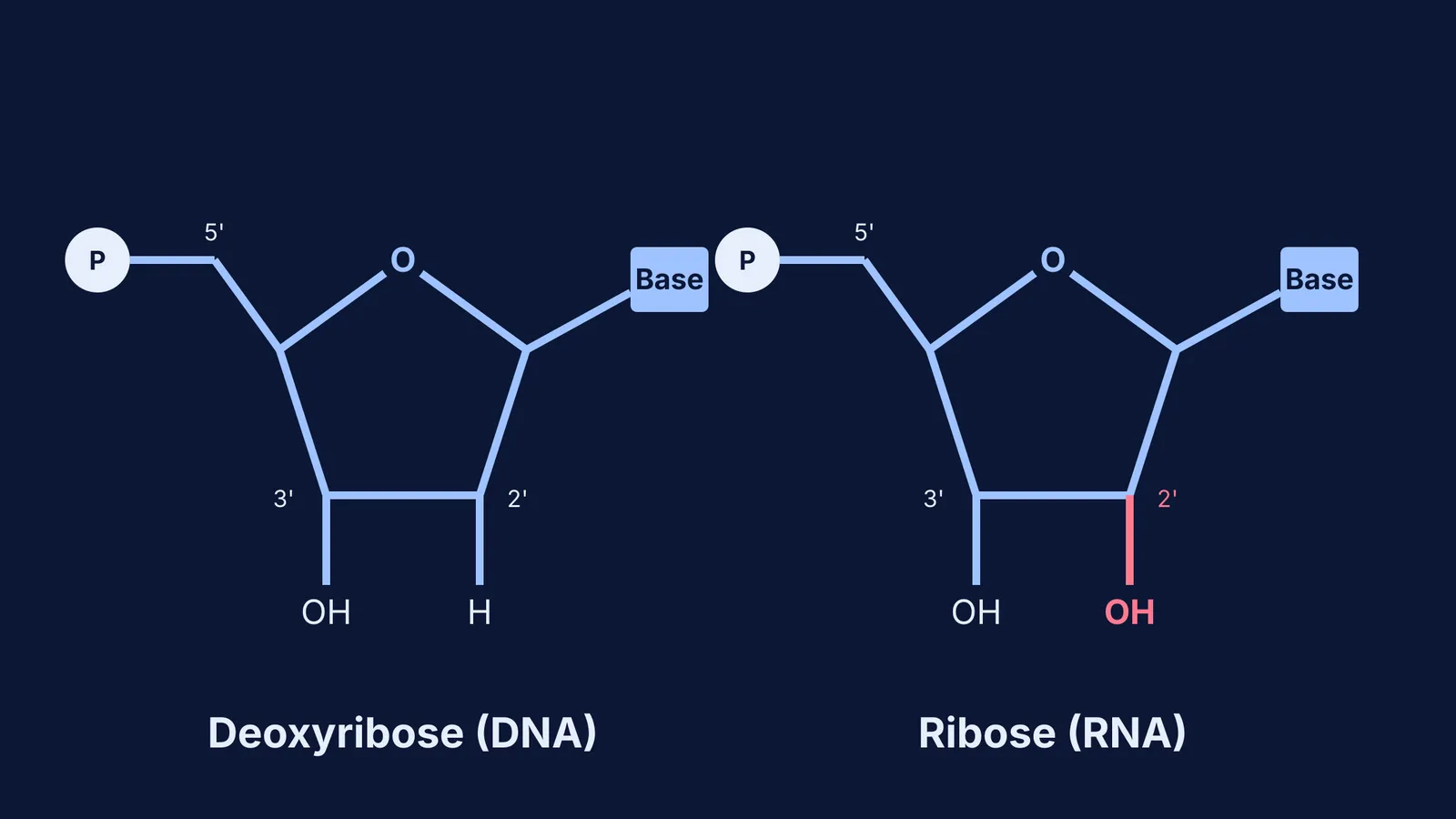
RNA has a highly reactive hydroxyl (`-OH`) group attached to the 2' position of its ribose sugar ring. This protruding oxygen atom acts like a chemical hook, making RNA prone to degradation and self-hydrolysis. DNA lacks this specific oxygen atom—hence the name "deoxyribose"—making it chemically inert and far less reactive. Furthermore, DNA uses the nitrogenous base thymine instead of uracil, which adds yet another layer of chemical stability to the double helix.
When you are memorising these structural differences, simply reading a list of facts is rarely enough. In the Fermi Concept Library, you can follow a lesson on nucleic acids, letting you clearly see why that single missing oxygen atom changes the chemical behaviour of the entire DNA strand.
Because RNA is chemically less stable, it mutates at a much faster rate than DNA. This explains why RNA viruses—often considered biological misfits along with viroids and lichens—evolve and produce new variants very quickly. In contrast, DNA mutates slowly enough to preserve the integrity of complex, multicellular organisms while still allowing for gradual evolution.
Why do proteins fail the criteria for genetic material?
Since proteins are responsible for almost every function in a living cell, early geneticists naturally suspected them of being the genetic material. However, proteins fail the very first biological criterion: they cannot replicate themselves.
A protein cannot act as a direct template to build another identical protein. There is no mechanism in nature for a protein to copy its own amino acid sequence. Instead, proteins are assembled strictly according to the genetic instructions provided by nucleic acids.
A simple revision checklist
Before your exam, make sure you can answer these key questions without looking at your notes. If you need a refresher on how the genetic code is actually read by the cell, review the three RNA polymerases in eukaryotes.
Which of the four mandatory criteria do proteins fail?
What are the two specific chemical reasons DNA is preferred for long-term storage over RNA?
Why is RNA's higher mutation rate an advantage for some viruses, but a disadvantage for complex life?


