

On this page
"Prove that n² + n is always even" is a classic first exercise in proof by cases. It teaches two skills you will use for years: splitting a problem into cases that cover everything, and spotting when a factorisation lets you skip the split.
How do you prove n² + n is always even?
The statement "If n is an integer, then n² + n is an even integer" opens section 3.4 of Ted Sundstrom's open textbook Mathematical Reasoning: Writing and Proof, section 3.4/03%3A_Constructing_and_Writing_Proofs_in_Mathematics/3.04%3A_Using_Cases_in_Proofs), where it is split into two cases: n even and n odd.
An integer is even if it can be written as 2k for some integer k, and odd if it can be written as 2k + 1.
Case 1: n is even. Write n = 2k. Then n² + n = 4k² + 2k = 2(2k² + k). Since 2k² + k is an integer, n² + n is even.
Case 2: n is odd. Write n = 2k + 1. Then n² + n = (4k² + 4k + 1) + (2k + 1) = 4k² + 6k + 2 = 2(2k² + 3k + 1). Again this is 2 times an integer, so n² + n is even.
Both cases give an even number, and there are no other cases, so the statement holds for every integer.
Why do two cases cover every integer?
This is where marks quietly go missing. Sundstrom's rule is that the cases "must be chosen so that they exhaust all possibilities" (section 3.4/03%3A_Constructing_and_Writing_Proofs_in_Mathematics/3.04%3A_Using_Cases_in_Proofs)). "Even or odd" passes that test for all integers, including negative numbers and zero. If you are not sure where zero fits, our explainer on whether zero is even, odd or neither settles it.
Don't write "similarly for odd n" and stop. In PLP: An Introduction to Mathematical Proof, Seçkin Demirbaş and Andrew Rechnitzer advise that it is "much safer" for an inexperienced prover "to actually do all those cases" in rough work. The odd case has the extra algebra, so write it out in full.
Is there a proof of n² + n even without cases?
Yes. Factorise first: n² + n = n(n + 1). Now n and n + 1 are consecutive integers, and of any two consecutive integers one is even. A product with an even factor is even, so you are done in two lines.
Sundstrom's exercises for the same section point at this idea: Exercise 1 asks you to explain how the n² + n result can be used to prove that the product of any two consecutive integers is divisible by 2 (section 3.4/03%3A_Constructing_and_Writing_Proofs_in_Mathematics/3.04%3A_Using_Cases_in_Proofs)). Note that "one of two consecutive integers is even" is itself a tiny proof by cases. The factorisation doesn't remove the cases. It moves them into a fact you prove once and then reuse.
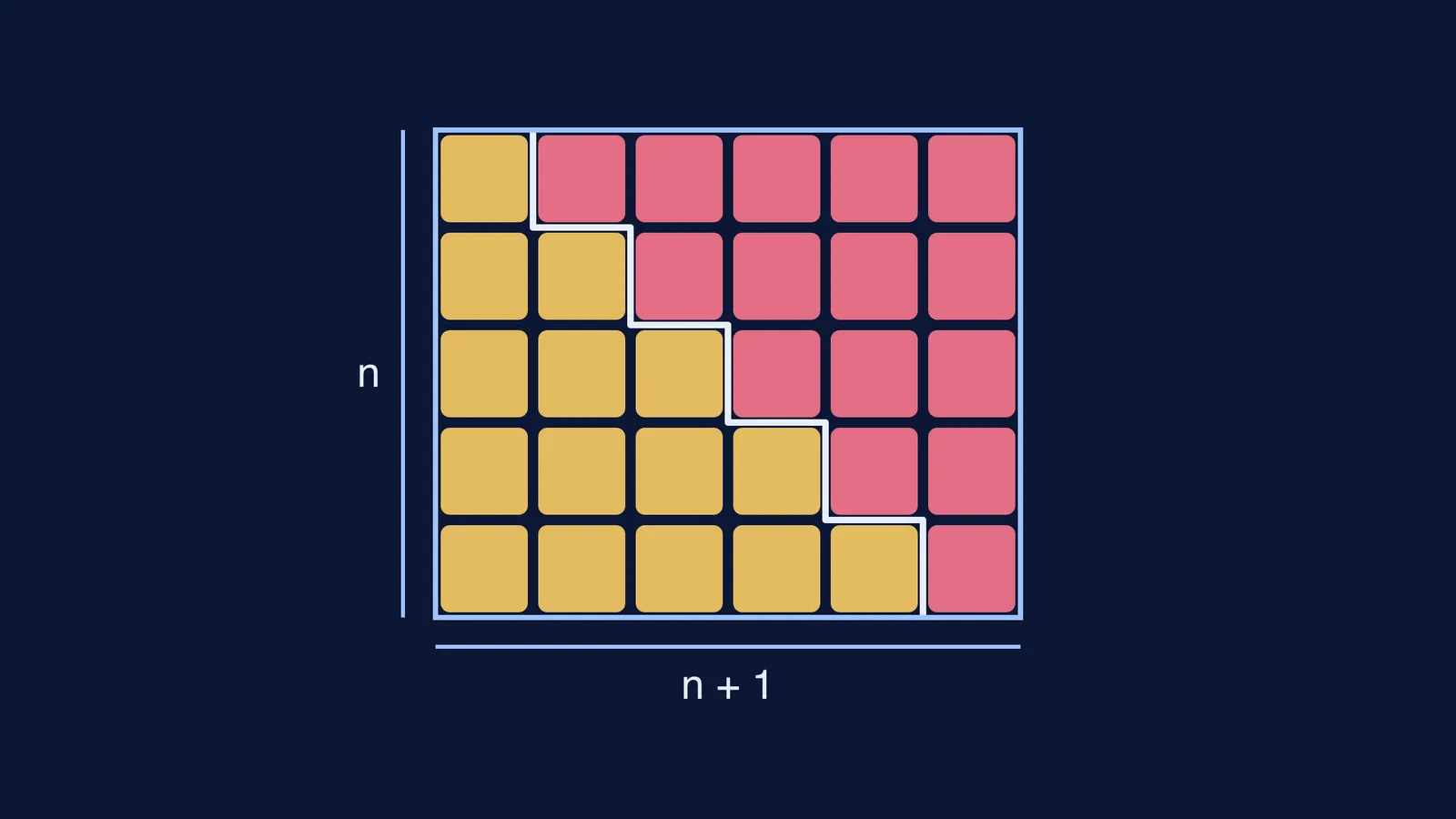
The picture at the top shows a third view: an n by n + 1 grid that a staircase cuts into two identical halves, so the total is twice a whole number.
When should you split into cases, and when should you factorise?
Use this checklist on any "show that ... is always even" or "divisible by" question:
Try to factorise. If you get consecutive integers, such as n(n + 1) or (n − 1)n(n + 1), use the consecutive-integer fact and skip the cases.
If the expression will not factorise usefully, split by remainder: two cases (even or odd) for divisibility by 2, three cases (3k, 3k + 1, 3k + 2) for divisibility by 3.
Check that your cases cover every integer before doing any algebra.
In each case, end with a line that shows the required factor outside a bracket, such as 2(...).
Finish with one sentence saying the cases cover everything.
Here is a worked example where cases do the real work. To show that every odd square leaves remainder 1 when divided by 8, write n = 2k + 1. Then n² = 4k² + 4k + 1 = 4k(k + 1) + 1. By the result above, k(k + 1) is even, so 4k(k + 1) is a multiple of 8. The n(n + 1) fact did the hard part. Our guide to finding remainders of large powers for JEE builds on the same idea.
When a statement builds up step by step, such as a sum up to n, reach for proof by mathematical induction.
Where can you practise proofs like this?
Take three statements and prove each one both ways: n² + n is even, n³ − n is divisible by 6, and n² + 3n + 2 is even. The third factorises as (n + 1)(n + 2), which is another pair of consecutive integers.
If your algebra keeps going wrong inside a case, the Fermi Problem Library has worked problems with a step-by-step solver that explains the reasoning rather than printing an answer. If the definitions of even, odd and divisibility feel shaky, the Fermi Concept Library gives each concept in mathematics its own lesson.


