

On this page
Zero is one of the most widely misunderstood concepts in mathematics. While people quickly accept that 2, 4, and 6 are even, 0 often feels different. Is zero positive or negative? Is it odd or even? Does it even count as a number?
Is zero an even number?
Yes, zero is an even number. In formal mathematics, the definition of an even number is any integer that can be divided by 2 with no remainder (Parity of zero, Wikipedia).
When you divide zero by two, the answer is exactly zero, with a remainder of zero. Another way to state the definition is that an even number is any integer n that can be written in the form 2k, where k is also an integer. Because 2 × 0 = 0, zero fits this rule perfectly.
Why is zero even and not neither?
Many students and adults believe that zero is "neither" even nor odd. A 1972 study by mathematics educator Betty Lichtenberg found that about 66% of prospective elementary school teachers incorrectly answered that zero is not an even number (Wikipedia).
Similarly, a 1999 survey by researcher Len Frobisher showed that only about 50% of English schoolchildren aged 7 to 11 could correctly identify zero as even, compared to an 85% success rate for other single digits (Wikipedia).
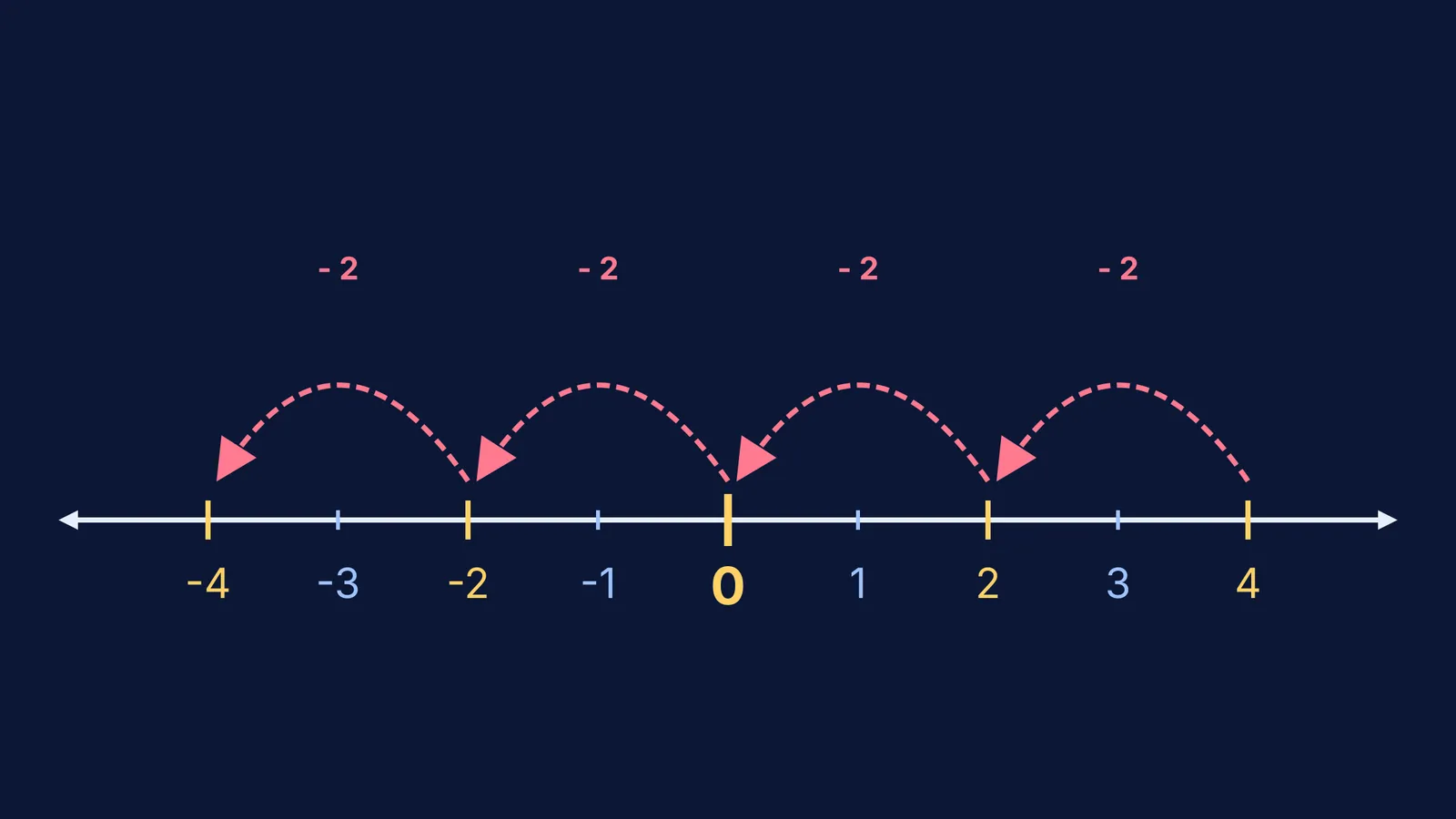
If you look at a number line, the parity of integers alternates strictly: odd, even, odd, even. The number -1 is odd, and 1 is odd. The integer sitting exactly between them must be even to keep the pattern intact. This alternating sequence is why adding or subtracting 2 from any even number always gives you another even number. For example, if you jump backwards from 4 to 2, and then subtract 2 again, you land on 0.
How do parity rules confirm it?
If zero were not an even number, the basic rules of arithmetic would stop working. The rules of parity dictate how odd and even numbers interact:
Even + Even = Even: If you add 2 and -2, you get 0. Since both 2 and -2 are even, their sum must also be an even number.
Odd + Odd = Even: If you add 1 and -1, you get 0.
These rules require zero to be an even number to remain mathematically consistent. Stanislas Dehaene, a cognitive neuroscientist, conducted reaction-time experiments in 1993 and found that adults take about 10% longer to identify zero as even compared to numbers like 2 or 4 (Wikipedia).
When mathematical definitions feel tricky or counterintuitive, the Fermi Concept Library can help. It holds every concept in physics, chemistry, biology, mathematics and computing, each with its own lesson and its place in the map.
How can you explain zero's parity to a student?
If your child struggles with the idea that zero is even, it helps to use a practical framework.
The sharing test: Explain that an even number of items can be shared equally between two people with none left over. If you have 4 apples, each person gets 2. If you have 0 apples, each person gets 0, and there are no apples left over.
The hopping game: Draw a number line. Start at 4 and have the student hop backwards by twos: 4, 2, 0, -2, -4. Since they only land on even numbers, 0 must be even.
For students who need help working through their reasoning on assignments, the Fermi Problem Library has worked problems with a step-by-step solver that explains the reasoning rather than printing an answer.
If you are exploring more foundational arithmetic patterns, you can see how numbers build on each other in series like the sum of 9, 99, 999. Or, if you are working with fractions, read about equivalent fractions and how to compare them.


