

On this page
Most projectile questions ask where the ball lands. A sharper kind asks about direction: at what angle is the ball moving 1 second after launch, or when does its velocity make 30° with the horizontal? One relation answers both.
What is the angle of projectile velocity with the horizontal at time t?
Split the motion into two independent straight-line motions. With air resistance neglected, the horizontal velocity never changes and the vertical velocity falls at a steady rate: OpenStax University Physics writes these as vx = v0x and vy = v0y − gt, with g = 9.8 m/s², and gives the direction of the velocity as θv = tan⁻¹(vy/vx).
For a ball launched at speed u and angle θ above the horizontal, that becomes:
Horizontal component: vx = u cos θ, the same at every instant.
Vertical component: vy = u sin θ − g t, shrinking by g every second.
Direction: tan α = (u sin θ − g t) / (u cos θ), where α is the angle with the horizontal at time t.
The sign of α tells you which way the ball is heading. Positive α means it is still rising, α = 0 means it is at the top (t = u sin θ / g), and negative α means it is coming down.
How do you find the time when velocity makes a given angle?
Flip the question: you know α and want t. Set u cos θ tan α = u sin θ − g t and solve:
t = (u sin θ − u cos θ tan α) / g = u sin(θ − α) / (g cos α)
The second form uses sin(θ − α) = sin θ cos α − cos θ sin α. Because the horizontal component never changes, the speed at that moment follows directly: v = u cos θ / cos α.
On level ground the ball starts at +θ and lands at −θ, so α must lie between those two. Ask for a steeper angle and the formula returns a time outside the flight: the ball never points that way.
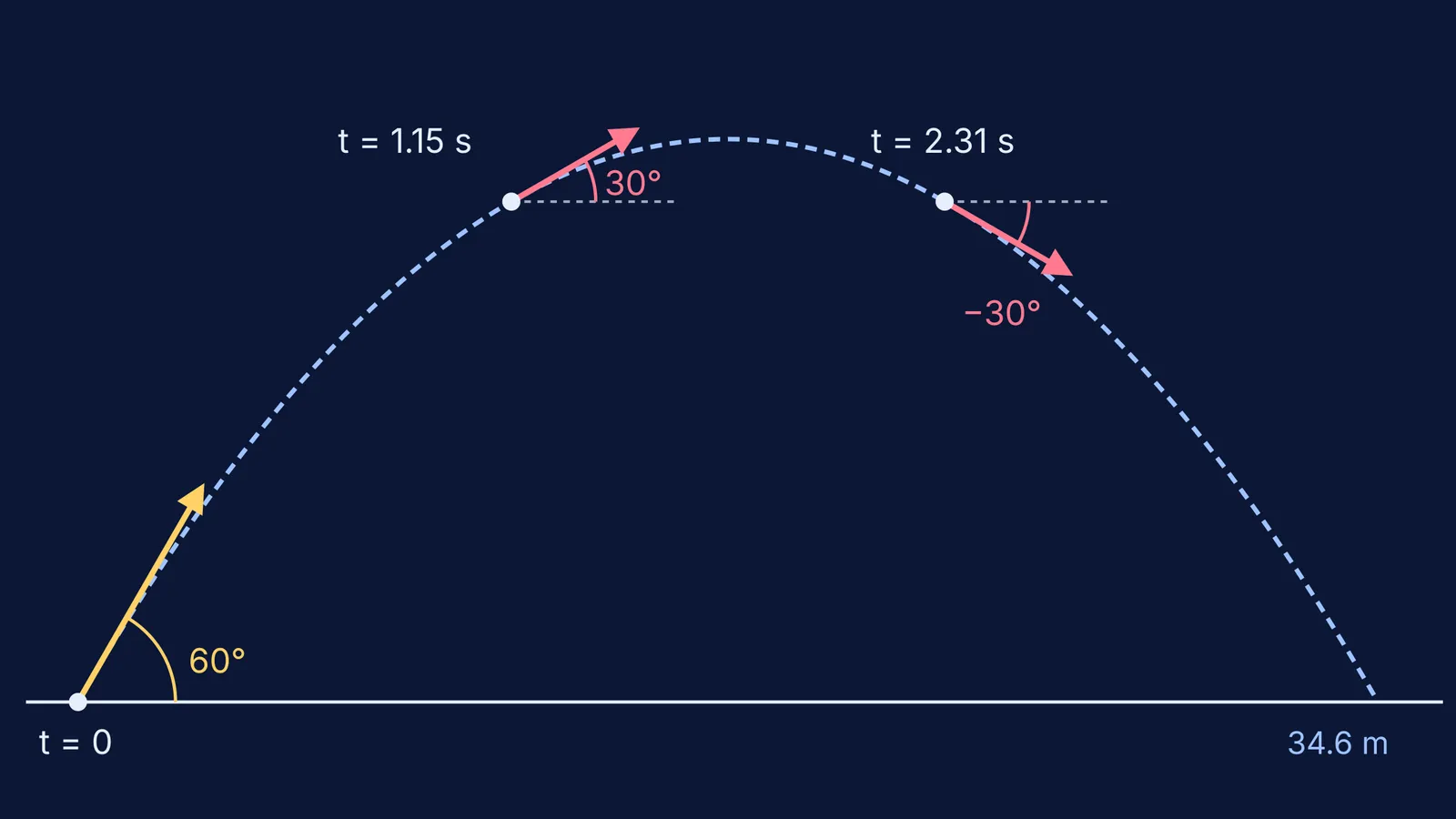
Worked example: when does the ball move at 30° to the horizontal?
A ball is thrown at u = 20 m/s and θ = 60°. Take g = 10 m/s² to keep the arithmetic clean (the OpenStax value of 9.8 m/s² shifts the answers slightly). When does its velocity make 30° with the horizontal?
Components: u cos 60° = 10 m/s and u sin 60° ≈ 17.32 m/s.
Rising at 30°: tan 30° ≈ 0.577, so 17.32 − 10t = 10 × 0.577 = 5.77, giving t ≈ 1.15 s.
Falling at 30°: now α = −30°, so 17.32 − 10t = −5.77, giving t ≈ 2.31 s.
Speed at both moments: v = 10 / cos 30° ≈ 11.5 m/s.
Sanity check: the flight time is 2u sin θ / g ≈ 3.46 s, so both times fall inside the flight. With g = 9.8 m/s² they become about 1.18 s and 2.36 s.
Notice that the two times sit symmetrically about the top, which comes at t ≈ 1.73 s. It is the same symmetry behind why a projectile passes the same height twice: equal heights, equal speeds, mirror-image directions.
When is the velocity perpendicular to the initial velocity?
Perpendicular means the dot product of the two velocities is zero: (u cos θ)² + u sin θ (u sin θ − g t) = 0, which simplifies to t = u / (g sin θ). Equivalently, α = θ − 90°.
It only happens in flight if that time is less than the flight time 2u sin θ / g, which needs sin² θ ≥ 1/2, so θ ≥ 45°. Launch at 30° and the velocity never turns through a right angle before landing. In the example above, θ = 60° gives t = 20 / (10 × 0.866) ≈ 2.31 s, exactly the falling-at-30° moment, because 60° − 90° = −30°.
Which mistakes cost marks on this question?
Measuring α from the vertical. tan α = vy / vx gives the angle with the horizontal; from the vertical it is vx / vy.
Dropping the sign. A negative tan α is the falling half of the flight, not an error.
Forgetting the second time when the question does not say rising or falling.
Putting the full speed u in the denominator instead of u cos θ.
If you keep making the same slip, the Fermi Problem Library has worked problems with a step-by-step solver that explains the reasoning rather than printing an answer, so you can find the line where your method went wrong. If the components themselves feel shaky, the Fermi Concept Library gives every concept in physics and mathematics its own lesson.
The same two components also give you the equation of the trajectory of a projectile and the radius of curvature at any point on its path.


