

On this page
When you pick a number at random from a set, finding the probability requires counting how many numbers fit your description. To find the chance of picking a prime number from the integers 1 to 100, you first need to identify the primes.
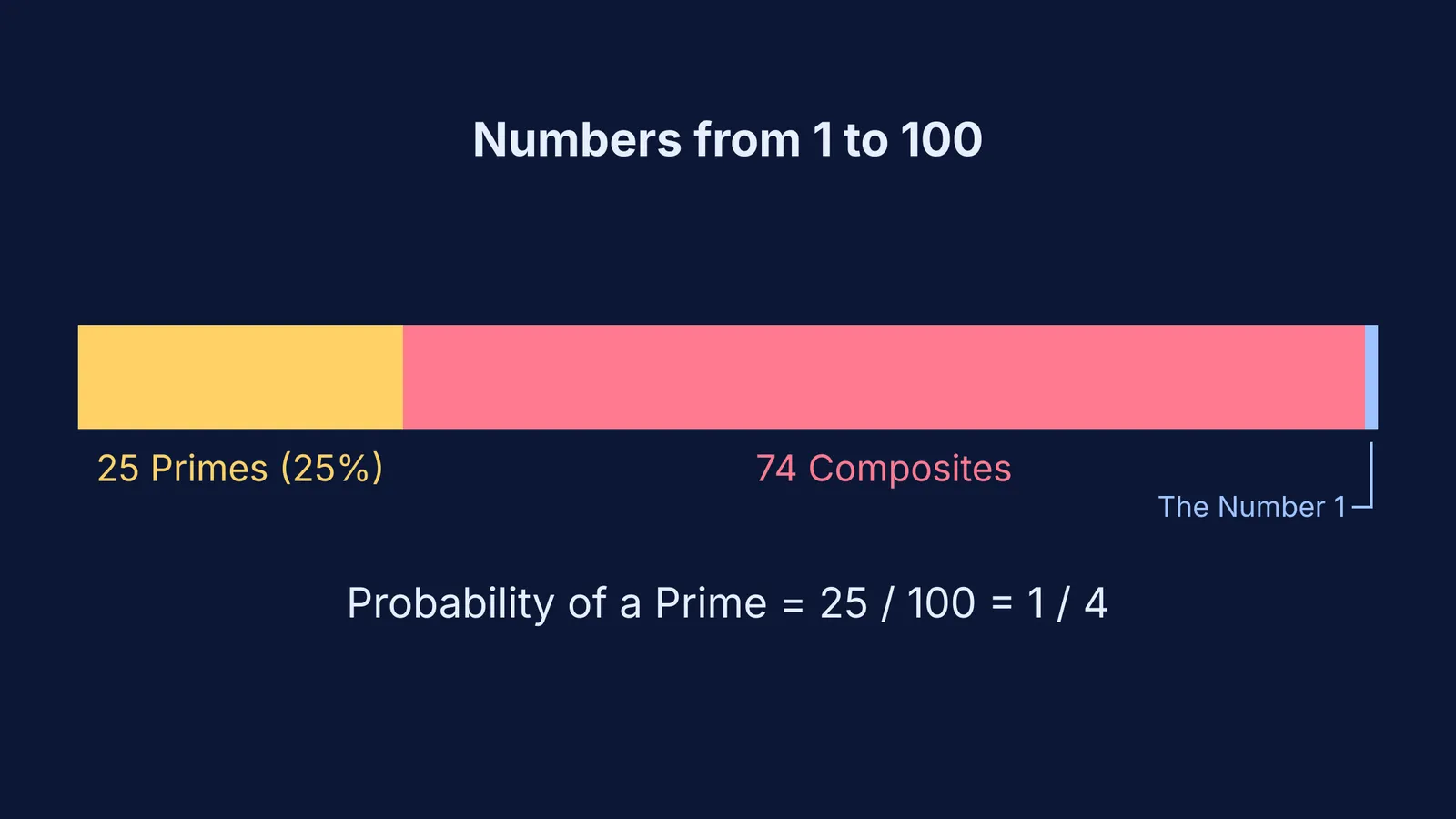
A prime number is an integer greater than 1 that has exactly two distinct factors: 1 and itself. The number of prime numbers up to 100 is exactly 25 (Wikipedia). They are: 2, 3, 5, 7, 11, 13, 17, 19, 23, 29, 31, 37, 41, 43, 47, 53, 59, 61, 67, 71, 73, 79, 83, 89, and 97.
To calculate the probability, divide the number of successful outcomes (the primes) by the total number of possible outcomes. Since there are 100 possible numbers to pick from, the calculation is 25 divided by 100. This simplifies to 1/4, which means there is a 25% chance that a number chosen at random from 1 to 100 is prime. If you are practising these kinds of counting questions and forget the divisibility rules that help identify primes, you can review them in the Fermi Concept Library.
Why is the number 1 excluded from the prime numbers list?
Students often mistakenly count 1 as a prime number when solving probability questions. By definition, a prime number must have exactly two distinct positive divisors. Since the only positive divisor of 1 is just the number 1 itself, it does not meet the mathematical criteria.
This means 1 is neither a prime nor a composite number; it stands alone as a "unit." Consequently, if you sort the first 100 positive integers, you will find exactly 25 prime numbers, 74 composite numbers, and the number 1. Remembering this distinction prevents common errors in exams.
How do you find the probability for perfect squares?
Another common probability question asks for the chance of choosing a perfect square. A perfect square is an integer that is the product of an integer multiplied by itself, such as 3 × 3 = 9.
There are exactly 10 square numbers up to and including 100 (Wikipedia). You can list them simply by squaring the integers from 1 to 10: 1² = 1, 2² = 4, 3² = 9, 4² = 16, 5² = 25, 6² = 36, 7² = 49, 8² = 64, 9² = 81, and 10² = 100.
The probability of picking one of these perfect squares is 10 out of 100. This simplifies to the fraction 1/10, or a 10% chance. Once you know the total outcomes, any basic probability question becomes a straightforward counting task. If you want to see this counting rule applied to drawing numbered cards or balls from a bag, the Fermi Problem Library has worked probability problems with a step-by-step solver that explains the reasoning.
What is the probability of choosing a multiple of 5?
You might also be asked to calculate the chance of picking a multiple of a certain number. A multiple is defined as the product of any quantity and an integer (Wikipedia)). For instance, 15 is a multiple of 5 because 5 × 3 = 15.
To count how many multiples of 5 there are between 1 and 100, you can simply divide the highest number in the range (100) by 5. The result is 20, meaning there are exactly 20 positive multiples of 5 up to 100.
The probability of choosing a multiple of 5 is therefore 20 divided by 100. This simplifies to 1/5, or a 20% chance. This division shortcut works perfectly when the sequence of integers starts from 1, saving you the time of listing out 5, 10, 15, and so on.
How do you handle probability for multiples of two different numbers?
Probability problems become slightly more complex when combining two conditions. For example, you might need to find the chance that a number from 1 to 100 is a multiple of both 2 and 3.
Every common multiple of two numbers is simply a multiple of their least common multiple, or LCM (Wikipedia). For the numbers 2 and 3, the LCM is 6. This means you just need to find the multiples of 6.
Dividing 100 by 6 gives 16.66. By dropping the decimal fraction, you can confirm there are exactly 16 multiples of 6 up to 100. The probability is 16/100, which simplifies to 4/25, or 16%. You can adapt this LCM logic to answer questions asking for the chance of a number being divisible by 3 or 5, or whether the sum of two chosen numbers is even.


