

On this page
When you toss a coin multiple times, working out the chance of getting a certain number of heads quickly becomes an exercise in counting. In foundational probability, the set of all possible results from an experiment forms the sample space, denoted by S, as detailed in the OpenStax Introductory Statistics guide on terminology. For n independent tosses of a fair coin, each toss yields heads (H) or tails (T), giving 2ⁿ equally likely elementary outcomes.
When a problem asks for the probability of obtaining "at least two heads," students often try to compute the answer by adding every qualifying condition. For five tosses, "at least two" means getting 2, 3, 4, or 5 heads. Summing combinations—C(5, 2) + C(5, 3) + C(5, 4) + C(5, 5)—is manageable for small numbers, but this brute-force approach quickly becomes impractical as the number of tosses increases.
The complement rule provides a faster path. Because the sum of an event and its complement must equal 1—expressed as P(A) + P(A') = 1 in OpenStax Introductory Statistics terminology—the logical opposite of getting at least two heads is getting strictly fewer than two heads. That leaves only two mutually exclusive cases: zero heads or one head. Instead of summing four or more terms, you evaluate just two and subtract their combined probability from 1. This inversion strategy is essential when solving selection problems with combinations.
How do you calculate at least two heads in five tosses?
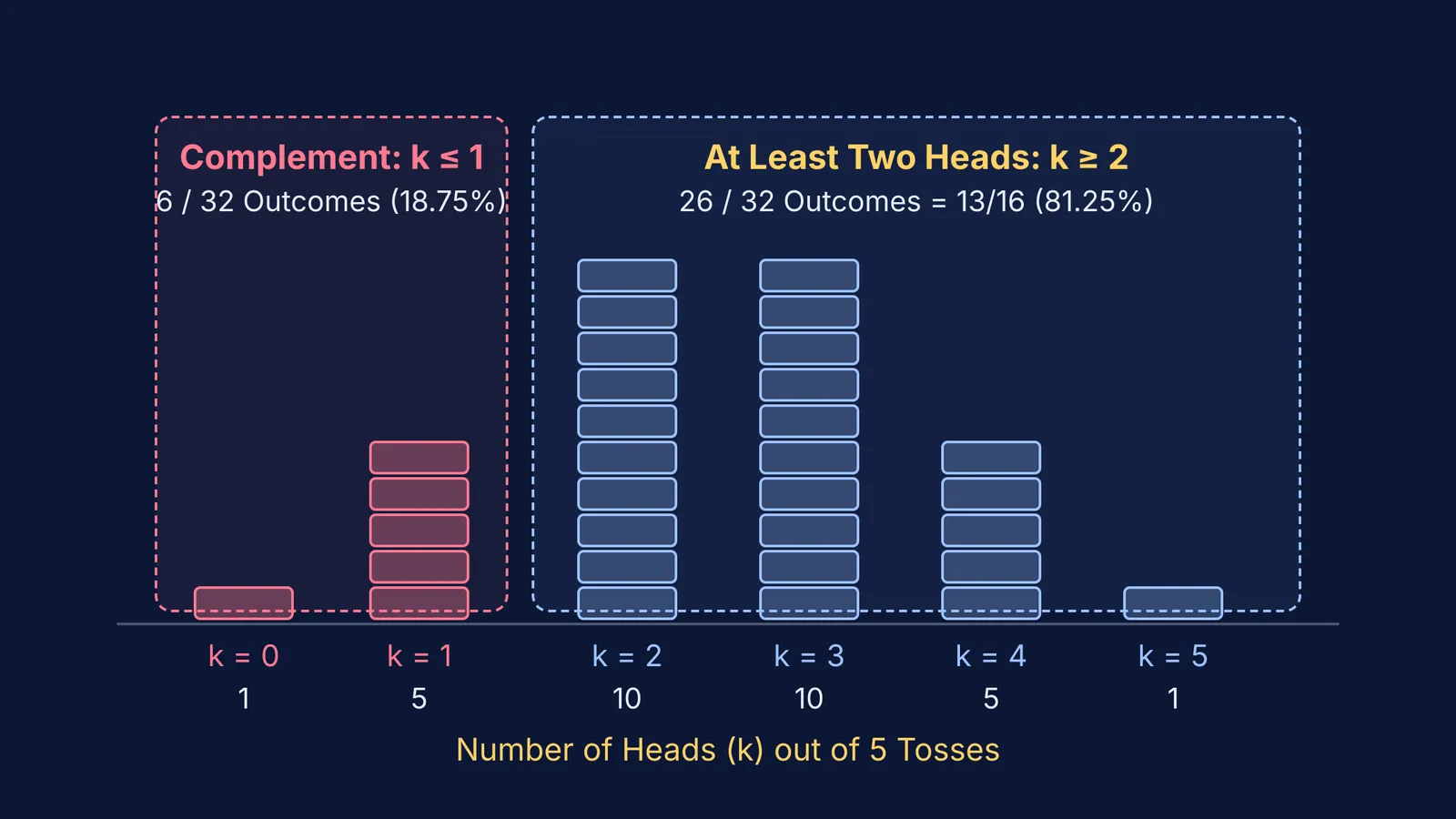
To find the probability of at least two heads in five tosses of a fair coin, first find the sample space size. As established in OpenStax Introductory Statistics terminology, five independent tosses produce 2⁵ = 32 outcomes, each occurring with probability 1/32.
Next, count the outcomes belonging to the complement event (fewer than two heads):
Case 1: Exactly zero heads (all tails). There is only C(5, 0) = 1 way: TTTTT.
Case 2: Exactly one head. The head can fall on any of the five tosses, giving C(5, 1) = 5 ways: HTTTT, THTTT, TTHTT, TTTHT, and TTTTH.
Together, these represent 1 + 5 = 6 unwanted outcomes out of 32. The probability of getting fewer than two heads is therefore 6/32, which simplifies to 3/16, or 18.75%.
Subtracting this complement from 1 gives the final result:
P(at least two heads) = 1 − 6/32 = 26/32 = 13/16
As a decimal, 13/16 equals 0.8125, or 81.25%. According to the OpenStax Introductory Statistics chapter on the binomial distribution, applying the complement rule P(X ≥ k) = 1 − P(X ≤ k − 1) avoids tedious multi-term sums. Directly summing the favourable cases—C(5, 2) = 10, C(5, 3) = 10, C(5, 4) = 5, and C(5, 5) = 1—confirms the same 26 favourable outcomes.
Reviewing these foundations connects directly to Class 10 coin toss probability, where smaller sample spaces show how symmetries emerge across power-of-two denominators.
What is the general formula for at least two heads in n tosses?
For any positive integer n, tossing an unbiased coin yields 2ⁿ possible sequences.
As explained in foundational probability texts like OpenStax Introductory Statistics, the complement event (fewer than two heads) always contains just two values:
Zero heads: C(n, 0) = 1 way (all tails).
One head: C(n, 1) = n ways (one head in any of the n positions).
Because these two mutually exclusive cases account for exactly n + 1 outcomes, the probability of at least two heads in n tosses of a fair coin is:
P(at least two heads) = 1 − (n + 1)/2ⁿ
Evaluating this formula shows how rapidly the probability approaches 1 as n grows:
For n = 2 tosses: P = 1 − 3/4 = 1/4 = 0.25 (25.0%).
For n = 3 tosses: P = 1 − 4/8 = 1/2 = 0.50 (50.0%).
For n = 4 tosses: P = 1 − 5/16 = 11/16 = 0.6875 (68.75%).
For n = 5 tosses: P = 1 − 6/32 = 13/16 = 0.8125 (81.25%).
For n = 10 tosses: P = 1 − 11/1024 = 1013/1024 ≈ 0.9893 (98.93%).
In senior secondary mathematics, outlined in the CBSE Senior Secondary Curriculum, analyzing random variables and distributions builds essential problem-solving skills for exams like JEE Main. The Fermi Concept Library maps every concept across mathematics and computing, each with its own lesson and its place in the map, helping students connect combinatorics with probability.
How do you solve problems with biased coins?
When a coin is unfair, outcomes are no longer equally likely. If heads has probability p and tails has probability q = 1 − p, each outcome depends on the binomial probability formula.
According to OpenStax Introductory Statistics on binomial trials, the probability of exactly k heads in n independent trials is P(X = k) = C(n, k) × pᵏ × qⁿ⁻ᵏ. Applying the complement rule gives:
P(at least two heads) = 1 − [qⁿ + n × p × qⁿ⁻¹]
For example, if a coin is weighted with p = 0.6 (so q = 0.4) across n = 5 tosses:
P(X = 0) = (0.4)⁵ = 0.01024
P(X = 1) = 5 × (0.6)¹ × (0.4)⁴ = 0.0768
The complement probability is 0.01024 + 0.0768 = 0.08704 (8.704%). Subtracting from 1 yields P(at least two heads) = 1 − 0.08704 = 0.91296, or roughly 91.3%.
A study on mathematical reasoning by Strohmaier and colleagues in Educational Studies in Mathematics demonstrated that verbal skills and reading comprehension are the most consistent predictors of successful word problem solving. In multi-step probability problems, misinterpreting relational phrases such as "at least" can cause students to set up incorrect events, leading to common probability mistakes in competitive exams.
When working through multi-stage problem sets, the Fermi Problem Library provides worked problems with a step-by-step solver that explains the reasoning rather than printing an answer, helping you master complement techniques across varied conditions.


