

On this page
When you pluck a guitar string or flick a rope, you create a mechanical wave that travels down its length. This wave does not just carry a shape; it carries energy. As the wave propagates, each segment of the string does work on the next segment, transferring kinetic and elastic potential energy.
For a continuous, sinusoidal wave, the rate of this energy transfer—the average power—is described by a specific equation.
What is the power transmitted by a wave on a string formula?
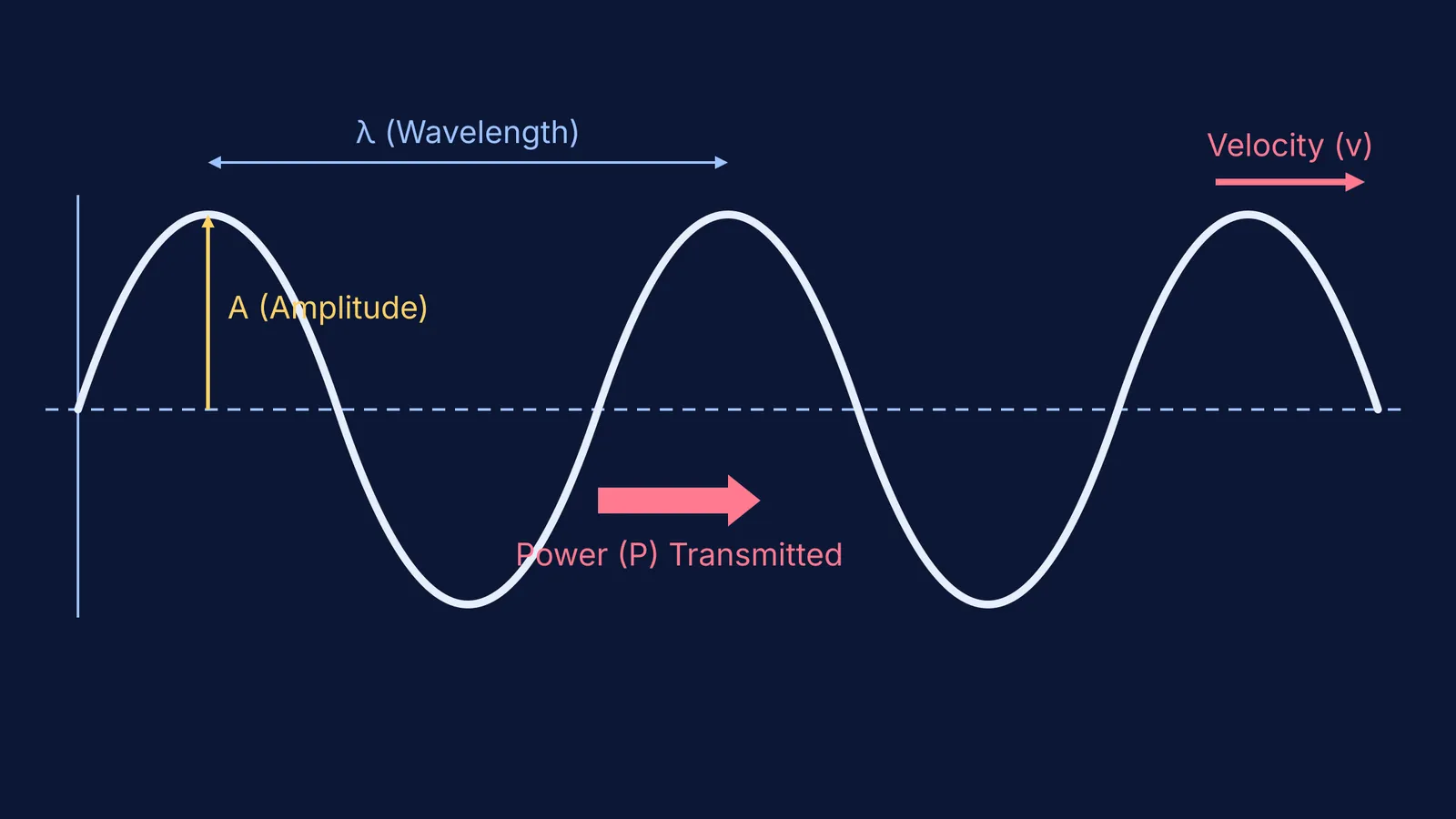
The time-averaged power (P) transmitted by a sinusoidal wave along a string is given by the formula P = ½μω²A²v, as detailed by OpenStax University Physics.
This equation brings together the properties of the string and the motion of the wave. Each factor in the formula tells you something physical about the system:
μ (Linear mass density): The mass per unit length of the string, measured in kg/m. A heavier, thicker rope takes more energy to move than a thin thread because there is more mass to accelerate.
ω (Angular frequency): How fast the source is vibrating, where ω = 2πf. It tells you how rapidly the string segments are oscillating up and down.
A (Amplitude): The maximum displacement of the string from its rest position. It measures how "tall" the wave is, and how far the string stretches from equilibrium.
v (Wave speed): The velocity at which the wave pattern travels down the string. The speed itself depends on the tension in the string (T) and its mass density (v = √(T/μ)).
Where does the wave power formula come from?
To understand why the formula takes this shape, it helps to look at the energy contained in a single wavelength (λ) of the string. The total energy is the sum of the kinetic and potential energy of the oscillating mass elements, according to OpenStax.
As the wave passes, each small segment of the string acts like a simple harmonic oscillator moving up and down. The kinetic energy for one complete wavelength is ¼μω²A²λ. At the same time, the string is being stretched and deformed, which stores elastic potential energy. The potential energy for one wavelength happens to equal the kinetic energy: ¼μω²A²λ.
When you add the kinetic and potential energy together, the total energy for one wavelength is ½μω²A²λ.
Because power is the rate at which energy is transferred, you can find the average power by dividing this total energy by the wave's period (T)—the time it takes for one wavelength to pass a given point. Since wavelength divided by the period equals the wave speed (v = λ/T), substituting the speed into the expression yields the final power formula: P = ½μω²A²v.
How does power change when amplitude or frequency doubles?
The most striking feature of the power formula is that the amplitude (A) and the angular frequency (ω) are both squared.
Because power is proportional to the square of the amplitude (A²), as noted by OpenStax, doubling the amplitude quadruples the power transmitted. If you shake a rope twice as high, you are putting four times as much energy per second into the wave.
Similarly, power is proportional to the square of the frequency (ω²). Shaking the rope twice as fast (while keeping the amplitude the same) also quadruples the power output. For a student tackling physics problems, these proportionalities are classic traps; remembering the squares is critical.
If you need to review the fundamentals of wave mechanics, the Fermi Concept Library holds every concept in physics, each with its own lesson and its place in the map.
How do you calculate string wave power?
To see the formula in action, consider a typical example from OpenStax University Physics.
Suppose a string has a length of 2.00 m and a mass of 0.070 kg, meaning its linear mass density (μ) is 0.035 kg/m. The string is under 90.0 N of tension. A vibrator sends a wave down the string with a frequency of 60 Hz and an amplitude of 4.00 cm (0.040 m).
First, find the wave speed: v = √(T/μ) = √(90.0 / 0.035) = 50.71 m/s
Next, find the angular frequency: ω = 2πf = 2 × π × 60 = 376.80 rad/s
Finally, plug everything into the power formula: P = ½ × 0.035 × (376.80)² × (0.040)² × 50.71 P = 201.59 W
The vibrator must supply about 202 watts of power to maintain this wave.
When you encounter similar numericals in your exam preparation, taking it step by step—finding μ, then v, then ω—prevents mistakes. If you prefer to have a guide while working through these multi-step calculations, the Fermi Problem Library provides worked problems with a step-by-step solver that explains the reasoning rather than printing an answer.
For more on how energy behaves in physical systems, you can also explore how elastic potential energy in a stretched wire works, or how to calculate the energy density and intensity of an EM wave.


