

On this page
Potassium trioxalatoferrate(III) trihydrate, with the formula K₃[Fe(C₂O₄)₃]·3H₂O, is a common transition metal complex synthesised in chemistry labs. It contains an iron(III) ion at its centre, surrounded by three bidentate oxalate ligands (C₂O₄²⁻). This arrangement gives the complex an overall charge of −3, which is balanced by three potassium ions. In solution, the salt dissociates to give the ferrioxalate anion, which appears fluorescent green.
Because the three oxalate ligands can arrange themselves in a left-handed or right-handed helix around the iron atom, the ferrioxalate complex displays helical chirality. If you want to review how oxidation states and ligands dictate these geometries, the Fermi Concept Library breaks down the bonding rules in transition metal complexes.
What materials are required for the synthesis?
To prepare the complex from an iron(II) starting material, you will need the following reagents:
Ferrous ammonium sulphate (Mohr's salt)
Oxalic acid (H₂C₂O₄)
Potassium oxalate (K₂C₂O₄·H₂O)
Hydrogen peroxide (H₂O₂)
Ethanol
Dilute sulphuric acid (H₂SO₄)
You might recognise Mohr's salt from another titration or synthesis experiment: Preparing Mohr's salt and potash alum in the chemistry practical.
Step 1: How do you prepare ferrous oxalate?
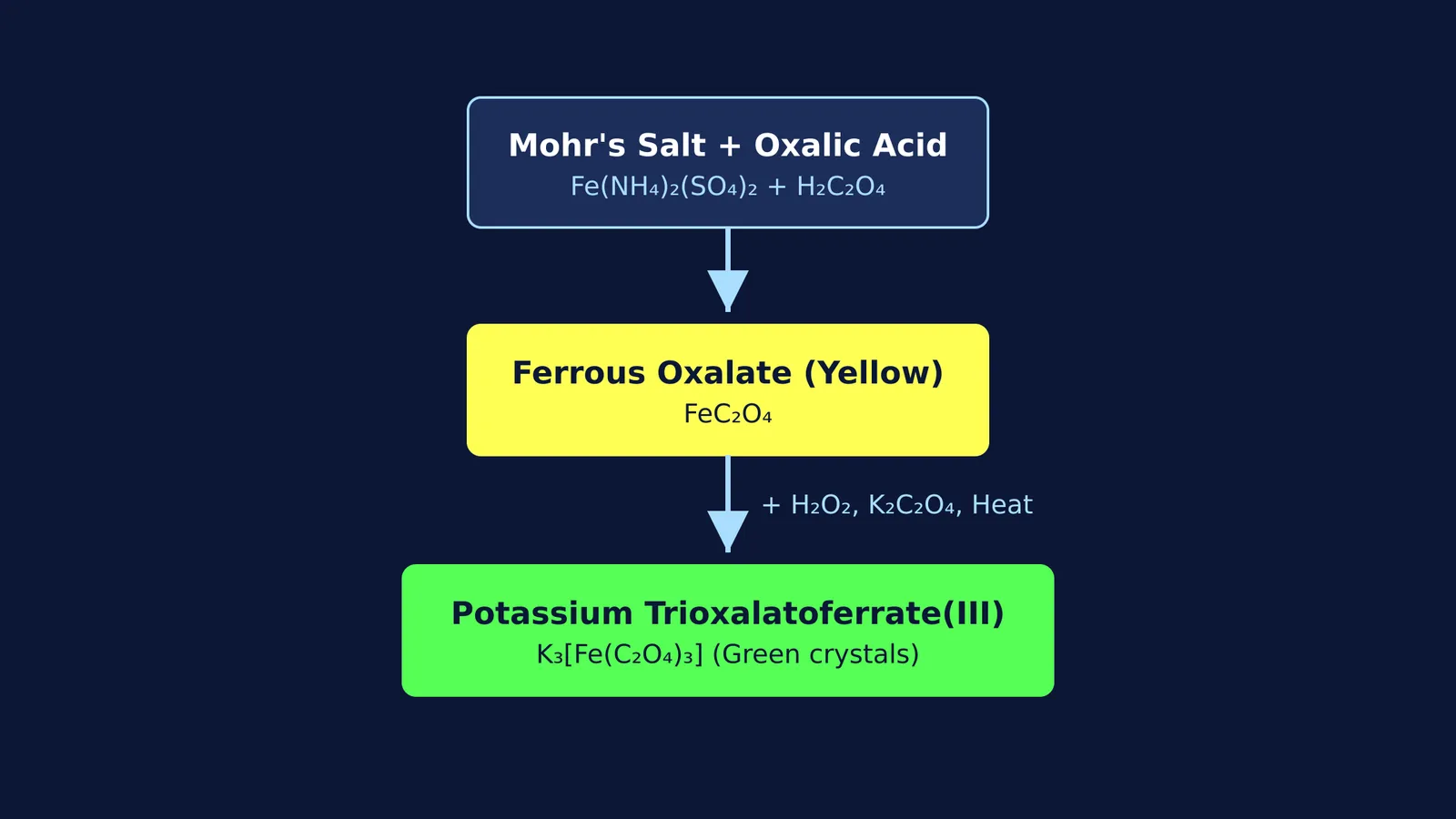
The synthesis is a two-step process, beginning with the precipitation of ferrous oxalate. Mohr's salt is an excellent starting material because this double salt is much more stable towards oxidation by air than simple iron(II) sulphate.
First, dissolve the ferrous ammonium sulphate in warm distilled water. Add a few drops of dilute sulphuric acid; this is crucial because it prevents the iron(II) ions from hydrolysing in water to form unwanted iron hydroxides.
Next, add the oxalic acid solution. Heat the mixture to boiling while stirring constantly. A bright yellow precipitate of ferrous oxalate will form rapidly.
Fe(NH₄)₂(SO₄)₂ + H₂C₂O₄ + 2H₂O → FeC₂O₄·2H₂O + (NH₄)₂SO₄ + H₂SO₄
Allow the yellow precipitate to settle, decant the supernatant liquid, and wash the solid twice with hot distilled water. This washing removes soluble impurities such as ammonium and sulphate ions.
Step 2: How does hydrogen peroxide complete the complex?
The yellow ferrous oxalate contains iron in the +2 oxidation state. To make the final complex, you must oxidise the iron to +3 and add the remaining oxalate ligands.
Add a nearly saturated solution of potassium oxalate to the yellow ferrous oxalate. Heat the mixture gently, and then slowly add the hydrogen peroxide dropwise while stirring. The hydrogen peroxide acts as a clean oxidising agent, leaving only water as a by-product.
During this step, the solution will turn dark brown or orange as an intermediate ferric hydroxide forms because the potassium oxalate makes the mixture slightly alkaline. Temperature control here is vital: do not let the mixture boil during the addition, or the hydrogen peroxide will decompose into water and oxygen gas before it can oxidise the iron.
To clear the brown precipitate, heat the mixture to boiling and add oxalic acid until the solid dissolves and the solution turns a clear, bright green.
2FeC₂O₄·2H₂O + 3K₂C₂O₄ + H₂O₂ + H₂C₂O₄ → 2K₃[Fe(C₂O₄)₃]·3H₂O
Finally, filter the hot green solution into a clean beaker and add ethanol. Because the complex is highly soluble in water but insoluble in ethanol, this lowers the solvent's polarity and forces the green crystals to precipitate. Place the beaker in an ice bath to maximise your yield.
For more on how to manage crystallisation and filtration, see Preparing acetanilide, iodoform and aniline yellow in the lab.
Why is potassium trioxalatoferrate(III) light-sensitive?
Once you filter and dry the green crystals, they must be stored in a dark bottle or wrapped in aluminium foil. The ferrioxalate anion, [Fe(C₂O₄)₃]³⁻, undergoes rapid photolysis when struck by light or high-energy electromagnetic radiation.
When a photon is absorbed, an internal electron transfer occurs from an oxalate ligand to the central iron atom. This reduces the iron(III) back to iron(II) and oxidises the oxalate to carbon dioxide gas:
2K₃[Fe(C₂O₄)₃] → 2K₂[Fe(C₂O₄)₂] + K₂C₂O₄ + 2CO₂
Because of this predictable and exact response, potassium ferrioxalate is widely used in chemical actinometry to measure the intensity of light beams. It is over 1000 times more sensitive than uranyl oxalate, the older chemical standard.
For another practical that relies on precise redox reactions with oxalate, review Titrating oxalic acid with KMnO4: the Class 12 practical.


