

On this page
Population questions in Class 12 Biology rest on one idea: a rate is a number divided by the population it came from. The NCERT chapter Organisms and Populations puts it simply: "An individual may have births and deaths, but a population has birth rates and death rates." These rates are per capita, meaning per individual.
How do you calculate birth rate and death rate?
Per-capita birth rate is the number of new individuals added in a time period, divided by the population at the start of that period. In the NCERT text, a pond has 20 lotus plants last year and 8 new plants are added, so the birth rate is 8/20 = 0.4 offspring per lotus per year.
Per-capita death rate works the same way. If 4 fruitflies die in a week in a laboratory population of 40, the death rate is 4/40 = 0.1 individuals per fruitfly per week, as the same NCERT chapter shows.
The common slip is dividing by the final population: 8/28 gives about 0.29, which is wrong, because the original 20 produced the new plants.
What are natality, mortality, immigration and emigration?
NCERT lists four processes that change population density (N), defined in its Organisms and Populations chapter:
Natality (B): births in the population during a given period.
Mortality (D): deaths during that period.
Immigration (I): individuals of the same species that come into the habitat from elsewhere.
Emigration (E): individuals that leave the habitat.
So if N is the density at time t, the density at time t + 1 is Nt+1 = Nt + [(B + I) − (D + E)]. NCERT notes that births and deaths usually matter most, while immigration can matter more when a new habitat is being colonised.
How do you use all four factors in one calculation?
A deer population starts the year at 500, with 120 births, 40 deaths, 15 arrivals and 25 departures.
Add the gains: B + I = 120 + 15 = 135.
Add the losses: D + E = 40 + 25 = 65.
Population after one year: 500 + (135 − 65) = 570.
Per-capita birth rate b = 120/500 = 0.24 per deer per year.
Per-capita death rate d = 40/500 = 0.08 per deer per year.
b − d = 0.16, while total change per individual, migration included, is 70/500 = 0.14.
That last line is the trap: NCERT's r comes from b and d only.
How do you find the per-capita growth rate r?
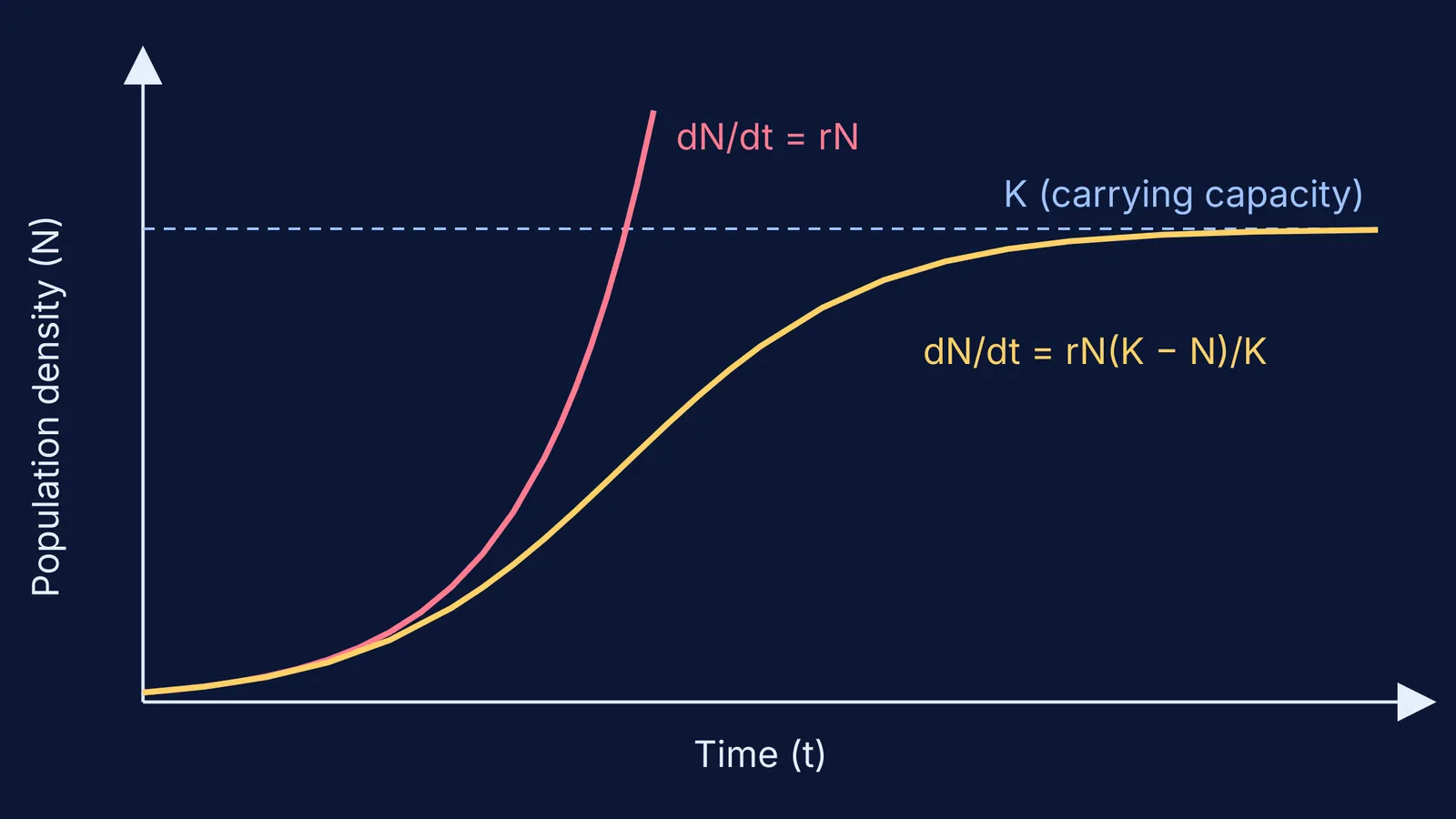
When resources are unlimited, the NCERT chapter gives the change in N per unit time as dN/dt = (b − d) × N. Writing r = b − d gives dN/dt = rN, where r is called the intrinsic rate of natural increase.
NCERT quotes r as 0.015 for the Norway rat and 0.12 for the flour beetle, and gives 0.0205 for India's human population in 1981. The integrated form is Nt = N0 e^(rt), which draws the J-shaped curve.
NCERT's exercise asks: if an exponentially growing population doubles in 3 years, what is r? Set Nt = 2N0 and t = 3, so 2 = e^(3r), 3r = ln 2 = 0.693, and r is about 0.231 per year.
Run it backwards with doubling time = ln 2 / r: taking India's 1981 value as a yearly rate, 0.693 / 0.0205 gives about 34 years, had that rate held. For the calculus behind e^(rt), see our guide to exponential growth and decay with dy/dt = ky.
What changes when growth is logistic?
NCERT calls the maximum a habitat can support its carrying capacity, K, and describes Verhulst-Pearl logistic growth with dN/dt = rN(K − N)/K, which draws an S-shaped (sigmoid) curve; the textbook calls this model more realistic.
Try it with r = 0.2 and K = 1000:
At N = 250: dN/dt = 0.2 × 250 × 750/1000 = 37.5 per unit time.
At N = 500: dN/dt = 0.2 × 500 × 0.5 = 50, the fastest growth, at K/2.
At N = 900: dN/dt = 0.2 × 900 × 0.1 = 18, slowing as N nears K.
A checklist before you write the answer
Note the starting N and the time period.
Divide by the starting N, never the final N.
Write units: per individual per unit time.
For change in numbers, use Nt+1 = Nt + [(B + I) − (D + E)].
For r, use b − d only; for doubling, ln 2 = 0.693.
If you keep getting the method wrong, the Fermi Problem Library has worked problems with a step-by-step solver that explains the reasoning rather than printing an answer. If the logistic model still feels shaky, the Fermi Concept Library gives each concept its own lesson.
Next, revise organisms and populations: growth models and species interactions and expanding, stable and declining age pyramids.


