

On this page
When you sit down to a meal, the rice or wheat on your plate came from wind-pollinated or self-pollinated grasses requiring no insect visits. But almost every vibrant colour, flavour, and micronutrient in the meal—from lentils and mustard oil to apples, mangoes, and watermelons—relies on animal pollinators. A global assessment by Klein et al. (2007) evaluated leading global food crops and found that 87 depend on animal pollination for fruit, vegetable, or seed production.
Which food crops depend most on insect pollination?
Crops vary widely in how strictly they depend on insect visitors. According to the United Nations Intergovernmental Science-Policy Platform on Biodiversity and Ecosystem Services (IPBES, 2016), crops fall into distinct dependence tiers:
Essential (>90% yield loss without pollinators): vanilla, passion fruit, kiwi, and watermelon.
High (40% to 90% loss): apples, mangoes, almonds, and pumpkins.
Modest (10% to 40% loss): oilseed mustard (*Brassica juncea*), sunflowers, and coffee.
Little (1% to 10% loss): cotton, peanuts, and tomatoes.
No dependence (0% loss): cereal grains such as wheat, rice, and maize, along with root crops like potatoes.
Although non-dependent staple cereals produce roughly 60% of total global crop volume, pollinator-dependent crops account for 35% of volume and the bulk of human micronutrient diversity, as documented by Klein et al. (2007). Angiosperms evolved floral rewards to secure cross-pollination, linking directly to syllabus concepts like sexual reproduction in flowering plants and outbreeding devices in flowering plants that prevent inbreeding depression.
What happens to crop yields and quality without pollinators?
Without animal pollination, food systems face both immediate yield drops and severe qualitative loss. The IPBES (2016) assessment estimated that between 235 billion and 577 billion US dollars of annual global food production depends directly on pollinator activity. If pollinators disappeared entirely, global agricultural production volume would drop by 5% to 8%, with catastrophic crashes in commercial fruit and oilseed regions.
In India, this ecosystem service carries enormous economic weight. A natural capital accounting study by the Ministry of Statistics and Programme Implementation (MoSPI, 2026) estimated the Pollination-Attributed Value of Output at ₹266.33 thousand crore for 2021–22, accounting for 8% to 10% of India's total crop output value. Oilseeds showed a 27% to 32% dependence on insect pollination, with cross-pollinated fruits and vegetables forming the largest monetary component.
Inadequate pollination also degrades produce quality and human health. In apples and cucurbits, each seed requires fertilisation by an individual pollen tube; uneven fertilisation produces misshapen fruit that fails commercial grading. Furthermore, a nutritional evaluation by Eilers et al. (2011) in *PLoS ONE* demonstrated that pollinator-dependent crops supply more than 90% of global vitamin C, 70% of vitamin A and carotenoids, and 55% of dietary folate.
Worked example: Calculating a farm's pollination deficit Agronomists quantify insect contribution using the standard Dependence Ratio formula:
Measure open yield: An apple orchard visited freely by bees yields Y(open) = 20.0 tonnes/ha.
Measure caged yield: An identical control plot under fine mesh netting yields Y(caged) = 4.0 tonnes/ha.
Calculate dependence: D = (Y(open) − Y(caged)) / Y(open) = (20.0 − 4.0) / 20.0 = 0.80 (80%).
Quantify net loss: Harvest attributable to insects is Y(open) × D = 16.0 tonnes/ha. Without pollinators, the orchard loses 80% of its marketable crop.
Why are insect pollinators declining worldwide?
Despite their agricultural contribution, pollinator populations are experiencing steep global declines. The IPBES (2016) assessment found that 16.5% of vertebrate pollinators face global extinction, while regional records indicate that over 40% of invertebrate pollinator species—especially wild bees and butterflies—are threatened. The primary causes include:
Habitat loss: Monocultures eliminate wildflowers, hedgerows, and nesting banks.
Agrochemicals: Systemic insecticides like neonicotinoids impair bee memory and navigation.
Disease: Commercial hive trade spreads the parasitic *Varroa destructor* mite to wild bees.
Climate shifts: Warming springs desynchronise flowering from insect emergence.
Historically, pioneering observations such as Christian Konrad Sprengel's studies on flower structures revealed that floral mechanisms and insect bodies evolved together as complementary partners. Modern habitat destruction breaks these delicate synchronies.
How can ecological farming close the pollination gap?
Growers often attempt to offset pollinator loss solely by renting domesticated honey bee hives (*Apis mellifera*). However, a global study led by Lucas A. Garibaldi in *Science* (2013) analysed 41 crop systems across 600 fields worldwide and revealed that wild insects pollinate crops far more effectively than honey bees. An increase in wild insect visits enhanced fruit set by twice as much as an equivalent increase in honey bee visits, and wild insect visitation improved fruit set across 100% of the crop systems surveyed, compared to only 14% for honey bees.
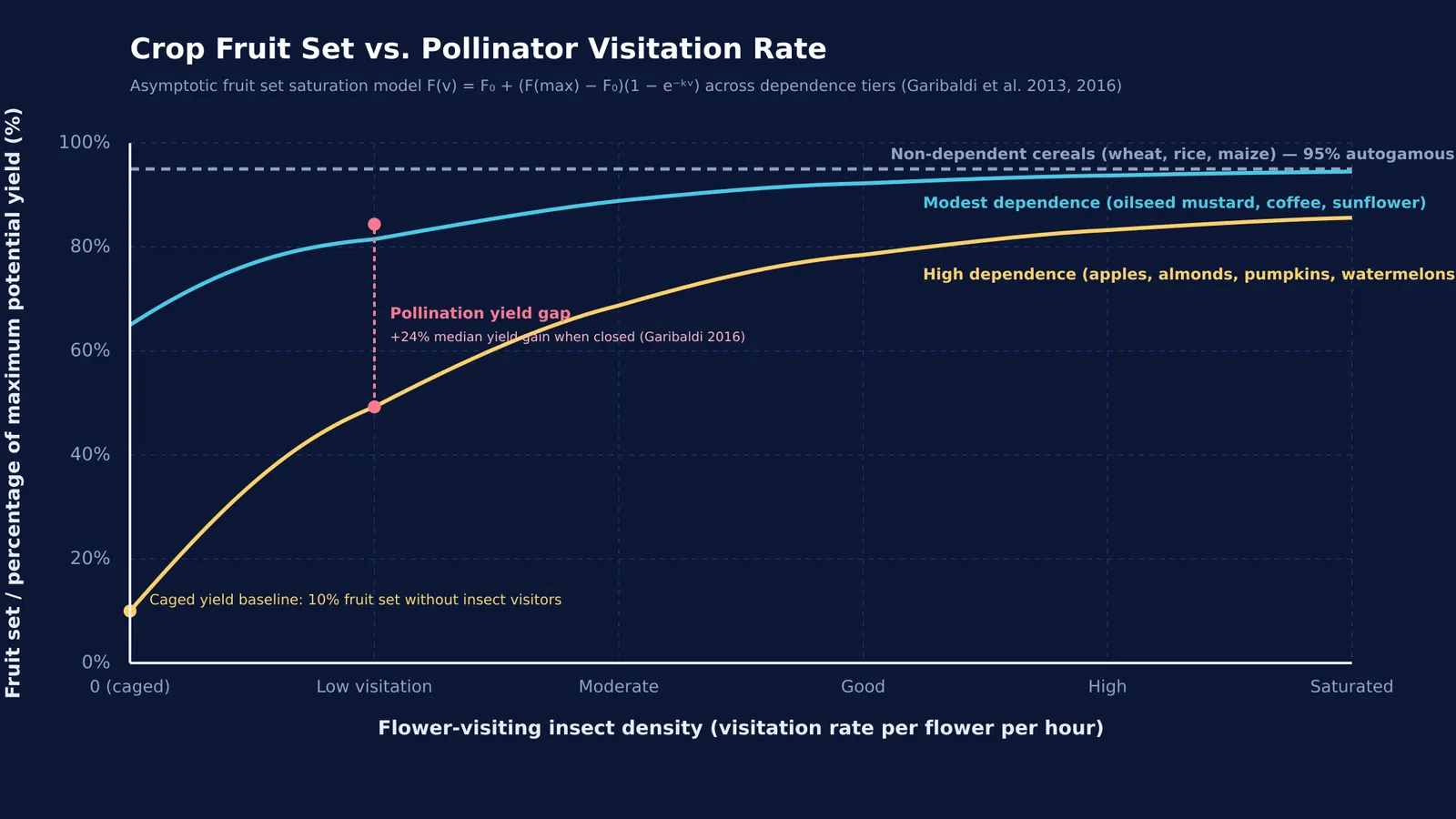
Furthermore, Garibaldi et al. (2016) showed in *Science* that on smallholder farms under 2 hectares, closing the pollination gap through higher flower-visiting insect density increased crop yields by a median of 24%. Farms can restore this natural capital by planting flowering border strips, preserving untilled soil for nesting burrows, and restricting pesticide sprays during peak bloom.
When preparing for competitive exams, students often find it challenging to connect floral morphology with quantitative ecological principles. The Fermi Concept Library covers every concept across biology and ecology, with each lesson given its place in the map. For numerical practice on species interactions or growth models, the Fermi Problem Library offers worked problems with a step-by-step solver that explains the reasoning rather than printing an answer. If you need a structured study routine, Fermi's AI tutor works out what you know and builds a plan for the session.
Protecting wild pollinators is not merely an environmental ideal; it is a measurable agricultural necessity that sustains both farmer incomes and global nutrition.


