

On this page
When you are studying microbiology or preparing for exams, one of the most common hurdles is telling apart the tiny structures that stick out from a bacterial cell. While flagella, fimbriae and pili all look like microscopic hairs extending from the cell membrane, they are built differently and do completely different jobs.
What is a bacterial flagellum?
The flagellum is the cell's outboard motor, designed primarily for swimming motility.
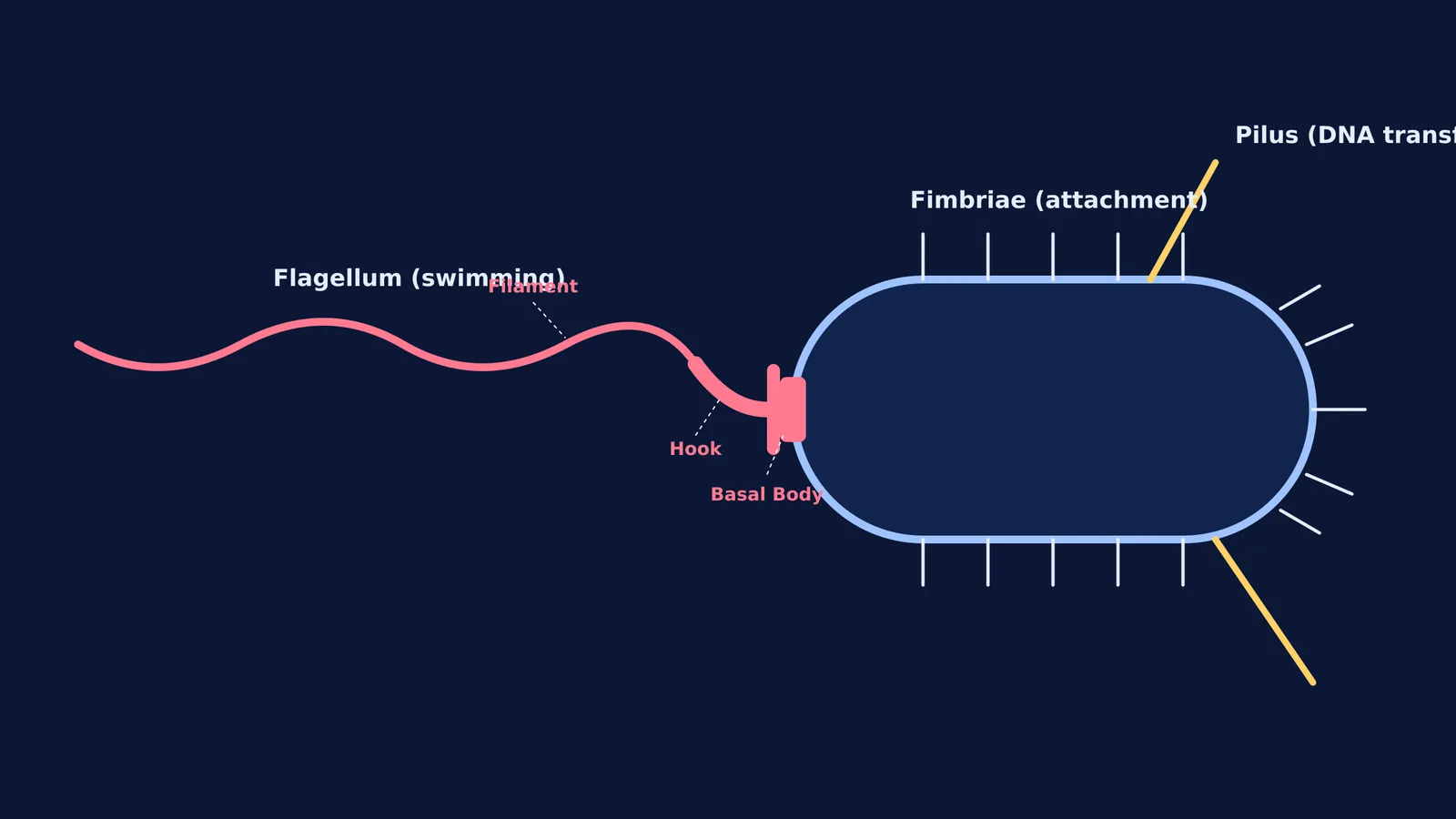
It is the largest of the three appendages, typically having a thickness of about 20 nanometers (nm) (source). For a typical bacterium, the flagellum is an enormous, powerful structure that can propel the cell at speeds up to 60 cell lengths per second (source). If you were to look closely at a bacterial flagellum, you would see it is not just a simple string, but a complex biological machine made of three main parts:
Basal body: This is the rotary motor embedded within the cell envelope. It consists of a central rod passing through a series of rings, and it is powered directly by the flow of protons across the membrane.
Hook: A flexible, curved joint that connects the motor to the long propeller, transmitting the rotational torque.
Filament: The long, rigid, hollow tube extending into the environment, constructed from thousands of copies of a protein called flagellin. It grows by adding new flagellin subunits to the tip, pushing them through the hollow centre of the tube.
How do fimbriae and pili differ?
While the terms fimbriae and pili are sometimes used interchangeably in older textbooks, modern biology separates them by their specific jobs and sizes.
Fimbriae (often called attachment pili) are short, bristle-like fibres that cover the entire surface of many bacteria. They range from 3 to 10 nm in diameter and can be a few micrometers long (source)). A single bacterium might have up to 1,000 fimbriae extending in all directions. Their main job is adhesion—they act like microscopic Velcro, allowing the bacteria to stick tightly to host tissues, medical devices or environmental surfaces to avoid being flushed away by fluids like blood or urine.
Pili (specifically sex pili or conjugative pili) are longer, thicker tubes (usually 6 to 7 nm in diameter) made of the protein pilin (source). A bacterium typically has only a very small number of pili—sometimes just dozens or fewer per cell. Their primary function is genetic exchange. During a process called bacterial conjugation, a sex pilus forms a physical bridge between a donor and a recipient bacterium to transfer DNA. Some bacteria also use a specialised appendage called a Type IV pilus for a jerky, pulling movement across solid surfaces, known as twitching motility.
If you struggle to picture these microscopic cellular machines in action, you can explore lessons in the Concept Library or run interactive simulations on Fermi. The AI tutor holds a line of reasoning across your session, noticing where you are stuck and deciding whether to explain, ask, or show how form follows function in a bacterial cell.
Comparing size, components and function
To keep them straight for your exams, focus on these three major contrasts:
Function: Flagella propel the cell through liquids, fimbriae attach the cell to surfaces, and pili transfer DNA or enable twitching.
Complexity: Only flagella have a complex rotary motor (the basal body) and hook. Pili and fimbriae are simpler protein tubes that generally grow from the base rather than the tip.
Quantity: A typical bacterium will have a few flagella, a handful of pili, and hundreds of fimbriae covering its surface.
A checklist for studying bacterial structures
To master cell biology, use this active learning framework for your revision:
Draw it out: Sketch a generic rod-shaped bacterium. Add one long, wavy flagellum at one end, a few medium-length pili, and hundreds of tiny fimbriae all over the surface.
Label the motor: On your flagellum, clearly mark the basal body (the rings in the membrane), the hook (the curved joint), and the filament (the long tail).
Link to function: Write "swimming" next to the flagellum, "adhesion" next to the fimbriae, and "DNA transfer" next to the pili.
Compare structures: Review how the flagellum's motor compares to eukaryotic structures in our guide to Cilia and flagella: the 9 + 2 axoneme and the basal body.
Understanding these structural differences makes it much easier to tackle assertion-reasoning questions on microbiology. If you are reviewing how bacteria fit into the broader tree of life, you might also find our post on Viruses, viroids and lichens: the misfits of five-kingdom biology a useful next step.


