

On this page
Rusting is easy to call chemical. Exam questions go for the cases in between: salt vanishing into water, wax dripping down a candle, milk setting into curd. Here is one test, run on each of them.
How do you tell a physical change from a chemical change?
Ask one question: has a new substance formed? NCERT's current Class 7 textbook, Curiosity, Chapter 5, defines physical changes as changes in which only physical properties like shape, size and state change, and no new substance is formed. The same chapter defines a chemical change as one in which one or more new substances are formed.
Everything else is a clue, not proof. The older NCERT Class 7 chapter, Physical and Chemical Changes, lists what may accompany a chemical change: heat, light or other radiation, sound, a change in smell, a colour change, or a gas. Most of these can also happen with no reaction at all. Boiling water gives off a gas, steam, and it is still a physical change.
Reversibility is a weak test too. In the Curiosity chapter's table of changes, chopping vegetables is marked as a change that cannot be reversed, yet nothing new forms when you cut a carrot. Use "can I get it back?" as supporting evidence, never as your deciding reason.
Is dissolving salt a physical or chemical change?
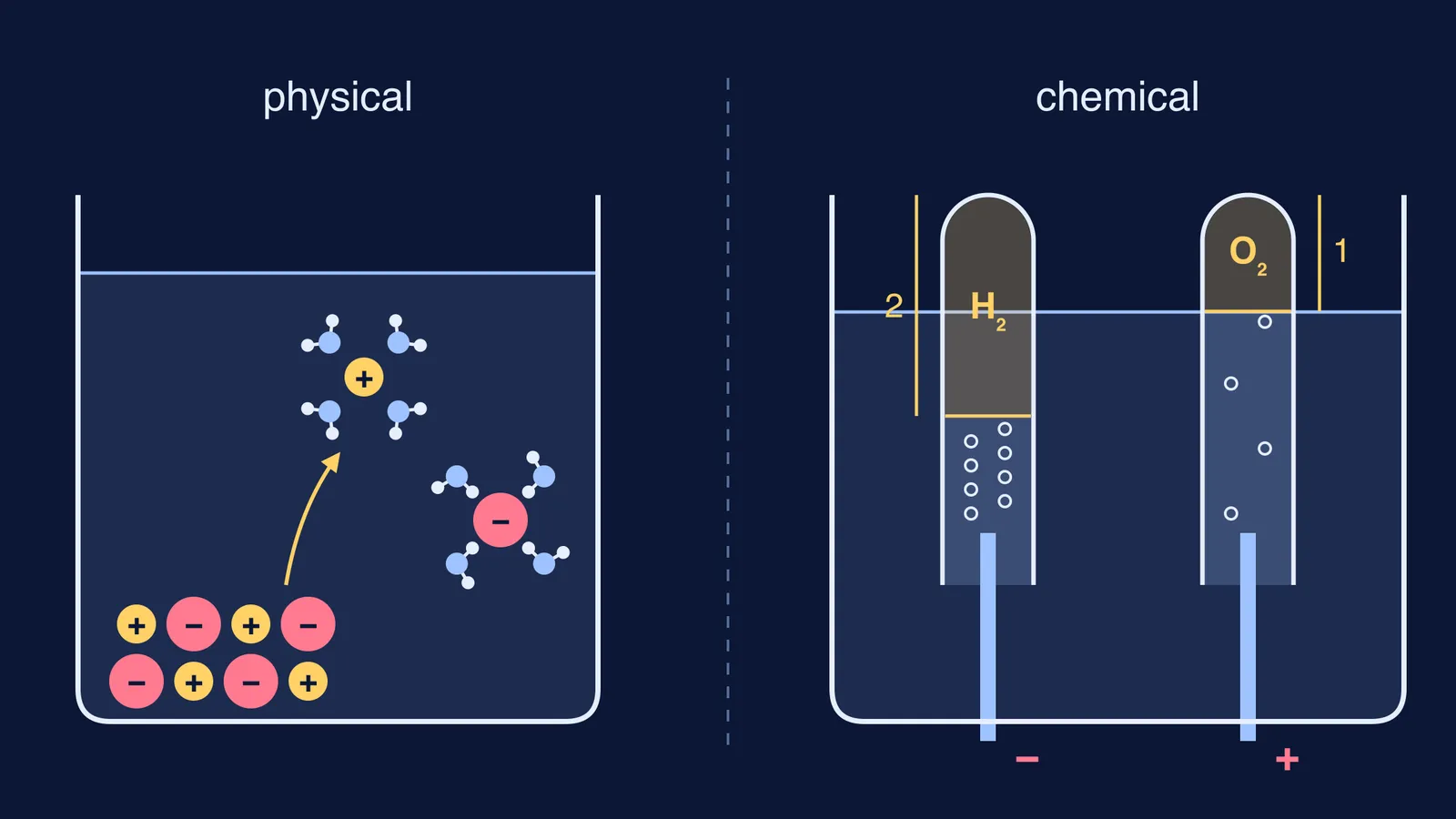
Physical. When salt dissolves, sodium and chloride ions leave the crystal and water molecules gather around each one, a process called hydration, as this LibreTexts chapter on hydration of ions explains. They are the same ions that were in the crystal. No new substance has formed, which is why evaporating sea water gives you salt, the example the older NCERT Class 7 chapter uses to introduce crystallisation, which it calls a physical change.
The doubt many students raise is fair: the attractions holding the crystal together do break. But the textbook test asks about substances, and the substance you recover at the end is still sodium chloride. To see the ions separate, read our post on watching salt dissolve in a hydration simulation.
Is a burning candle a physical or chemical change?
Both, and that is exactly what the question is testing. The Curiosity chapter explains that the wax melts, is carried up the wick and evaporates in the heat of the flame, and the wax vapour burns to produce the flame. Melting, solidifying and evaporating are physical changes; burning the vapour is a chemical change.
Your evidence for the chemical part: the same chapter covers a candle under a glass tumbler and tests with lime water, which turns milky, showing carbon dioxide formed from the carbon in the wax and oxygen in the air. Melting wax on its own, say a candle softening in the sun, is physical. Cool it and you have wax again.
Why is curdling milk a chemical change?
Because new substances form. The NCERT Class 12 Biology chapter Microbes in Human Welfare explains that lactic acid bacteria such as Lactobacillus grow in milk and produce acids that coagulate and partially digest the milk proteins. Curd tastes sour, has a new texture, and cannot be stirred back into milk. Here irreversibility agrees with the main test, but the acid and the changed proteins are the real reason to write down.
Is electrolysis of water a chemical change?
Yes. In the NCERT Class 10 chapter Chemical Reactions and Equations, current from a battery passes through water with a few drops of dilute sulphuric acid, bubbles form at both electrodes, and the textbook asks why one test tube collects double the gas of the other. Water breaks down into hydrogen and oxygen, two new substances, so this is a decomposition reaction; the chapter notes that decomposition reactions need energy as heat, light or electricity. Our explainer on why hydrogen collects at twice the volume of oxygen works through the ratio.
Practise: can you sort these five?
Write the two lines from the callout for each before you read the answer.
Sugar dissolving in tea: physical. The sugar spreads through the water, and evaporating the water leaves sugar behind.
Ghee setting on a cold morning: physical. Only the state changes.
An iron nail in copper sulphate solution: chemical. The older NCERT Class 7 chapter shows the blue solution turning green as iron sulphate forms, with brown copper deposited on the iron.
Baking soda in vinegar or lemon juice: chemical. Fizzing is only a clue; the proof in the Curiosity chapter is that the gas turns lime water milky, so it is carbon dioxide, a new substance.
Crushing chalk: physical. The same Curiosity chapter notes the chalk stays chalk even though its size changed.
If one of these tripped you up, revisit the definition. The Fermi Concept Library gives every concept in chemistry its own lesson. For practice, the Fermi Problem Library has worked problems with a step-by-step solver that explains the reasoning rather than printing an answer. For the full chapter, start with our guide to Changes Around Us in Class 7.


