

On this page
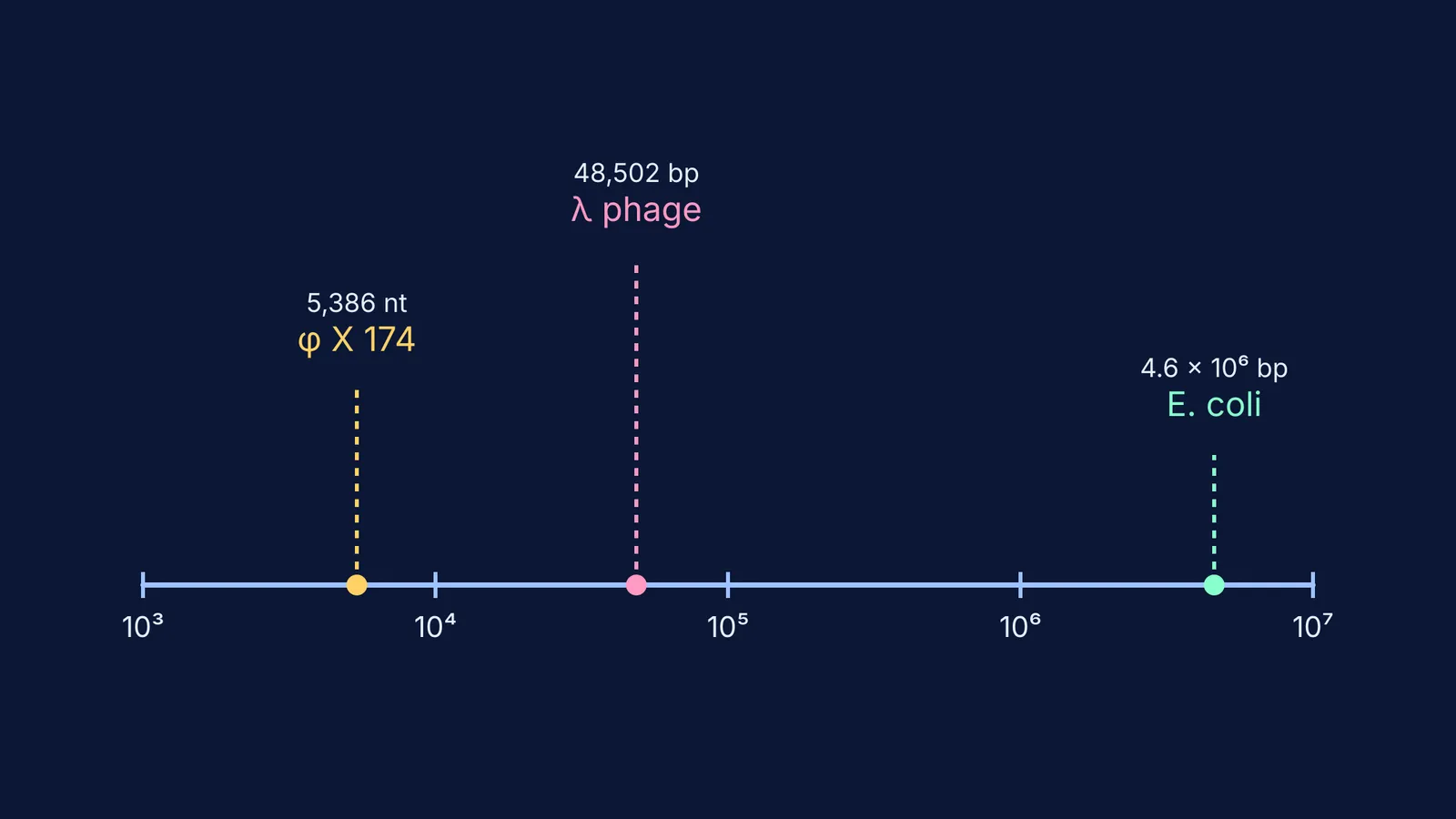
When studying the molecular basis of inheritance, you will encounter the exact genome sizes of three specific organisms: bacteriophage φ X 174, bacteriophage lambda (λ phage), and *Escherichia coli* (*E. coli*). You will frequently see these numbers in multiple-choice and assertion-reason questions.
Why does phi X 174 use nucleotides instead of base pairs?
The first essential number belongs to the bacteriophage φ X 174. Its genome was completely sequenced by Fred Sanger and his team in 1977, revealing a length of 5,386 nucleotides 1.
Notice the unit is nucleotides, not base pairs. This is because φ X 174 uses single-stranded DNA (ssDNA). Without a complementary second strand, its bases cannot pair up. A very common exam trap is to state that "φ X 174 has 5,386 base pairs." Read the units carefully. If you ever struggle to remember which common organisms use single or double strands, the Fermi Concept Library has a lesson for every concept in biology.
How large is the lambda phage genome?
Unlike φ X 174, the lambda phage carries double-stranded linear DNA inside its head. Its genome is exactly 48,502 base pairs (bp) long 2.
Because it has two strands, you could also say it contains 97,004 individual nucleotides, but geneticists standardise the measurement of double-stranded DNA using base pairs. Lambda phage is often referenced when you study Nucleosides vs nucleotides: the chemistry of DNA and RNA units, and it is widely used in biotechnology because its predictable size makes it an ideal vector for carrying foreign genes.
Beyond its size, the lambda phage is famous for how it interacts with *E. coli*. It can enter a lytic cycle, where it forces the host cell to build new phage particles until the bacterium bursts. Alternatively, it can enter a lysogenic cycle, where its 48,502 base pairs integrate directly into the *E. coli* chromosome. During this dormant phase, it replicates silently alongside the host DNA until stress triggers it to break out and destroy the cell 2.
What is the E. coli genome size?
*Escherichia coli*, a bacterium found in the human intestine, has a circular double-stranded DNA genome. The reference strain genome measures 4.6 million base pairs (4.6 × 10⁶ bp) 3.
In many numerical biology problems, you will need to convert this number of base pairs into a physical length.
How to calculate DNA length from base pairs
To find the total length of the *E. coli* DNA, you must multiply the number of base pairs by the physical distance between them. As noted in the callout, the distance between two consecutive base pairs in standard B-DNA is 0.34 nm 4:
Length = 4.6 × 10⁶ bp × (0.34 × 10⁻⁹ m/bp) Length = 1.564 × 10⁻³ m, which is approximately 1.56 mm.
Keep in mind that the bacterium itself is only about 2 micrometres (μm) long 3. The fact that 1.56 millimetres of DNA can fit inside a cell that is nearly a thousand times smaller demonstrates the remarkable efficiency of DNA supercoiling and packaging.
However, standard textbook exercises often ask you to work backwards from a simplified length of 1.36 mm. If you divide 1.36 × 10⁻³ m by the 0.34 × 10⁻⁹ m distance, you get exactly 4 × 10⁶ bp.
Examiners use this rounded number (1.36 mm) so the arithmetic divides neatly without a calculator. The true biological length is closer to 1.56 mm, but you should use the simplified numbers when prompted. When you bring such calculations to Fermi's AI tutor, it will work out what you already know and teach through the problem step by step. These are the same basic organisms often used to study the Viruses, viroids and lichens: the misfits of five-kingdom biology.


